
Construction Project Profitability Analysis: A Strategic Framework for 2026

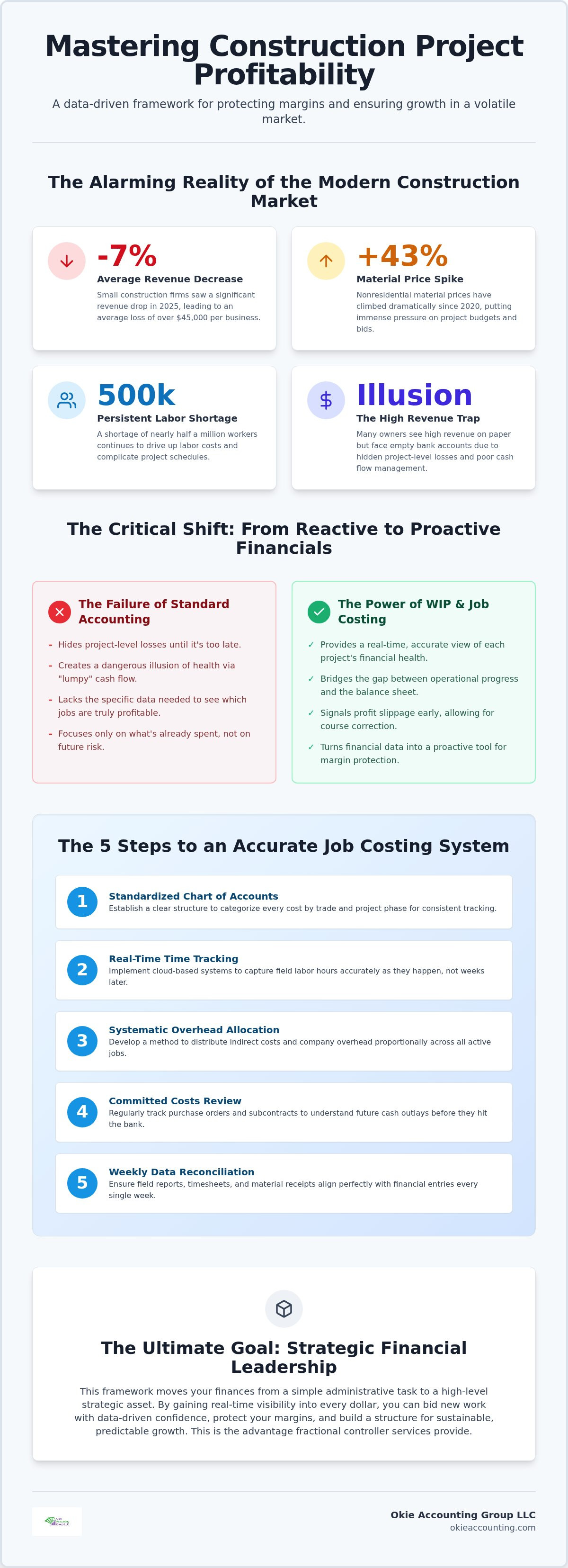
In 2025, small construction firms saw an average annual revenue decrease of 7%, resulting in a loss of over $45,000 per business despite a busy project schedule. It's a sobering reality for many owners who see high revenue figures on paper but struggle with empty bank accounts. You likely feel the pressure of nonresidential material prices that have climbed 43% since 2020, paired with a persistent labor shortage of nearly 500,000 workers. Maintaining a precise construction project profitability analysis has transitioned from a back-office task to a critical survival strategy in this volatile 2026 market.
We understand that surprise losses discovered only at the end of a project aren't just frustrating; they're a threat to your company's structural integrity. This article promises to help you master the framework of job costing and WIP management so you can protect your margins and ensure predictable growth. We'll move beyond basic administrative tracking to explore the fractional controller systems that provide real-time visibility into every dollar. By the end of this guide, you'll have the data-driven confidence needed to bid new work accurately and scale your operations without increasing your financial risk.
The Foundation of Construction Project Profitability Analysis
A construction project profitability analysis is more than a simple comparison of numbers on a spreadsheet. It's the systematic tracking of actual costs against estimated budgets throughout the entire lifecycle of a build. In the 2026 market, where building material costs rose by 6.7% in a single year and nonresidential materials are up 43% since 2020, precision is a choice. Relying on gut feelings or bank balances is no longer a viable strategy for growth. Financial readiness has become a primary competitive advantage, allowing firms to pivot when tariffs shift or labor costs spike.
True profitability isn't found in high revenue figures. It's found in the structural integrity of your financial data. Most generalist providers focus on administrative recording, which simply documents where money went after it's already spent. We advocate for a shift toward strategic oversight. This approach transforms accounting from a historical record into a proactive framework that protects your margins before they erode.
Why Standard Financial Statements Fail Contractors
Traditional "cash-basis" accounting is often the silent killer of growing construction firms. It hides project-level losses by focusing on the timing of cash moving in and out of a bank account rather than when costs are actually incurred. This creates a dangerous mismatch between revenue recognition and real-world outlays. For example, a large deposit on a new contract can mask significant inefficiencies on a project nearing completion. This "lumpy" cash flow creates an illusion of health while underlying project margins are actually bleeding out.
Standard P&L statements fail because they lack the granularity required for professional construction management. Without project-specific reporting, you can't see which jobs are subsidizing others. Multi-month contracts require a system that tracks progress and costs in real-time, ensuring that every dollar spent is tied to a specific phase of production.
The Role of Strategic Financial Oversight
Moving beyond basic bank reconciliations requires a commitment to margin protection. This starts with disciplined data entry that serves as the bedrock for all analysis. When every receipt and labor hour is coded accurately, the data becomes an asset rather than a chore. Strategic oversight, often facilitated through fractional controller services, ensures that these details roll up into actionable insights.
Building a culture of financial accountability across your project team is essential. When field managers understand how their daily choices impact the final margin, the entire organization becomes more resilient. This transition from administrative bookkeeping to strategic partnership is what separates stagnant firms from those capable of sustainable scaling.
Mastering the Mechanics: Job Costing and WIP Accounting
Job costing serves as the engine of a robust construction project profitability analysis. It's the disciplined process of assigning every expense, from a bulk lumber order to a single hour of field labor, to a specific project code. In 2026, this process must include precise labor burden calculations. With the Employment Cost Index for construction rising by 3.4% and benefit costs increasing by 3.8%, failing to account for the true cost of an hour in the field can erode margins instantly. Accurate job costing ensures that your bids are based on reality rather than outdated estimates.
Work in Progress (WIP) accounting acts as the ultimate truth-teller of construction finance. It bridges the gap between your project's operational progress and your balance sheet, providing a level of oversight that basic bookkeeping cannot match. By comparing actual costs incurred to the total estimated costs, you gain a clear picture of whether a project is truly ahead or behind its financial targets.
The 5 Steps to Accurate Job Costing
Building a reliable system requires a methodical approach to data collection and categorization. We recommend these foundational steps to ensure your ledger reflects operational reality:
Standardized Chart of Accounts: Establish a structure that categorizes costs by trade and phase.
Real-time time tracking: Implement cloud-based systems to capture field labor hours as they happen.
Overhead allocation: Distribute indirect costs and overhead proportionally across all active jobs.
Committed costs review: Regularly track purchase orders and subcontracts before they hit the bank.
Data reconciliation: Ensure that field reports align with financial entries every week.
Following these steps allows you to move beyond administrative recording. Referencing the Construction Financial Benchmarker report can help you see how your project margins compare to industry standards during this period of high labor demand and material volatility.
Understanding WIP: Over-billings vs. Under-billings
The WIP schedule reveals critical insights into your company's cash position. Under-billings, or "unbilled revenue," occur when you've performed more work than you've invoiced. While this technically shows up as an asset, it represents a significant drain on cash flow that can stall future operations.
Conversely, over-billings can create a false sense of security. Having extra cash in the bank might feel like profit, but it actually represents a liability for work yet to be performed. A well-maintained WIP schedule allows you to predict future cash needs with accuracy. This is vital when construction loan interest rates remain elevated, typically ranging from 6.5% to 9.5% for bank financing. If your current reports don't provide this level of clarity, it's likely time to schedule a discovery call to discuss building a more resilient financial framework.
Critical KPIs for Evaluating Project Performance
Data collection is only the first step toward financial control. To truly leverage a construction project profitability analysis, you must interpret that data through specific Key Performance Indicators (KPIs). These metrics allow you to distinguish between company-wide financial health and individual project performance. A firm can appear profitable on a consolidated P&L while several projects are actively losing money, masked by the cash flow of newer contracts. We focus on project-level KPIs to ensure every job contributes to your bottom line.
Gross Profit Margin acts as the primary North Star for project managers. It isolates direct job costs from general overhead, revealing the true efficiency of your field operations. We also emphasize "Slippage" as a vital metric. Slippage measures the erosion of profit from the initial estimate to the final project closeout. If your bid anticipated a 20% margin but the job closed at 14%, that 6% gap indicates a breakdown in either estimating accuracy or field execution. Identifying this trend early allows for the strategic financial reporting necessary to correct future bids.
Project-Specific Profitability Metrics
Monitoring these three metrics provides a real-time health check for any active job site:
Gross Profit Margin: Regular benchmarking against industry standards ensures your pricing remains competitive while protecting your internal requirements.
Cost to Complete vs. Budget Remaining: This is a predictive tool. It focuses on the cash required to finish the work rather than simply looking at historical spending.
Change Order Ratio: Tracking the volume of change orders helps identify scope creep. A high ratio often signals that the initial contract was poorly defined or that the field team is performing unbilled work.
Liquidity and Efficiency Ratios for Contractors
Profitability is meaningless if your cash is trapped in the hands of your clients. With construction loan interest rates currently ranging from 6.5% to 9.5% for bank financing, the cost of capital is too high to ignore. Days Sales Outstanding (DSO) tracks the velocity of your capital by measuring how many days it takes to collect payment after an invoice is issued. The faster your DSO, the less you rely on expensive external financing.
Working Capital Turnover measures how hard every dollar in your business is working to generate revenue. A high turnover rate suggests an efficient operation that can scale without massive cash injections. Finally, we use the Quick Ratio to assess immediate liquidity. This conservative metric excludes inventory and focuses on your ability to meet short-term obligations using only your most liquid assets. Maintaining a strong Quick Ratio ensures you can weather the unexpected material cost spikes, which rose 6.7% in the last year alone, without jeopardizing the business.
Identifying and Mitigating Project Profit Slippage
Profit slippage is the silent erosion of your hard-earned margins. It represents the gap between the profit you projected during the bidding phase and the actual profit realized at closeout. A disciplined construction project profitability analysis identifies these discrepancies before they become irreversible losses. In an environment where a 50% tariff on copper or a 25% tariff on specific imported goods can materialize mid-project, passive monitoring is no longer a viable option. We view slippage not as an inevitability, but as a structural failure that can be corrected through rigorous oversight.
Protecting your margins requires moving beyond simple expense tracking to implement strategic procurement controls. These controls ensure that every purchase order and subcontract agreement is aligned with the original estimate before the commitment is made. This proactive stance prevents "end-of-project surprises" where hidden costs suddenly surface during final reconciliation.
Common Causes of Profit Bleed
Identifying "profit leaks" early is essential for maintaining financial integrity. We frequently observe three primary drivers of slippage in the current market:
Inaccurate initial estimates: Relying on pricing data from even six months ago is risky, as building material costs rose by 6.7% in the 12 months leading up to July 2026.
Uncaptured field changes: Handshake agreements and undocumented scope creep lead to unbilled labor and materials that never make it into a formal change order.
Inefficient labor utilization: With the industry needing 499,000 additional workers in 2026, poor scheduling often results in excessive overtime costs that were never factored into the original bid.
The Monthly Financial Review: A Strategic Guardrail
A formal monthly review acts as a critical checkpoint to verify that your project is performing as expected. This process involves comparing actual costs to date against the true percentage of completion. If you've exhausted 60% of your budget but have only finished 40% of the work, you have a clear indicator of distress. Learn how our fractional controller services facilitate these reviews by providing the high-level analysis needed to spot these trends early.
Additionally, reviewing your accounts receivable aging report is vital. Stalled payments represent a significant liquidity risk, especially when the cost of capital remains high. By maintaining a steady rhythm of financial oversight, you transform your accounting from a historical record into a predictive tool for profit protection. To build this level of clarity into your own operations, schedule a discovery call with our team to discuss a customized framework for your business.
Building a Structural Framework for Sustainable Profit
Many contractors believe that buying the right software will automatically solve their margin issues. However, software is merely a tool. True profitability stems from the financial leadership that directs that tool. A robust construction project profitability analysis requires a marriage between organized data and high-level strategy. Without a disciplined framework, even the most advanced systems just produce faster reports of your losses. We believe that financial clarity is a byproduct of systems, not just technology.
Transitioning from chaotic bookkeeping to disciplined financial readiness is a journey toward operational strength. Okie Accounting Group serves as your strategic partner, moving you beyond basic administrative tasks to a position of control. We don't just record history; we help you build a future where every project is a predictable source of growth. By establishing foundational systems, you create the stability needed to weather market volatility and material cost spikes.
Leveraging QuickBooks for Construction Success
Professional configuration is the difference between a messy ledger and a strategic asset. Most firms use only a fraction of their accounting software's potential, often failing to set up the job costing modules correctly. By prioritizing QuickBooks Setup & Training, you ensure your chart of accounts and job codes are built for the specific demands of the 2026 market. You can find more details in our guide on Mastering QuickBooks for Contractors. Integrating your project management tools with cloud-based accounting allows for real-time data flow, ensuring that the field and the office stay in sync.
The Strategic Advantage of a Fractional Controller
Scaling a construction firm often requires the foresight of a financial executive, but the cost of a full-time CFO is often prohibitive for mid-sized contractors. Our fractional controller services bridge this gap. We provide the strategic oversight needed to make data-driven investment decisions, such as when to expand your fleet or how to navigate the 6.7% rise in material costs seen this year. This level of rigorous management protects your firm from the industry's notoriously high failure rates by identifying risks before they impact your cash flow.
When you're ready to secure your margins and build a resilient business, contact Okie Accounting for a consultation to begin building your structural framework for success. We're invested in your long-term health and dedicated to providing the clarity you need to scale with confidence.
Securing Your Firm’s Financial Future
The transition from administrative bookkeeping to a disciplined construction project profitability analysis is the most critical step you can take toward sustainable scaling. By implementing a structural framework that combines precise job costing with the predictive power of WIP accounting, you move from reacting to historical losses to proactively protecting your margins. This level of financial readiness is what separates firms that struggle with cash flow from those that build lasting equity in a volatile market. It's about turning your financial data into a strategic asset that supports every bid and every hire.
At Okie Accounting Group, we provide the specialized construction industry expertise and cloud-based efficiency required to scale your business from $1M to $10M and beyond. Our strategic oversight ensures that your financial data serves as a roadmap for growth rather than a source of stress. We're ready to partner with you to construct the foundational systems your business deserves. Gain financial clarity with Okie Accounting’s Fractional Controller Services today. Let's work together to turn your complex financial data into a position of strength and control.
Frequently Asked Questions
What is the most important metric in construction project profitability analysis?
Gross Profit Margin is the primary metric for evaluating individual job success. It isolates direct project costs from general company overhead, revealing how efficiently your field teams utilize labor and materials. In a market where building material costs rose 6.7% in the last year, monitoring this margin ensures your construction project profitability analysis stays grounded in reality. If your gross margin erodes, your net profit will inevitably follow regardless of your total revenue.
How often should I perform a profitability analysis on my active projects?
We recommend a formal review at least once a month, though high-growth firms often benefit from weekly job cost reconciliations. A monthly cadence allows you to compare actual costs to date against your percentage of completion. This regular rhythm ensures you catch profit slippage early enough to make corrections. It transforms your accounting from a historical record into a proactive management tool, providing the clarity needed to adjust field operations.
What is the difference between job costing and general bookkeeping?
General bookkeeping records the total financial activity of your business, such as rent, insurance, and utilities. Job costing is a specialized system that assigns every dollar of expense to a specific project code or phase. While bookkeeping keeps you compliant, job costing provides the granular data required for a deep construction project profitability analysis. This distinction is the difference between simply tracking bank balances and building a structural framework for growth.
How does WIP accounting help prevent cash flow crises?
WIP accounting acts as an early warning system by identifying over-billings and under-billings. Over-billings occur when you have cash in the bank for work not yet performed, which is actually a liability. Under-billings signal that you've spent cash on labor or materials you haven't invoiced yet. By tracking these figures, you avoid the trap of spending "future cash" today, which is a primary cause of financial distress for contractors.
Can QuickBooks Online handle complex construction project analysis?
QuickBooks Online is a powerful tool for construction when it's professionally configured for the industry's unique needs. It handles project-level tracking, labor burden, and detailed financial reporting effectively. However, technology alone isn't a strategy. Our QuickBooks Setup and Training services ensure your system is built to capture the data necessary for a comprehensive construction project profitability analysis, allowing you to scale your firm without increasing your financial risk.
Why is my project showing a profit on paper but I have no cash in the bank?
This discrepancy usually happens because of "lumpy" cash flow or significant under-billings. Your P&L might show profit based on work performed, but if that revenue is tied up in accounts receivable, the cash isn't available. Additionally, cash outlays for materials often happen before you can invoice the client. WIP accounting helps you bridge this gap by revealing the truth behind your bank balance and identifying where your capital is trapped.
What is a "good" net profit margin for a construction company in 2026?
While margins vary by trade, many successful general contractors aim for a net profit margin between 5% and 10%. With nonresidential materials prices up 43% since 2020, maintaining these margins requires extreme discipline. A "good" margin is one that covers your overhead, funds your growth, and provides a buffer for market volatility. We help you benchmark your performance against industry standards to ensure you're pricing work for long-term health.
How can a fractional controller help improve my project bidding process?
A fractional controller provides the strategic oversight to turn historical data into accurate bidding templates. Instead of relying on gut feelings, you can use actual cost data from previous construction project profitability analysis reports to ensure every bid accounts for current labor and material costs. This data-driven approach gives you the confidence to walk away from low-margin work and focus on projects that align with your firm's sustainable scaling goals.


Comments