
Construction Work in Progress (WIP) Reporting: The 2026 Strategic Guide to Profit Protection

Updated: Sep 7
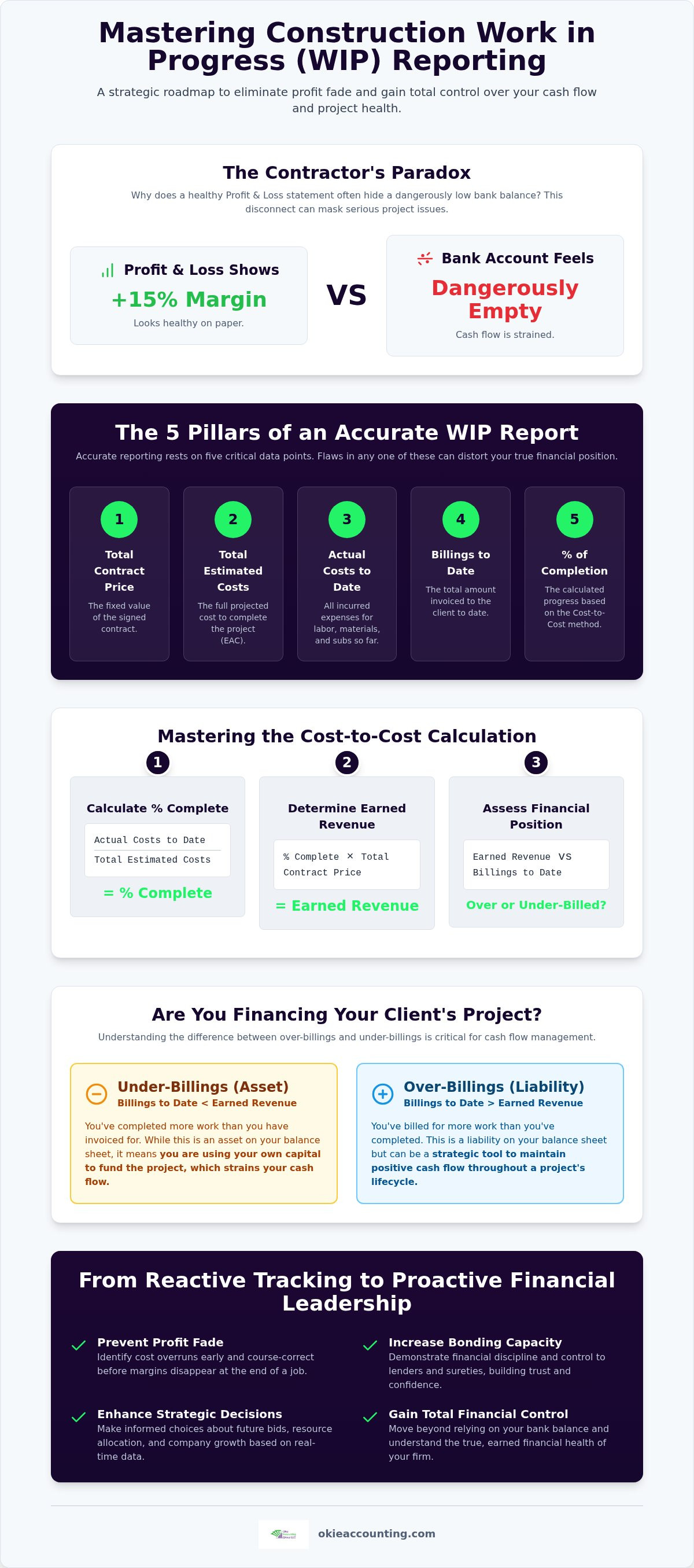
Why does your Profit and Loss statement show a healthy margin while your bank account feels dangerously empty? It's a frustrating paradox that leaves many owners feeling like they're flying blind despite a full project pipeline. If you've ever discovered a project lost money only after it was 100% complete, you know that basic bookkeeping isn't enough. Mastering construction work in progress reporting is the only way to bridge the gap between your bank balance and your true project health.
We understand the pressure of maintaining lender-ready financials while managing rising labor costs and shifting 2026 regulations. You need a structural framework that turns messy data into a protective shield for your margins. This guide provides a strategic roadmap to eliminate profit fade and gain total control over your cash flow. We'll break down the mechanics of over and under-billing, leverage new native WIP features in QuickBooks Online Advanced, and establish a monthly rhythm that ensures you're always prepared for a bonding or loan application. It's time to move from reactive tracking to proactive financial leadership.
Beyond the Balance Sheet: Why WIP Reporting is the Pulse of Your Construction Firm
At its core, construction work in progress reporting is a financial schedule that tracks project costs and revenue based on the percentage of completion. It's much more than a simple spreadsheet; it's a diagnostic tool that reveals the true health of your operations. Effective WIP reporting serves as the essential bridge between field-level project management and the corporate general ledger.
Relying on a bank balance to gauge success is a dangerous gamble in the construction industry. When you receive a large deposit for a new contract, it's easy to feel secure. However, without a WIP schedule, you can't see that this money is often "borrowed" from the future of the project. A proactive earned-revenue strategy shifts your focus from what's in the bank to what you've actually earned through performance.
The Difference Between Cash and Accrual in Construction
A standard Profit and Loss statement can lie to you if it isn't adjusted for WIP. Under cash-basis accounting, you might look profitable simply because you've front-loaded your billings. For the 2026 tax year, the IRS has set the small contractor exception threshold at $32 million in average annual gross receipts. Even if you fall below this limit, using the Percentage of Completion Method (PCM) is vital for internal management. This data often flows into a balance sheet account known as Construction in Progress (CIP), which holds these costs as assets until the job is finalized.
Without this adjustment, "profit fade" can hide in your financials for months. You might think a project is hitting its 15% margin target, only to realize at 90% completion that unexpected labor costs have gutted your returns. WIP reporting identifies these variances early, allowing you to course-correct before the margin disappears entirely.
How WIP Reporting Alleviates Industry-Specific Stress
The transition from reactive bookkeeping to strategic oversight provides a sense of quiet confidence. When you understand your true project margins, the anxiety of bonding or loan applications evaporates. Lenders and sureties look for the structural integrity that a reliable WIP system provides. It proves that you have a disciplined grip on your data and a methodical approach to risk.
This level of transparency builds deep trust with your stakeholders. By providing accurate over and under-billing entries, you demonstrate that your firm is managed with professional precision. Our fractional controller services are designed to build these high-level frameworks, moving your business away from basic administrative tasks and toward long-term financial stability. You stop guessing and start knowing exactly where your profit stands.
The Anatomy of an Accurate WIP Report: Essential Data Pillars
Building a reliable system for construction work in progress reporting requires more than just pulling numbers from a ledger. It demands a disciplined approach to data collection that mirrors the physical construction of a project. To gain total financial clarity, your reporting must rest on five critical pillars: total contract price, total estimated costs, actual costs to date, billings to date, and the calculated percentage of completion. If any of these inputs are flawed, the resulting report will provide a distorted view of your firm's health.
The most volatile variable in this framework is the Estimated Cost at Completion (EAC). While your contract price is often fixed, your EAC fluctuates based on labor productivity, material price shifts, and site conditions. Managing this volatility is essential for profit protection. Accurate data ensures you meet federal requirements for progress reports and stay compliant with bonding and lending standards. Without a rigorous process for updating these estimates, you risk making strategic decisions based on outdated or optimistic projections.
Mastering the Cost-to-Cost Calculation
The industry standard for determining project progress is the Cost-to-Cost method. This objective approach removes the guesswork often associated with visual inspections. First, you divide your actual costs to date by your total estimated costs to find your percentage complete. Next, you apply that percentage to the total contract value to determine your Earned Revenue. The final step is to compare this earned revenue to your actual billings. This comparison reveals whether you are ahead of the project financially or if you are essentially providing an interest-free loan to the project owner.
Estimating Remaining Costs: The Contractor's Greatest Challenge
The "90% complete" trap is a common industry pain point where costs balloon unexpectedly as a project nears the finish line. This often happens because field updates lag behind accounting entries, or punch-list items aren't properly factored into the remaining cost estimates. To maintain the structural integrity of your financials, regular communication between project managers and the finance team is non-negotiable. This proactive coordination prevents profit fade from eroding your final margins. Learn more about our Management Accounting services to see how we help firms build these essential feedback loops.
Establishing these data pillars is the first step toward a more predictable business model. If you are ready to transition from reactive data entry to strategic financial oversight, schedule a discovery call to discuss how we can strengthen your reporting framework.
Navigating the Danger Zone: Interpreting Over and Under-Billings
Interpreting the spread between your earned revenue and your actual billings is the most critical phase of construction work in progress reporting. This variance defines your cash position and your long-term viability. While a high bank balance suggests success, it often hides a failing model if those funds are merely over-billings. You must distinguish between what you've collected and what you've truly earned to maintain the structural integrity of your firm's financials.
Under-billings and over-billings aren't just accounting entries; they're indicators of your operational health. Failing to recognize these variances leads to an unpredictable cash flow that can paralyze a business even when the pipeline is full. Mastering this interpretation allows you to move from reactive "bank-balance" management to a proactive strategy focused on protected margins and long-term stability.
Under-billings: The Silent Cash Flow Killer
Under-billing happens when your earned revenue exceeds your billings, meaning you've performed work you haven't yet invoiced. This often signals a breakdown in project oversight, such as unapproved change orders or a lag in the field reporting cycle. In the 2026 economic environment, where labor and material costs remain volatile, carrying these costs on your own balance sheet is a massive risk. Under-billings drain your liquidity and signal to sureties that your revenue may be uncollectible. If you don't tighten your invoicing rhythm, you're essentially providing an interest-free loan to the project owner while starving your own operations of working capital.
Over-billings: Managing Your 'Borrowed' Cash
Over-billing is a strategic tool for managing mobilization costs and front-loading a project's cash needs. However, it's easy to fall into a false sense of security. Because this cash appears in your bank account before it's earned, it is a liability, not profit. Spending these funds on general overhead or other struggling jobs is a recipe for a cash crunch as the project nears completion. You're effectively spending tomorrow's money today. Protecting your margins requires strict internal controls to ring-fence over-billed funds for future project costs. Our fractional controller services at Okie Accounting Group LLC help you build these structural frameworks, ensuring you always know exactly how much of your cash is actually yours to keep.
Implementing WIP Reporting in QuickBooks Online: A Strategic Framework
You don't need a massive ERP system to achieve professional-grade results. Many firms believe high-level construction work in progress reporting is reserved for companies with five-figure software budgets. That is no longer true. As of the August 2026 update, QuickBooks Online Advanced includes native WIP reporting and AIA-style progress billing features at no additional cost. This allows you to build a sophisticated financial framework without the overhead of complex legacy systems.
To make this work, your Chart of Accounts must be structured with precision. You need two specific accounts: "Costs in Excess of Billings" (an asset account) and "Billings in Excess of Costs" (a liability account). These accounts act as the holding pens for your WIP adjustments. They ensure your balance sheet reflects the true status of your projects rather than just the timing of your deposits. Without these structural anchors, your financial statements will continue to fluctuate wildly based on your billing cycle.
Setting Up Your QBO Construction Infrastructure
The Projects feature in QBO is the engine of your job costing. It allows you to track actual costs against your initial estimates in real-time. By utilizing cloud-based automation tools, you reduce the risk of human error in data entry. This ensures that the numbers your team reviews are accurate and timely. For a deeper dive into the technical setup, see our guide on Mastering QuickBooks for Contractors: The 2026 Strategic Guide. If your team needs expert guidance to implement these systems, we offer professional QuickBooks training for construction teams.
The Fractional Controller’s Monthly WIP Checklist
A reliable system requires a disciplined monthly review cycle. The fractional controller’s checklist focuses on moving beyond basic administrative tasks to strategic oversight. This disciplined approach creates a rhythm of accountability that protects your margins. A standard cycle includes four essential steps:
Reconcile all job costs to the general ledger to ensure no expenses are missing.
Review "Estimated Costs to Complete" with project managers to capture field-level changes.
Calculate the WIP adjustment using the cost-to-cost method.
Post adjusting journal entries to the balance sheet to reflect true project profitability.
This process transforms your accounting from a historical record into a forward-looking strategy. It provides the clarity needed to make data-driven choices about which projects to pursue and which to avoid. If you are ready to build a more resilient financial foundation, book a discovery call to see how our fractional services can stabilize your reporting.
Strategic Growth: Leveraging Fractional Oversight for WIP Management
Relying on basic bookkeeping for complex projects is like building a skyscraper on a residential foundation. While administrative tasks keep the lights on, they don't provide the structural integrity required for scaling. Professional construction work in progress reporting requires a specialized understanding of how field operations translate into financial liabilities and assets. This is where the transition from simple data entry to a strategic financial partnership becomes essential for long-term health. You need a system that doesn't just record the past but actively protects your future margins.
At Okie Accounting, we position ourselves as the high-level advisor your firm needs to maintain this structural integrity. We move beyond the granular operational details to focus on the broader implications of your financial health. By establishing these foundational systems, we help you shift from a reactive stance to one of quiet confidence. You stop worrying about whether a project is truly profitable and start making data-driven choices that fuel disciplined growth.
Lender-Ready Financials and Bonding Capacity
Sureties and banks don't just look at your cash balance; they scrutinize your operational maturity through your WIP schedule. They look for consistency in your estimates and accuracy in your over and under-billing entries. A well-maintained report proves that your firm has a disciplined grip on its data, which directly increases your bonding capacity and improves loan terms. This level of readiness is a core pillar of Strategic Growth with Fractional Controller Services. By presenting lender-ready financials, you signal to stakeholders that your business is managed with professional precision.
Moving from Complexity to Operational Clarity
The true value of expert oversight isn't just in the numbers; it's in the emotional relief of moving from guessing to knowing. The anxiety of unpredictable cash flow evaporates when you have a reliable monthly system to see true project profitability. We alleviate the stress of project-based financial tracking by building the comprehensive frameworks your business needs to thrive. The ROI of this oversight is found in profit protection and the mitigation of risks like profit fade and uncollectible under-billings. Explore our Fractional Controller Services to see how we can transform your financial data into a tool for stability. We're as invested in your business's success as you are, providing the meticulous, forward-thinking approach required to navigate the 2026 construction landscape.
Secure Your Profit Margins with Strategic Financial Leadership
Implementing a rigorous system for construction work in progress reporting is the most effective way to eliminate profit fade and stabilize your firm's cash flow. By mastering the cost-to-cost method and accurately adjusting for over and under-billings, you move from reactive bookkeeping to proactive financial leadership. This structural framework ensures your financials are always lender-ready and your project margins are protected against unexpected cost ballooning.
As you scale your firm in 2026, you don't have to manage these technical complexities alone. Okie Accounting Group LLC provides a specialized construction and real estate focus, delivering strategic fractional controller oversight that goes beyond basic administrative tasks. We offer national remote financial leadership designed to build the foundational systems your business deserves. Our team acts as a dedicated partner, ensuring your data is accurate, your cash is managed, and your growth is sustainable.
Schedule a consultation with Okie Accounting Group LLC to gain total control over your project profitability. Take the first step toward operational clarity and build a business that thrives on disciplined, data-driven confidence.
Frequently Asked Questions
What is a WIP report in construction?
A WIP report is a specialized financial schedule that tracks the progress of active projects by comparing actual costs incurred to the total estimated costs. It provides a real-time snapshot of a project's financial health by calculating earned revenue based on the percentage of completion. This report acts as a critical diagnostic tool, ensuring your financial statements reflect true performance rather than just the timing of your cash deposits or invoice cycles.
How often should a construction company run a WIP report?
You should run and review your WIP reports at least once a month as part of your standard closing process. For high-volume firms or projects with tight margins, a bi-weekly review may be necessary to catch variances early. Consistent monthly construction work in progress reporting allows you to make adjusting entries on your balance sheet, ensuring your profit and loss statement accurately represents your true project earnings.
Why is a WIP report important for bonding and surety companies?
Sureties use WIP reports to evaluate your firm's operational maturity and financial stability. They look for "fade" or "gain" in your margins to determine if you can accurately estimate and manage complex work. A reliable WIP schedule proves that you have the internal controls to protect profits. This transparency builds trust with lenders, which can lead to increased bonding capacity and better financing terms for your upcoming projects.
Can I run a WIP report in QuickBooks Online?
Yes, you can run a WIP report in QuickBooks Online, specifically within the Advanced edition. As of the August 2026 update, QBO Advanced includes native construction features like WIP reporting, AIA-style progress billing, and retainage tracking. To ensure accuracy, your chart of accounts must be properly mapped with "Costs in Excess" and "Billings in Excess" accounts. We provide specialized QuickBooks training to help teams implement these structural frameworks correctly.
What is the difference between under-billing and over-billing on a WIP schedule?
Over-billing occurs when your total billings exceed the revenue you've earned based on project progress. This creates a liability because you owe the remaining work to the client. Under-billing happens when you've performed more work than you've invoiced, meaning you're essentially financing the project for the owner. Tracking these variances is essential for maintaining liquidity and ensuring your balance sheet reflects your actual financial position at the end of every month.
How do I calculate earned revenue for a WIP report?
Earned revenue is calculated by multiplying the total contract price by the percentage of completion. To find the percentage of completion, you divide your actual costs to date by your total estimated costs at completion. For example, if a $100,000 project is 50% complete based on costs, your earned revenue is $50,000. This figure is then compared to your total billings to determine if an adjustment is required.
What is profit fade and how does WIP reporting detect it?
Profit fade is the gradual decrease in a project's projected gross profit margin as the job progresses. This often occurs due to underestimated labor costs, material price increases, or unbilled change orders. Construction work in progress reporting detects this by comparing the current estimated cost at completion to previous estimates. If your costs are rising faster than your progress, the WIP report highlights the variance, allowing you to investigate and course-correct immediately.
Do I need a CPA to manage my WIP reporting?
You don't necessarily need a CPA for the monthly management of your WIP reports, but you do need specialized financial oversight. While many generalists focus on historical data, a fractional controller provides the proactive, forward-looking strategy required for project-based accounting. We focus on building the structural systems that manage these complexities. This strategic oversight ensures your data is accurate and your firm is prepared for bonding without the need for a full-time executive hire.


Comments