
Fractional Controller for Real Estate Investors: Building a Scalable Financial Framework
- Wendy Okie

- 5 days ago
- 12 min read
If your real estate portfolio is expanding but your clarity on project-level profitability is shrinking, are you actually building a business or just managing a collection of spreadsheets? With real estate investment volume projected to hit $562 billion this year, the stakes for financial accuracy have never been higher. You've likely realized that basic bookkeeping can't keep up with the complexities of 100% bonus depreciation or the new $40,000 SALT deduction cap. It's a common pressure point for investors who feel the need to do more with less in a rapidly recovering market.
A fractional controller for real estate investors provides the specialized oversight needed to move beyond simple data entry and administrative tasks. This article explains how to build a scalable financial framework that produces lender-ready statements and robust internal controls. We'll show you how to transform your back office into a strategic partnership that guides every acquisition decision with quiet confidence. You'll learn the methodology for transitioning from reactive accounting to a proactive, data-driven growth engine that protects your profits while you scale.
Key Takeaways
Identify why basic bookkeeping eventually fails to provide actionable data and how to break through the "invisible ceiling" of portfolio growth.
Discover how a fractional controller for real estate investors designs a standardized Chart of Accounts and internal controls to safeguard your assets.
Learn the functional differences between a controller’s focus on systems and accuracy versus a CFO’s focus on capital raising and high-level strategy.
Recognize the operational red flags, like delayed monthly financials or complex entity structures, that indicate your firm is ready for professional oversight.
Understand how a strategic financial partnership transitions your back office from a cost center into a data-driven engine for acquisition success.
Scaling Beyond Bookkeeping: Why Real Estate Investors Need Controller-Level Oversight
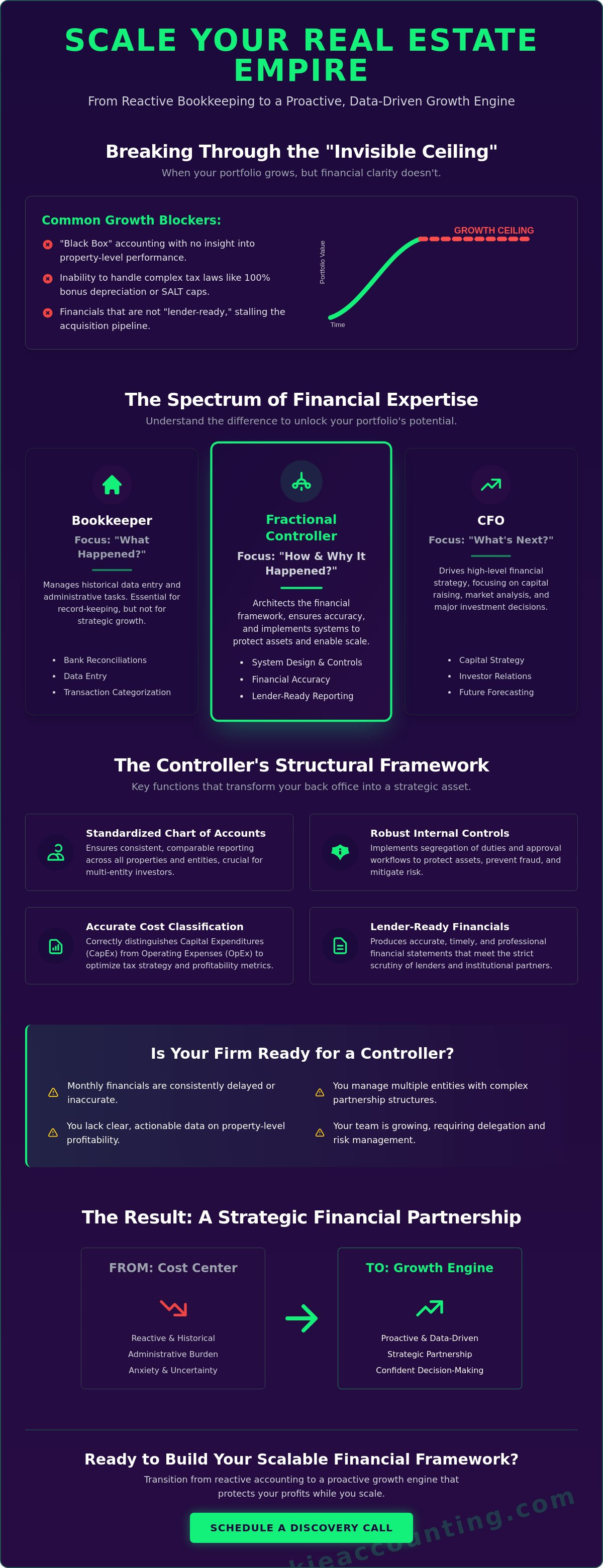
Many real estate investors hit an "invisible ceiling" where their financial data no longer supports their growth ambitions. You might have clean bank reconciliations, yet you still lack clarity on which properties are truly performing. This happens because basic bookkeeping is inherently historical. It records what happened yesterday without preparing you for tomorrow. A fractional controller for real estate investors changes this dynamic by shifting the focus from simple data entry to high-level financial oversight.
Think of this role as a strategic partner who bridges the gap between administrative tasks and executive decision-making. While a bookkeeper manages the "what," a Comptroller or controller manages the "how" and "why" of your financial systems. They ensure that every transaction serves a broader strategy, transforming your accounting department from a cost center into a data-driven engine. This is particularly vital when navigating complex tax laws like the 100% bonus depreciation rules or managing the increased $40,000 SALT deduction cap that became effective in 2026.
One of the most significant advantages of this level of oversight is the accurate classification of costs. Misidentifying Capital Expenditures (CapEx) as Operating Expenses (OpEx) is a common error that can skew your profitability metrics and lead to missed tax opportunities. A specialized controller understands these nuances, ensuring your balance sheet reflects the true value of your assets while protecting your cash flow. This precision allows you to move from simply recording history to actively managing your financial future, ensuring that every dollar spent on a property is optimized for its long-term return on investment.
The Limitations of Traditional Bookkeeping
Bank reconciliations are the baseline, not the finish line. Relying solely on them for a scaling portfolio often leads to "black box" accounting, where you see the final numbers but don't understand the mechanics behind them. This lack of transparency creates anxiety and eventually stalls your acquisition pipeline. The Controller serves as the essential bridge between raw data entry and the strategic insights needed to secure your next deal.
The Value of Industry-Specific Expertise
Real estate requires a unique architectural approach to accounting. A generalist provider might miss the specific reporting requirements lenders demand in a market where interest rates range from 5.51% to 8.80%. By ensuring your QuickBooks for real estate investors is configured for growth, a fractional controller for real estate investors prepares you for the scrutiny of institutional partners. They build the structural framework that yields lender-ready financials, making your firm a more attractive prospect for high-stakes financing.
The Structural Framework: Core Responsibilities of a Fractional Controller
Building a scalable financial framework requires more than just recording transactions; it demands a rigorous architectural approach to your entire accounting system. A fractional controller for real estate investors acts as the primary architect of this system. They move beyond the granular details of daily entries to establish the foundational structures that ensure long-term stability. This oversight transforms your back office from a simple administrative function into a disciplined department capable of supporting rapid portfolio expansion.
The core of this framework is the implementation of robust internal controls designed to protect your assets and prevent fraud. As your team grows and you begin delegating more tasks, the risk of mismanagement increases. A controller mitigates this risk by establishing clear segregation of duties and automated approval workflows for large vendor payments or construction draws. These systems provide a layer of profit protection that basic bookkeeping simply cannot offer. This organized methodology creates an environment of trust where you can focus on acquisitions while knowing your capital is safeguarded by professional oversight.
Standardization is another critical pillar of the controller’s role. For investors managing multiple entities or complex partnership structures, a standardized Chart of Accounts is essential for clear reporting. Without this consistency, comparing the performance of different assets becomes nearly impossible. A controller ensures that every property follows the same financial logic, allowing for seamless consolidation and clear communication with partners or lenders. If you are ready to implement these high-level systems, you can schedule a discovery call to discuss your portfolio’s specific structural needs.
Internal Controls and Risk Mitigation
Effective risk management starts with the segregation of duties. By ensuring that the person who approves a payment is not the same person who initiates the transaction, a controller closes the loopholes that lead to internal fraud. They also implement rigorous compliance checks to ensure all activities align with local regulations and specific partnership agreements. These workflows are not just about safety; they are about creating a professional environment that is ready for institutional-level scrutiny.
Advanced Financial Reporting and Analysis
A fractional controller for real estate investors elevates your reporting beyond the standard Profit and Loss statement. They track sophisticated metrics like Debt Service Coverage Ratios (DSCR) and equity growth across your entire portfolio. In a 2026 market where conventional mortgage rates range from 5.51% to 8.80%, understanding your debt position is vital for survival. By utilizing management accounting, your controller provides project-level margin analysis for development or fix-and-flip projects. This data-driven approach ensures that every acquisition decision is based on hard numbers rather than abstract theories or gut feelings.
Fractional Controller vs. CFO: Choosing the Right Financial Leadership
Real estate investors often use the terms "CFO" and "Controller" interchangeably, but confusing these roles can lead to expensive hiring mistakes. A CFO focuses on the "where" of the business, prioritizing capital raising, high-level strategy, and long-term equity growth. In contrast, a fractional controller for real estate investors focuses on the "how." They are the architects of accuracy, managing the systems, internal controls, and the overall integrity of your data. While a CFO looks at the horizon, a controller ensures the engine is running perfectly.
Hiring a CFO to fix messy books is like hiring a lead architect to swing a hammer; it's an inefficient use of high-level talent. Before you can execute a complex strategy, you need a foundation of reliable data. A controller ensures your reporting is accurate so that when a CFO eventually steps in, they're working with a solid baseline rather than a house of cards. This disciplined approach ensures that your financial readiness matches your growth ambitions.
Choosing the right leadership depends on your current operational maturity. If your primary goal is to stabilize your existing portfolio and protect your margins, a controller is your most valuable asset. They build the structural framework that yields the clarity you need to manage daily operations with quiet confidence. This partnership provides the stability required to survive in a market where 74% of finance professionals are being asked to do more with less.
When the Controller is the Priority
If your monthly financials are consistently late or your partnership distributions feel like guesswork, your priority is a controller. Institutional investors and lenders won't look at your vision if your current books are a black box. Clean, audited-quality data is the prerequisite for raising capital in a 2026 market where transaction activity is projected to increase by 16%. A controller prepares the lender-ready statements that prove your portfolio’s viability to external partners.
The Synergy of Fractional Services
The fractional model provides a strategic middle ground between basic bookkeeping and a full-time executive hire. A full-time controller's fully loaded cost can range between $180,000 and $265,000 annually, which is a significant overhead for many growing firms. By utilizing specialized controller services on a part-time basis, you gain high-level oversight without the excessive payroll burden. This allows you to scale your level of service as your portfolio grows from 5 to 50+ units, ensuring your financial infrastructure always matches your operational complexity.
Signs Your Real Estate Investment Firm is Ready for a Fractional Controller
Recognizing the exact moment to transition from basic record-keeping to professional oversight is a critical milestone for any growing firm. You'll often feel this shift as a sense of friction in your daily operations. Perhaps your monthly financials are consistently late, or they require significant corrections before you can trust the numbers. When your data feels like a liability rather than an asset, it's a clear signal that you've outgrown your current systems. A fractional controller for real estate investors provides the structural remedy to these operational bottlenecks.
Multiple Entity Complexity: Managing varied partnership structures or tiered ownership requires a sophisticated Chart of Accounts that simple bookkeeping can't support.
Delayed Monthly Close: If you aren't receiving finalized reports by the 10th business day, you're making acquisition decisions based on stale data.
Lender Scrutiny: As you move into larger multifamily or commercial deals, lenders demand professional-grade reporting that exceeds the capabilities of a generalist.
Expansion Readiness: If you're planning a capital raise or a significant acquisition in the next 12 months, your books must be beyond reproach.
If these symptoms sound familiar, you can schedule a discovery call to assess your current financial framework and identify areas for immediate stabilization.
The Complexity Threshold
Complex transactions like 1031 exchanges or tiered debt structures create a "Complexity Threshold" that standard real estate investor bookkeeping services aren't designed to handle. Managing the transition from active, hands-on property management to a scalable investment firm requires a dedicated focus on internal controls and reporting accuracy. A controller ensures that these high-stakes activities are tracked with precision, preventing the "black box" accounting that often plagues growing portfolios. This oversight is vital as you scale beyond your first few properties and into more sophisticated asset classes.
The "Lender-Ready" Test
Lenders are increasingly cautious in a market where interest rates range from 5.51% to 8.80%. They look for common reporting gaps, such as inconsistent debt service coverage ratios or unclear equity tracking, which can cause significant loan delays or rejections. Having a professional controller available to answer technical inquiries from lenders adds a layer of credibility that can accelerate your financing timeline. The ROI of faster financing through better financial readiness often far outweighs the cost of professional oversight, ensuring you don't miss out on time-sensitive acquisitions in a recovering market.
Strategic Growth with Okie Accounting Group LLC: The Controller Partnership
At Okie Accounting Group LLC, we define our relationship with clients as a strategic partnership rather than a simple administrative transaction. Our fractional controller for real estate investors services focus on building the comprehensive structural framework your portfolio deserves. We don't just record historical data; we design and implement the systems that support your long-term growth objectives. This disciplined methodology allows you to stop firefighting daily administrative errors and start focusing on high-level acquisition decisions with quiet confidence.
The transition from reactive accounting to proactive financial planning is the hallmark of professional stewardship. Our team integrates seamlessly with your existing staff and software, providing the high-level oversight necessary to ensure data integrity across all entities. By establishing clear workflows and automated internal controls, we provide the peace of mind that comes from knowing your capital is protected. This organized approach creates a sense of predictability that is essential for navigating a market where transaction volume is projected to rise.
Our goal is to transform your back office into a data-driven engine. When you have a dedicated professional managing the "how" of your accounting, you gain the freedom to lead your firm with clarity. This partnership ensures that your financial infrastructure is as stable and reliable as the physical assets in your portfolio.
Our Methodology for Real Estate Investors
We begin every engagement with a thorough initial assessment to identify gaps in your current accounting infrastructure. This process involves customizing your QuickBooks setup to support project-based tracking and sophisticated class reporting. Once the foundation is stabilized, we provide ongoing oversight through a monthly strategic review process. These reviews move beyond the basic P&L to analyze the deeper implications of your financial health, ensuring you're always ready for the next phase of financing.
Your Partner in Profit Protection
Our deep specialization in the construction and real estate sectors makes Okie Accounting Group LLC a uniquely qualified ally for your business. We understand the mechanics of the niche, from managing complex debt structures to optimizing for the latest tax regulations. You can explore our full ecosystem of support in our guide on Accounting for Real Estate Investors. If you are ready to move beyond basic bookkeeping and build a scalable financial framework, schedule a discovery call today to begin our partnership.
Securing the Future of Your Real Estate Portfolio
Scaling a real estate firm requires a shift from simple tracking to a comprehensive framework. Establishing robust internal controls and standardizing your reporting moves your business beyond the limits of basic bookkeeping. A fractional controller for real estate investors ensures that your data is not just accurate; it's lender-ready and strategically aligned with your acquisition goals.
Okie Accounting Group LLC provides the specialized expertise in real estate and construction needed to stabilize your growth and safeguard your capital. Led by Sarah O’Quinn, a veteran in niche-specific financial strategy, our team offers nationwide remote service delivery that integrates with your existing operations. You deserve a partner who values accuracy and long-term stability as much as you do. Take the first step toward operational clarity and confidence today.
Build your scalable financial framework with Okie Accounting Group LLC
Frequently Asked Questions
What exactly does a fractional controller do for a real estate investor?
A fractional controller for real estate investors establishes the structural framework required to scale a portfolio with precision. They oversee the monthly close process, implement internal controls to prevent fraud, and ensure that all financial reporting is lender-ready. Their role is to bridge the gap between basic data entry and the high-level strategic decisions made by the ownership team.
How much does a fractional controller cost compared to a full-time hire?
The cost of a fractional controller is significantly lower than the fully loaded expense of a full-time executive. Research indicates that a full-time controller typically costs between $180,000 and $265,000 annually when including benefits and payroll taxes. Fractional services provide the same level of specialized oversight at a fraction of that cost, making it a more efficient model for growing firms.
Will a fractional controller replace my current bookkeeper?
A fractional controller usually complements rather than replaces your existing bookkeeping function. They act as the supervisor for your bookkeeper, ensuring that transactions are classified correctly for CapEx and OpEx. This creates a system of checks and balances that improves data integrity while allowing your administrative team to focus on daily tasks under professional guidance.
Can a fractional controller help with my real estate tax strategy?
While they don't provide income tax preparation, a controller ensures your books are structured to maximize the benefits of current tax laws. This includes accurately tracking assets to take advantage of the permanent 100% bonus depreciation or the increased $40,000 SALT deduction cap. They provide your tax preparer with clean, organized data that reduces the risk of errors and missed deductions.
How many hours a month does a fractional controller typically work?
The engagement level varies based on the size and complexity of your portfolio. Most real estate investors find that 5 to 20 hours per month is sufficient to manage the monthly close, review financial statements, and maintain internal controls. This flexibility allows you to scale the level of professional oversight as your entity count or transaction volume increases.
Do I need a fractional controller if I only own a few rental properties?
Investors with a small, stable portfolio of simple rentals may not yet require controller-level oversight. The need for a fractional controller for real estate investors typically arises when you hit a complexity threshold. If you are managing multiple entities, navigating complex partnership structures, or planning a significant capital raise, professional financial leadership becomes essential for your stability.
What software does a fractional controller usually use for real estate?
QuickBooks is the industry standard for maintaining a scalable financial infrastructure. A controller ensures your software is configured for project-based tracking and class reporting across multiple properties. They may also integrate specialized property management or construction tracking tools to ensure that your financial data flows seamlessly into your core accounting system.
How do I know if I need a controller or a CFO for my investment firm?
The choice depends on whether your primary bottleneck is internal systems or external strategy. If you need to fix messy books, establish internal controls, and produce accurate reports, you need a controller. If you are focused on high-level capital raising and long-term equity strategy, you need a CFO. Most firms find that a stable controller-level foundation must be built before a CFO can be effective.


Comments