
How Much Do Construction Payroll Services Charge? The 2026 Buying Guide
- Wendy Okie

- Jun 1
- 12 min read
The most expensive construction payroll service isn't the one with the highest monthly fee; it's the one that leaves you vulnerable during a Department of Labor audit. For contractors managing multi-state union fringes or federal projects, the true cost of construction payroll services is often hidden in the gap between basic administration and strategic financial oversight. With the September 30, 2026, deadline for the mandatory new WH-347 form fast approaching, the stakes for compliance and profit protection have never been higher.
You already know that a single reporting error can stall a project or trigger penalties that erase your hard-earned margins. This 2026 buying guide provides total clarity on the costs, features, and long-term ROI of specialized payroll management. You'll discover how the right partnership transforms complex data into accurate job costing and compliant certified payroll reports, providing the control you need over your financial data. We'll break down current pricing structures, explore the impact of the latest NYSDOL electronic mandates, and show you how to choose a partner that acts as a structural framework for your business's long-term health.
Key Takeaways
Recognize the "low-cost" trap of generalist payroll software and how manual workarounds can inadvertently eat into your project margins.
Gain clarity on the 2026 WH-347 mandate and the necessity of specialized construction payroll services for managing complex prevailing wage requirements.
Learn to evaluate fee structures, from per-employee charges to flat monthly retainers, to find the model that best fits your operational rhythm.
Use our contractor's checklist to verify industry-specific expertise, ensuring your payroll system communicates perfectly with your QuickBooks setup.
Shift your perspective from viewing payroll as a clerical burden to leveraging it as a foundational system for project-based financial health.
Navigating the Complexity of Construction Payroll Compliance
For a specialty contractor, payroll is never just a clerical task. It's a multi-layered compliance system where every line item is scrutinized by regulators. Generalist payroll providers often treat your business like a retail shop or a law firm, but those models don't account for the unique mechanics of the job site. When you invest in construction payroll services, you're building a structural framework for financial readiness. This system protects your profit margins from the catastrophic impact of Department of Labor audits and contract debarment.
Non-compliance carries heavy consequences. If your reporting lags or contains inaccuracies, you risk more than just fines. You risk losing the ability to bid on future public works projects. In a market where construction spending is projected to reach over $2,185 billion in 2026, being sidelined by administrative errors is a risk you can't afford. A proactive approach to payroll ensures you remain eligible for high-value contracts while maintaining the trust of your workforce and your clients.
The Burden of Certified Payroll and Davis-Bacon
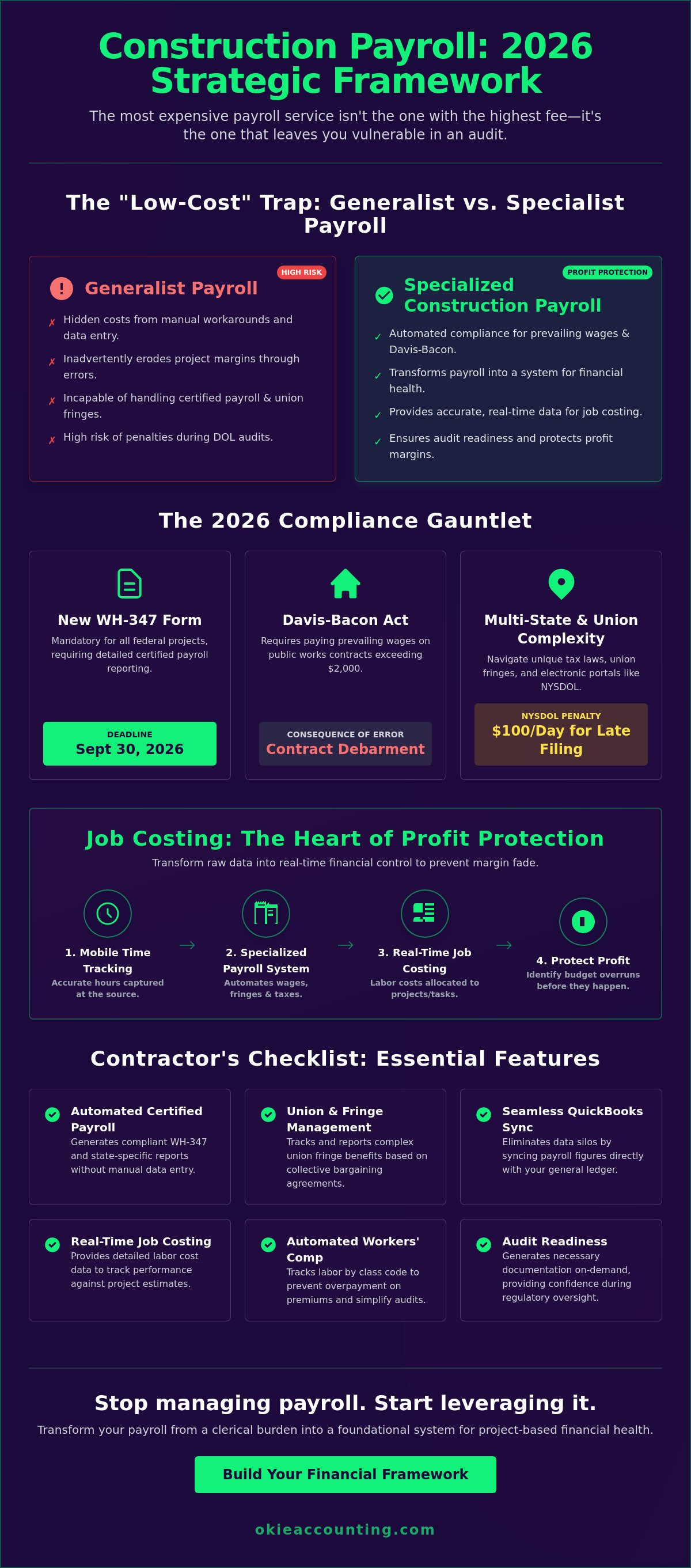
Federal and state-funded projects require a level of transparency that standard software simply can't provide. The Davis-Bacon Act of 1931 established the requirement for paying prevailing wages on public works contracts exceeding $2,000. Managing these rates manually consumes dozens of administrative hours every month. Without an automated approach, your team spends more time on paperwork than on project management. Transitioning to specialized construction payroll services: a strategic framework ensures that your WH-347 forms are accurate and submitted on time. This is especially critical now, as the new WH-347 form becomes mandatory on September 30, 2026.
Multi-State and Union Fringe Complexity
Crossing state lines introduces a new layer of friction. Different jurisdictions have different tax laws and reporting portals. For instance, as of January 1, 2026, New York State requires electronic submission of certified payroll via the NYSDOL portal. Late filings now incur a penalty of $100 per day after the 14-day grace period. Union contracts add even more weight to this burden. You must track unique fringe benefit calculations for every hour worked, ensuring that health, welfare, and pension contributions align perfectly with collective bargaining agreements. Accuracy in fringe tracking isn't just a goal; it's a requirement for maintaining your standing with the union and the state. By centralizing this data, you transform a chaotic administrative hurdle into a streamlined, predictable process.
Essential Features of Specialized Construction Payroll Services
Generalist payroll providers focus on the basic task of moving money from your bank account to your employees' pockets. However, construction payroll services must do much more to support the structural integrity of a contracting business. The right platform acts as an automated compliance engine. It handles the intricate requirements of prevailing wages and fringe benefits without requiring manual data entry from your office staff. By automating jurisdictional rate updates, these services ensure that your bids remain accurate and your payments stay compliant with federal mandates.
Real-time data visibility is the foundation of an organized operation. A specialized provider ensures seamless integration with QuickBooks Online, allowing payroll figures to sync instantly with your general ledger. This connectivity eliminates the data silos that often lead to financial discrepancies. When field crews use mobile time-tracking tools, that data flows directly into the system. This preserves data integrity by capturing hours at the source, reducing the risk of guesstimated time cards that can inflate your labor costs.
Audit readiness is another critical feature that distinguishes specialized services. Workers' compensation tracking should be automated, categorizing labor hours by class code to ensure you aren't overpaying on premiums. When the annual audit arrives, you won't need to scramble for records; the system generates the necessary documentation with a few clicks. This level of organization provides the quiet confidence needed to handle regulatory oversight without stress.
Job Costing: The Heart of Profit Protection
Profit protection begins with understanding exactly where your labor dollars are going. Specialized payroll data must flow directly into project budgets to track performance against estimates. This level of detail is essential for effective WIP Accounting, as it allows you to see labor costs down to the specific task or phase. When you can identify exactly which activities are exceeding their budget in real time, you can take corrective action before margin fade turns a profitable project into a loss. If you're looking to tighten these financial controls, you might consider a discovery call to discuss your current systems.
Automated Reporting and Audit Readiness
A specialized provider should offer a library of 40 or more industry-specific reports. These aren't just summaries; they are strategic tools. EEO minority compliance reports and automated new hire reporting keep you in good standing with regulatory bodies. For contractors looking to scale, lender-ready financials are a must. Providing banks or bonding agents with clean, detailed payroll and job costing data builds the trust necessary to secure higher bonding limits and credit lines. This transformation from administrative burden to strategic asset is what defines a true partnership.
Evaluating the Real Cost: Generalist vs. Specialized Construction Payroll
Many contractors select a generalist payroll provider based on a low monthly subscription fee, only to discover that those "savings" are quickly consumed by manual labor. When an office manager spends eight hours every week manually calculating union fringes or re-entering data into the NYSDOL portal, the true cost of that software skyrockets. Specialized construction payroll services eliminate these hidden labor costs by automating the very tasks that generalist systems ignore. You aren't just paying for a paycheck; you're investing in a system that prevents costly administrative leakage.
Pricing models in this sector usually fall into two categories: per-employee fees or flat monthly retainers. A per-employee model might seem attractive for smaller crews, but it makes your overhead unpredictable as you scale or take on seasonal labor. A flat monthly retainer, often used by strategic partners, provides cost certainty and reflects a commitment to ongoing oversight rather than just transaction processing. This predictability allows for better cash flow forecasting and ensures that your administrative costs remain stable even as your project volume increases.
The most significant cost is often the one you don't see until it's too late. A single misclassification of a workers' compensation code can lead to thousands in overpaid premiums or a massive bill after an audit. When you weigh a slightly higher service fee against the $100 per day penalty for late certified payroll submissions in New York, the ROI of accuracy becomes undeniable. One compliance mistake can easily outweigh years of service fees, making specialized expertise a form of financial insurance.
The Hidden Costs of Generalist Payroll
Manual entry for certified reports is a massive time sink that drains your team's productivity. Generalist software doesn't understand the nuances of the Davis-Bacon Act, forcing your staff to bridge the gap with error-prone spreadsheets. This manual intervention creates a significant risk of inaccurate workers' comp codes, which often leads to overpayment on insurance premiums. Furthermore, the sheer stress of managing complex union fringes in-house can lead to staff burnout and high turnover in your administrative roles.
The ROI of a Strategic Payroll Partner
Professional payroll management reduces overhead by building a resilient system that functions without constant owner intervention. Having a "Controller-level" eye on your payroll data ensures that labor costs are captured accurately, which is essential for precise project bidding and protecting your margins. This rigorous management provides the long-term stability needed to scale. It frees you to focus on high-level project management and strategic growth, moving you away from the daily chaos of back-office firefighting.
A Contractor’s Checklist for Selecting a Payroll Partner
Selecting a partner for your construction payroll services requires a disciplined approach to vetting. You aren't just buying software; you're choosing a strategic ally that will safeguard your compliance and project profitability. The first step is verifying their industry-specific expertise. Ask specifically about their experience with the Davis-Bacon Act and the $2,000 contract threshold. A provider that doesn't immediately understand the nuances of prevailing wage rates or the updated WH-347 form mandate isn't a specialist. They're a liability.
Next, confirm that their system has full software compatibility. It must talk to your QuickBooks for contractors setup without requiring manual workarounds. You should also request samples of their certified payroll reports to ensure they meet federal and state requirements, such as the New York State electronic submission portal standards. Finally, evaluate their support model. You need a dedicated advisor who understands your business, not a generic call center representative who reads from a script. If you're ready to move beyond basic administration, schedule a discovery call to vet your potential partner.
Software Integration and Data Integrity
Cloud-based systems are non-negotiable in 2026. They provide the agility needed to manage a mobile workforce and ensure that data is captured accurately at the job site. This real-time visibility prevents the delays and errors associated with paper time cards or manual spreadsheets. To maximize this technology, invest in QuickBooks training for your field team. When your foremen can input data correctly from the start, you create a single source of truth for all financial data. This structural integrity is what allows you to make data-driven choices about your project's health and readiness for expansion.
Vetting for Strategic Partnership
A true partner offers more than just processing. Look for providers who provide "Fractional Controller" level insights, helping you understand the broader implications of your labor costs on your overall cash flow. Ask how they handle complex scenarios like workers' comp audits or union grievances. A proactive partner will have systems in place to manage these challenges before they become crises. For a comprehensive look at what your back office should look like, reference our Construction Bookkeeping Checklist. This ensures your foundational systems are built for long-term stability and growth into new states or unions.
Beyond the Paycheck: Strategic Payroll Management with Okie Accounting
At Okie Accounting Group LLC, we view payroll as the cornerstone of your financial architecture. While generalist providers stop at the paycheck, our construction payroll services serve as the primary data feed for your entire business ecosystem. This proactive stance moves you beyond the stress of weekly deadlines into a state of quiet confidence. By integrating payroll data directly into your monthly bookkeeping and cash flow forecasting, Okie Accounting Group LLC provides a holistic view of your firm's performance that basic software can't replicate. You gain a partner who's as invested in your project margins as you are.
Our approach is defined by professional discipline and a supportive partnership. We understand that as a contractor, your needs are specialized and your time is best spent on the job site. Whether you're managing the 2026 regulatory changes in New York or overseeing projects across multiple states, our national reach ensures you have the expertise required to protect your margins. This isn't just about administrative relief; it's about building an organized system where financial data is a tool for strategic growth rather than a source of constant confusion.
The Okie Accounting Group LLC Difference: Structural Integrity
The true value of our oversight lies in the role of a Fractional Controller. This high-level advisor at Okie Accounting Group LLC doesn't just process numbers; they analyze them for structural integrity. By ensuring that labor hours are meticulously tracked and allocated, we build a foundation for long-term financial health and scalability. This level of management is essential for profit protection, as it allows you to see the immediate impact of labor costs on your project budgets. When your payroll feeds into a comprehensive financial reporting system, you can make data-driven choices that keep your business stable and ready for new opportunities.
Next Steps for Your Construction Firm
Achieving operational clarity in a complex market requires more than just a vendor; it requires a mentor who speaks your language. As you prepare for the challenges of 2026, from labor shortages to increased regulatory enforcement, having a strategic partner becomes your greatest competitive advantage. We invite you to transition from a state of administrative complexity to one of data-driven control. This transformation allows you to stop reacting to payroll crises and start leading your firm with financial readiness. To secure your firm's future and protect your hard-earned profits, schedule a consultation with Okie Accounting Group LLC today.
Securing Your Firm's Structural Integrity
Safeguarding your margins in an increasingly complex regulatory environment requires a transition from administrative chaos to strategic oversight. You've seen how the gap between generalist software and specialized expertise often leads to hidden costs and compliance risks. By choosing a partner that understands the nuances of prevailing wages and union fringes, you move beyond simple data entry into a world of profit protection. Specialized construction payroll services act as a comprehensive structural framework, ensuring your job costing is accurate and your financial reports are always audit-ready.
Sarah O’Quinn founded Okie Accounting Group LLC with a specific focus on the construction and real estate sectors to provide the professional discipline your back office requires. We combine national reach with cloud-based efficiency to deliver the financial readiness your firm needs to scale. It's time to stop reacting to Department of Labor updates and start leading your business with total data control. You've built your business on solid foundations; your financial systems should be no different.
Your business deserves the stability and peace of mind that comes with a methodical, forward-thinking partner by your side.
Frequently Asked Questions
What is the average cost of construction payroll services?
The cost varies based on the complexity of your operations, such as the number of states where you work and the presence of union contracts. Most providers utilize either a per-employee fee or a flat monthly retainer model. Instead of looking for the lowest price, focus on the value of specialized expertise that prevents costly audit penalties and manual data entry errors.
Can a general payroll provider handle certified payroll reports?
Most generalist providers struggle with the automated reporting required for federal and state projects. While they might offer basic forms, they often require your staff to perform manual workarounds to meet specific jurisdictional mandates. This increases the risk of non-compliance, especially with the mandatory new WH-347 form requirements taking effect on September 30, 2026.
How does construction payroll integrate with QuickBooks Online?
Integration works through a direct data sync that maps labor hours and costs to your specific projects and general ledger accounts. This connectivity ensures that your financial reporting remains accurate and reflects real-time field data. When construction payroll services are properly integrated, you eliminate the need for double entry and maintain a single source of truth for your business.
What happens if my construction payroll is non-compliant?
Non-compliance leads to severe financial and operational consequences, including heavy fines, project shutdowns, and debarment from bidding on future government contracts. In New York, for instance, failing to submit electronic certified payroll via the NYSDOL portal results in a $100 per day penalty. These costs quickly outweigh the investment in professional payroll management.
Do I need a specialized service for union fringe benefits?
Specialized expertise is essential because union contracts dictate unique benefit calculations that must be tracked by the hour. These rates often vary by trade and jurisdiction, making manual tracking nearly impossible for a growing firm. A specialized service automates these complex calculations, ensuring your contributions to health, welfare, and pension funds are always accurate and on time.
How does job costing through payroll improve my profit margins?
Job costing allows you to compare actual labor expenses against your original project estimates in real time. By identifying labor overruns as they happen, you can take corrective action in the field before margin fade erodes your profitability. This data-driven approach transforms payroll from a basic administrative task into a powerful tool for profit protection.
What is the difference between payroll processing and payroll management?
Payroll processing is the limited clerical task of issuing checks and filing basic tax returns. Payroll management is a strategic partnership that includes compliance oversight, granular job costing, and the construction of a comprehensive financial framework. Management focuses on long-term stability and financial readiness rather than just moving money from one account to another.
Can a remote accounting firm handle my multi-state payroll needs?
A specialized remote firm uses cloud-based efficiency to navigate the varying laws and reporting portals of multiple states simultaneously. They provide a disciplined focus on compliance that isn't limited by geography. This allows you to scale your operations into new jurisdictions with the confidence that your construction payroll services are being managed by experts who understand the national landscape.


Comments