_edited_edited.jpg)

How to Scale a Construction Business: The 2026 Strategic Framework for Growth

What if the same volume that built your seven-figure company is the very thing preventing you from reaching eight figures? You likely feel the pressure of shrinking margins even as your project backlog hits record highs. It's a common paradox where more work leads to tighter cash flow, especially with 2026 material costs for lumber and copper rising by as much as 40% and 50% respectively. You know that simply working harder isn't the answer, but finding the path to a self-sustaining business feels out of reach when you're caught in the daily grind of project oversight.
This article provides the strategic framework for how to scale a construction business by replacing owner-dependent chaos with disciplined financial systems. You'll discover how to protect your profits against volatile markets and OSHA's increased $16,550 penalties for serious violations through rigorous financial reporting and cash flow forecasting. We will examine the operational shifts and fractional controller insights needed to move you from the job site to the CEO's chair, ensuring your firm is built on a foundation of clarity, stability, and professional control.
Key Takeaways
Understand the vital distinction between growth and scaling to ensure your revenue increases at a significantly faster rate than your operational overhead.
Discover how to scale a construction business by moving beyond basic bookkeeping toward a cloud-based financial architecture that offers real-time project visibility.
Identify your firm's operational ceiling to avoid the common paradox where taking on more jobs leads to systemic failure and shrinking profit margins.
Learn to transition from a hands-on problem solver to a strategic mentor by building departmental frameworks that empower middle management.
Follow a structured 2026 roadmap that leverages fractional controller services to gain executive-level financial oversight and long-term stability.
The 2026 Scaling Landscape: Why Growth vs. Scaling Matters
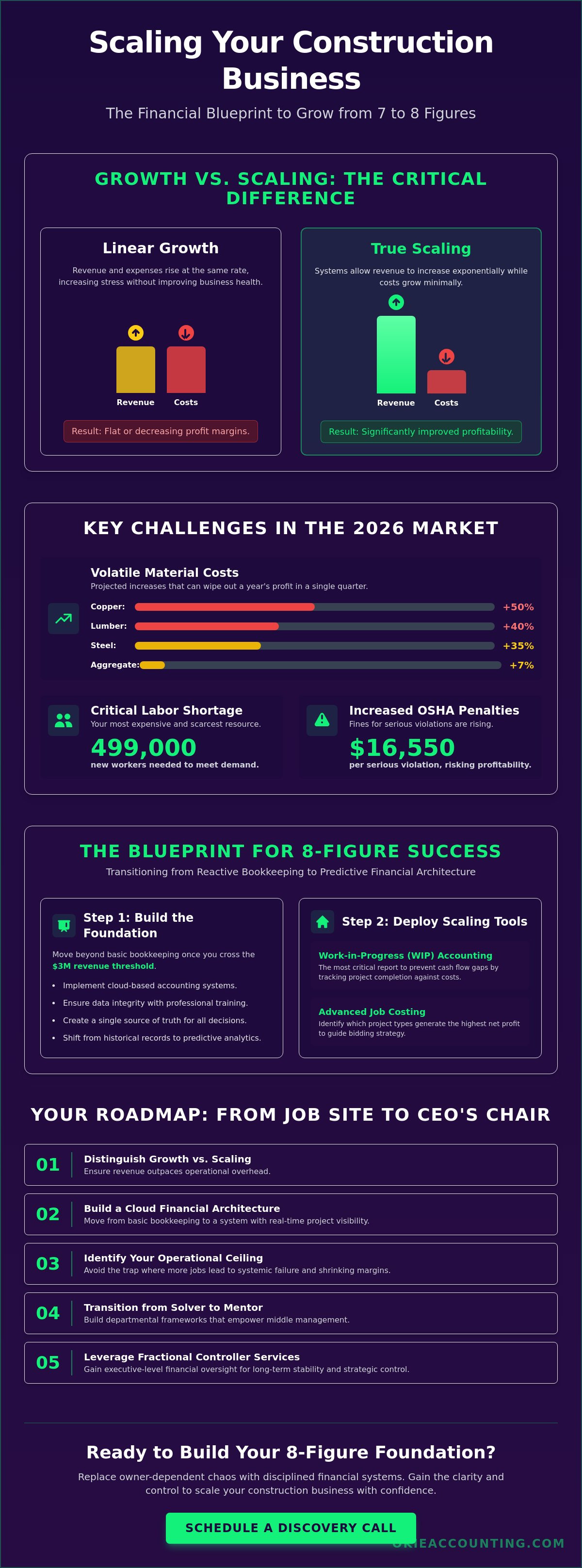
Scaling a construction firm is often confused with simply growing one. Growth is a linear process where your revenue and your expenses rise at the same rate. If you double your project load but also double your overhead, you haven't actually improved the health of your business; you've just increased your stress. Real scaling occurs when you build systems that allow your revenue to increase at a significantly faster rate than your costs. Understanding how to scale a construction business requires a shift from chasing more leads to engineering a more efficient machine.
Many owners fall into the "Hustle Trap," believing that a full pipeline is the ultimate indicator of success. However, in the 2026 market, volume without a structural framework is a liability. With the industry needing an estimated 499,000 new workers to meet current demand, labor is your most expensive and scarcest resource. If your growth relies solely on adding more bodies to a project without refining your internal processes, your profit margins will inevitably collapse under the weight of inefficiency.
The Linear Growth Trap in Construction
The linear growth trap happens when an owner-operator tries to expand by duplicating themselves. They hire more crews and take on more debt to buy equipment, but they fail to implement the foundational principles of construction management required for oversight. This leads to "profit leak," where hidden costs in mobilization, unmanaged change orders, and administrative bloat eat away at the bottom line. You can identify if you are growing rather than scaling by looking at your net profit percentage. If that number stays flat or decreases as your top-line revenue hits $5M or $8M, you are trapped in linear growth.
2026 Trends Impacting Construction Scalability
The current economic environment demands a more disciplined approach to financial readiness. Material price volatility has become a permanent fixture of the landscape. Through April 2026, aggregate prices rose by 7.0%, while lumber and steel are projected to see increases of up to 40% and 35% respectively. These aren't just minor fluctuations; they are structural shifts that can wipe out a year's profit in a single quarter.
Successful firms are now utilizing AI-driven project management tools to reduce administrative friction and gain real-time visibility. This data-driven approach is no longer optional. To survive and thrive, you must move toward management accounting practices that prioritize profit protection over mere record-keeping. When you understand how to scale a construction business in this climate, you focus on protecting your margins through precise bidding and aggressive cash flow management rather than just winning the next bid.
Financial Architecture: Building a Foundation for 8-Figure Growth
Standard bookkeeping often suffices for smaller contractors who manage their operations by looking at the bank balance. However, once you cross the $3M revenue threshold, this reactive approach becomes a significant liability. To understand how to scale a construction business, you must transition from "tax-ready" books to "growth-ready" financial architecture. This shift involves moving beyond simply recording historical transactions to building a system that predicts future performance. A research-based analysis of growth strategies suggests that structural integrity in financial management is as vital as the physical structures you build. Without real-time visibility into your cash position, you're essentially flying blind into your next eight-figure expansion.
Modern scalability depends on cloud-based accounting systems that provide instant access to project health. It's not enough to have the software; your team must know how to use it with precision. Investing in professional QuickBooks training for contractors ensures that your administrative staff can maintain the integrity of your data. This creates a single source of truth for every bidding and hiring decision you make. When your internal systems are optimized, you can focus on high-level strategy rather than correcting entry errors.
Work-in-Progress (WIP) Accounting as a Scaling Shield
WIP accounting is the most critical report for any firm looking to scale safely. It prevents the common disaster of "borrowing from Peter to pay Paul" by clearly identifying overbillings and underbillings across all active contracts. We define WIP accounting as the bridge between current cash and future liability. By tracking the percentage of completion against costs incurred, you protect your business from sudden cash flow gaps that occur when projects reach the finish line but the funds have already been spent. If you're unsure how your current reports stack up, you can schedule a discovery call to review your financial structure.
Advanced Job Costing for Profit Protection
Scaling requires you to know exactly which project types generate the highest net profit. Advanced job costing moves beyond simple expense tracking into granular, project-based data. When you analyze your margins at this level, you can identify if a specific niche is truly scalable or if it's merely consuming resources. This data-driven approach allows you to double down on profitable work and eliminate projects that drain your capital. For a deeper dive into the specific metrics you should be tracking, refer to our guide on Key Financial KPIs for Construction. Mastering these numbers is the only way to ensure how to scale a construction business leads to long-term stability rather than a financial collapse.
Operational Capacity and the Scaling Roadblock Paradox
A growing backlog is often viewed as a sign of health, yet taking on more jobs is actually the primary cause of construction business failure. This is the scaling roadblock paradox. As you increase volume, your operational ceiling becomes a hard limit. This ceiling represents the maximum amount of work your current staff and systems can manage without losing quality or profit. Pushing past this limit without systematic adjustments leads to leakage, where unmanaged overhead and project delays erode your bottom line. Learning how to scale a construction business requires you to implement internal controls that protect your capital as your footprint expands.
Predicting your capital needs is the first step in raising that ceiling. Utilizing construction cash flow forecasting allows you to see the financial impact of new contracts before you sign them. This foresight is essential when material prices for lumber are rising by 20% to 40% and steel by 15% to 35% in 2026. You cannot afford to discover a cash shortage in the middle of a major project. Accurate forecasting ensures you have the liquidity to handle these volatile inputs while maintaining your growth trajectory.
The Cash Gap: Surviving the Growth Spurt
Rapid expansion creates a cash gap because you must fund labor and materials long before you receive progress payments. If you plan to fund a 20% increase in volume, you need to calculate the exact working capital required to cover that float. Managing vendor payments and payroll during this phase requires more than just a line of credit. Utilizing strategic accounts with The CEO Creative can help you manage branding and office expenses with net 30 terms, preserving your cash for job-site costs. This growth also requires lender-ready financials. As of May 2026, variable interest rates for SBA 7(a) loans are approximately 9% to 11.5% APR. Securing these rates depends on having clean, professional reports that prove your business's stability to potential lenders.
Standardizing the "Un-standardizable"
Scaling is impossible if every project is handled differently. You must create SOPs for financial workflows just as you do for field work. A uniform Chart of Accounts is the backbone of multi-project management. It ensures that data from one job site is comparable to the next. When your data is standardized, you can effectively delegate tasks to your administrative team. This transition is a core part of how to scale a construction business, as it allows you to move from micro-managing every invoice to overseeing a department that runs on proven, repeatable systems.
Strategic Delegation: Hiring for Growth vs. Hiring for Survival
Most contractors hire only when the pressure of a missing role becomes unbearable. This is "hiring for survival," a reactive approach that simply fills a hole to keep the current machine running. True scaling requires "hiring for growth," which involves building departments and systems that can function independently of the owner's daily input. When you learn how to scale a construction business, your primary objective shifts from being the Chief Problem Solver to becoming a Strategic Mentor. This transition is only possible when you define clear roles and responsibilities that eliminate owner-dependency at every level of the organization.
Delegation fails when managers are forced to fly blind. To succeed, your leadership team needs access to high-level data that informs their daily decisions. Implementing management accounting frameworks provides your department heads with the visibility they need to manage their own budgets and timelines. By providing these structural tools, you empower your staff to take ownership of their results. This reduces the administrative friction that typically occurs when an owner tries to maintain control over every granular detail of a project.
The Role of the Fractional Controller in Scaling
There comes a point where standard bookkeeping is no longer sufficient to guide your firm's trajectory. This is the moment to transition toward Fractional Controller Services. While a bookkeeper records what happened in the past, a controller uses that data to build a strategy for the future. They interpret complex financial reports to guide eight-figure business decisions, ensuring your growth remains profitable. In the ecosystem of a healthy firm, a fractional controller protects the profit that the project manager creates.
Building an Accountable Culture
Scaling requires a culture of accountability where every team member understands their impact on the bottom line. You can achieve this by using financial KPIs to measure performance without resorting to micromanagement. This creates a feedback loop where field data from completed projects directly informs the bidding process for the next contract. When project managers are given true budget ownership and the data to track it, they become invested in the firm's long-term stability. If you're ready to build the leadership structure your business deserves, book a discovery call today to explore our fractional controller and management accounting options.
The 2026 Roadmap: Implementing Fractional Financial Leadership
Scaling your firm is not a matter of chance; it's a matter of architectural sequence. The journey from a seven-figure plateau to an eight-figure powerhouse follows a specific, disciplined roadmap: Infrastructure, Visibility, Delegation, and finally, Scale. You cannot skip the infrastructure phase and expect your business to survive the weight of new projects. At Okie Accounting Group LLC, we specialize in building this structural framework for construction firms, ensuring that your back-office systems are as resilient as the buildings you construct.
Understanding how to scale a construction business means recognizing that your financial systems must evolve before your project list does.
Many owners hesitate to hire executive-level financial help due to the high cost of a full-time CFO. Fractional leadership offers a cost-effective alternative, providing you with C-suite expertise without the six-figure salary burden. By utilizing our Fractional Controller Services, you gain access to the strategic oversight required to navigate 2026's volatile market inputs and labor shortages. We recommend a monthly financial review as the essential pulse of your scaling firm. This meeting shifts your focus from historical data to future strategy, allowing you to make bidding and hiring choices based on facts rather than intuition.
Transitioning to High-Level Oversight
The transition from "doing the books" to "reviewing the strategy" is a psychological hurdle for many founders. However, the ROI of professional financial oversight is found in the mistakes you don't make. It's found in the overbillings you catch early and the low-margin projects you decline. To begin this shift, you must assess your current financial readiness for growth. If your reports aren't yet accurate enough to secure the flexible SBA terms available in the current market, your first step is refining your data integrity through specialized training and system setup.
Conclusion: Your Path to an 8-Figure Firm
Building an eight-figure construction company requires a pragmatic shift in how you view your role as an owner. You aren't just a builder; you're the architect of a complex financial and operational machine. By implementing the systems discussed in this framework, you move toward a state of clarity, control, and genuine freedom. A self-sustaining business that runs without your constant presence isn't a dream. It's the natural result of a well-engineered foundation. When you master how to scale a construction business through disciplined financial leadership, you protect your profits and your legacy. If you're ready to audit your scaling readiness and build a firm that lasts, schedule a consultation with Okie Accounting Group LLC today.
Engineering Your Growth Foundation
Transitioning from a hands-on builder to a strategic CEO requires more than just a larger crew. It demands a structural shift in how you process financial data and delegate authority. By implementing cloud-based systems and rigorous job costing, you move beyond the daily firefighting that limits your potential. You've learned that how to scale a construction business is fundamentally a challenge of systems; once the foundation is set, the growth becomes predictable rather than chaotic.
Okie Accounting Group LLC provides the specialized construction industry expertise required to navigate this transition. Led by strategic mentor Sarah O’Quinn, our team implements the cloud-based accounting systems and financial reporting frameworks that provide real-time visibility into your firm's health. Ready to build a scalable financial foundation? Explore our Fractional Controller services.
The path to an eight-figure firm is open to those who prioritize structural integrity over simple volume. With the right systems in place, your business can finally run without your constant presence, giving you the freedom to focus on the legacy you're building. Your firm is ready for its next level; it's time to build the structure that supports it.
Frequently Asked Questions
How do I know if my construction business is ready to scale?
You are ready when your current systems produce consistent net profits and your project backlog consistently exceeds your operational capacity. Readiness is defined by having "clean" financial data and a middle management team that can execute field work without your daily intervention. If you can step away from the job site for a week without a project stalling, you have the foundational stability required to begin adding volume.
What is the difference between growing and scaling a construction company?
Growth is a linear process where your revenue and your expenses rise at the same rate. Scaling is the strategic ability to increase revenue at a significantly faster rate than your costs. To understand how to scale a construction business, you must focus on building repeatable systems and automation. Scaling allows you to double your project load without needing to double your administrative overhead or office staff.
Why do construction companies fail when they try to grow too fast?
Most failures occur due to the "cash gap" where mobilization costs and payroll for new contracts outpace incoming progress payments. When a firm lacks real-time visibility into their Work-in-Progress (WIP) reports, they often use funds from new projects to finish old ones. This creates a cycle of debt that collapses quickly when material prices spike or a single large payment is delayed by a general contractor.
Do I need a full-time CFO to scale to $10 million in revenue?
You don't need a full-time executive at that stage; in fact, the high salary can actually hinder your cash flow. Fractional Controller Services provide the same level of strategic financial oversight and C-suite expertise at a much lower cost. This model allows you to access high-level cash flow forecasting and financial reporting while keeping your overhead lean as you move toward eight figures.
What are the most important financial KPIs for a scaling contractor?
You should prioritize your Net Profit Margin, Days Sales Outstanding (DSO), and your Underbilling versus Overbilling ratios from your WIP report. These metrics reveal the actual health of your projects beyond the current balance in your bank account. Tracking these specific KPIs ensures that your scaling efforts are generating actual wealth rather than just increasing your administrative workload and liability.
How can I improve my construction cash flow while expanding?
Implement rigorous cash flow forecasting and tighten your billing cycles to match your specific project milestones. Negotiating better terms with material vendors and ensuring your project managers submit change orders immediately also protects your liquidity. In 2026, with SBA 7(a) variable rates between 9% and 11.5%, maintaining high liquidity is much more cost-effective than relying on high-interest lines of credit to fund your growth.
What role does QuickBooks Online play in scaling a construction firm?
QuickBooks Online serves as the central hub for real-time data integration between your field operations and the back office. It allows for granular job costing and automated financial reporting that generalist accounting systems cannot match. When paired with professional QuickBooks training, it empowers your administrative staff to maintain the data integrity needed for how to scale a construction business safely and profitably.
How do I stop being the bottleneck in my construction business?
You must transition from the "Chief Problem Solver" to a strategic mentor by documenting every financial and operational workflow into Standard Operating Procedures (SOPs). Delegation only works when you provide your team with the data and authority to make independent decisions. Shifting your focus to high-level oversight ensures the business runs on disciplined systems rather than your personal stamina or constant presence.



Comments