
HVAC Bookkeeping: 2026 Profit Protection Framework

Why does your bank account often feel empty in November when your technicians were booked solid all through July? It's a frustrating cycle where high-volume summer installs don't always translate into year-round stability. You aren't alone in feeling that seasonal revenue swings and messy QuickBooks files make it difficult to see your true profit margins per technician. Effective bookkeeping for HVAC contractors requires more than just recording past transactions; it demands a structural framework designed for the specific mechanics of the trade.
We understand that you need more than basic administrative support to scale your firm nationwide. You deserve a system that offers real-time visibility into job costs and technician performance. In this guide, we'll show you how to transform your financial data into a 2026 profit protection framework. We will explore how to automate your systems, master job costing, and utilize strategic oversight to ensure your business remains resilient through every shoulder season. This transition from simple record-keeping to a disciplined financial infrastructure is the key to securing your margins and achieving long-term growth.
Beyond the Service Call: Why Specialized HVAC Bookkeeping is Non-Negotiable
Specialized bookkeeping for HVAC contractors is not a luxury; it's the foundation of a scalable enterprise. Unlike retail or standard service businesses, HVAC firms operate on a project-based model where cash flow and profitability are often decoupled. You might have a healthy balance in your bank account today while simultaneously owing significant sums for equipment and labor on projects that aren't yet complete. Without a specialized system, you're essentially guessing at your financial health rather than managing it.
A generalist bookkeeper often lacks the technical depth to manage work-in-progress (WIP) accounts or complex job costing. They might record a large equipment purchase as a simple expense the moment the invoice arrives. This distorts your monthly profit and loss statement, making a profitable month look like a loss. By applying fundamental Cost Accounting Principles, we ensure that costs are matched to the revenue they generate. This level of precision creates the financial readiness required to survive the industry's inherent volatility.
Seasonal swings are the primary stressor for most firm owners. Without a strategic foundation, the "shoulder seasons" can trigger a cash crunch that threatens your ability to retain top talent. Our philosophy focuses on building a structural framework that anticipates these cycles. We don't just record history; we build the systems that protect your margins during the summer peaks and provide stability during the winter lulls.
The High Cost of Generalist Bookkeeping
When overhead isn't correctly allocated, your pricing becomes guesswork. Many firms fail to account for the "burdened" labor rate, which includes payroll taxes, workers' comp, and benefits. If your books don't reflect these costs per hour, your quotes will consistently underperform. During peak seasons, a lack of specialized oversight often leads to unbilled revenue. Technicians finish jobs, but if the paperwork doesn't trigger an immediate invoice, your cash stays locked in the field. This leaves you "flying blind" when the phone stops ringing in November.
Transitioning from Administrative Tasks to Structural Frameworks
Your financial data should be a proactive decision-making tool. It isn't just a record for a tax file; it's the roadmap for your growth. Establishing a structural framework allows you to see exactly which technicians are most efficient and which service lines offer the best return on investment. This is where fractional controller oversight provides a competitive advantage. Instead of just reacting to your bank balance, you gain the ability to forecast and plan with quiet confidence. Data accuracy is the mechanism that secures your long-term stability and allows you to scale nationwide.
The Anatomy of Profit: Mastering HVAC Job Costing and Chart of Accounts
Job costing is the heartbeat of a profitable HVAC firm. It's the disciplined process of assigning every dollar spent on materials, equipment, and labor to a specific project. For many, bookkeeping for HVAC contractors feels like an administrative burden, but when executed as a structural framework, it reveals exactly where you're generating profit and where your margins are eroding. Without this granular view, you risk completing high-revenue installs that actually result in a net loss once all variables are settled.
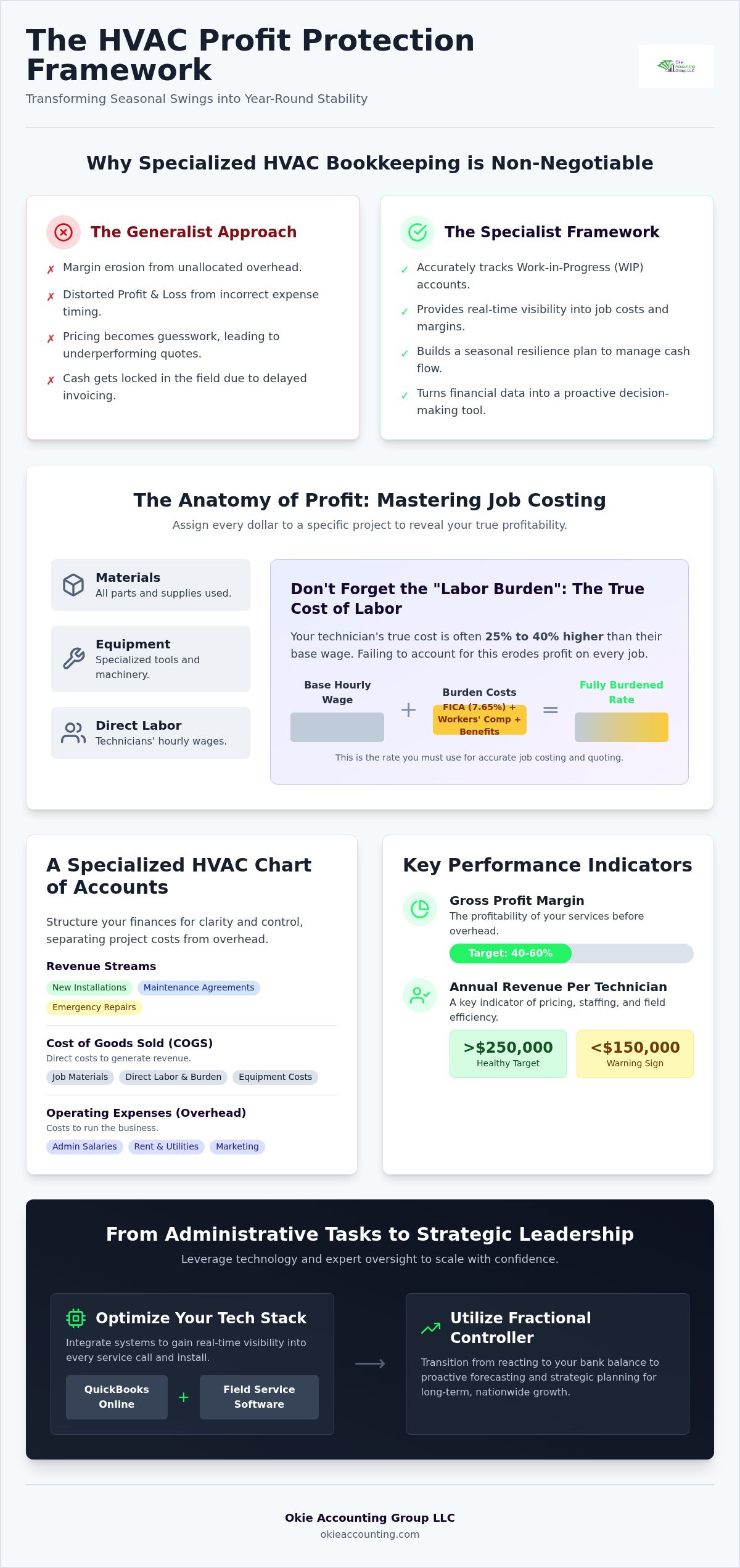
The core components of job costing include materials, specialized equipment, and direct labor. However, many firm owners overlook the "labor burden," which is the true cost of keeping a technician on the road. This burden includes FICA taxes, which for 2026 sit at 6.2% for Social Security and 1.45% for Medicare, alongside workers' compensation, insurance, and benefits. Industry data indicates the burdened rate is often 25% to 40% higher than the base hourly wage. Capturing these "hidden" costs is a fundamental pillar of our construction bookkeeping services, where we help you build the infrastructure to track these variables automatically.
Designing a Specialized HVAC Chart of Accounts
A Chart of Accounts serves as the structural map of your firm’s financial health. To gain real-time visibility, you must categorize revenue by service type, such as new installations, maintenance agreements, and emergency repairs. This allows you to distinguish between high-margin service work and high-volume capital projects. By strictly separating Cost of Goods Sold (COGS) from general operating expenses, you can accurately target the industry benchmark of a 40% to 60% gross profit margin. This level of organization ensures that fixed overhead costs aren't quietly swallowing your project-level profits.
Technician Efficiency and Labor Tracking
Tracking billable versus non-billable time is essential for maintaining a healthy bottom line. Well-run HVAC companies often generate over $250,000 in revenue per technician annually. If your financial reporting shows a figure below $150,000, it's a clear signal of issues with pricing, staffing, or field efficiency. Daily time tracking isn't just a payroll task; it's a strategic tool for identifying a money-losing service call before it impacts your quarterly performance. If you're ready to gain this level of control over your data, consider scheduling a discovery call to discuss your firm's specific growth goals.
Seasonal Resilience: Managing Cash Flow and Payroll Complexity in HVAC
The most common objection we hear from firm owners is that they don't have the budget for specialized support during the shoulder seasons. It's a natural reaction to want to cut costs when the phone stops ringing. However, effective bookkeeping for HVAC contractors isn't a variable expense you trim during slow months; it's the structural framework that ensures you have the reserves to survive them. Cutting your financial oversight when cash is tight is like turning off your GPS when you're low on fuel. You need clarity most when the margin for error is smallest.
By implementing proactive construction cash flow management, you shift from reacting to your bank balance to operating with financial readiness. This methodology allows you to anticipate the dip in service calls and plan your capital expenditures accordingly. Instead of wondering if you can meet payroll in November, you'll know exactly how much of your July surplus was true profit and how much needed to be sequestered for seasonal stability. This disciplined approach eliminates the "feast or famine" anxiety that plagues many trade businesses.
The Cash Flow Forecast: Your 2026 Survival Map
Proactive forecasting moves your firm away from "bank balance accounting," where decisions are made based on today's available cash. Through management accounting, we identify cash leaks such as uncollected rebates or inefficient inventory stocking. A well-constructed forecast accounts for the 2026 restored 100% bonus depreciation, allowing you to time equipment purchases for maximum tax benefit without draining your operational reserves. Setting aside these reserves during peak summer and winter months creates a buffer that protects your firm's long-term health.
Managing Payroll and Compliance for Field Teams
HVAC payroll is notoriously complex. You aren't just managing flat hourly rates; you're balancing overtime, performance spiffs, and installation commissions. For 2026, compliance requirements are more rigorous. The Social Security wage base has increased to $184,500, and you must accurately track the additional 0.9% Medicare tax for high-earning technicians. Miscalculating these figures or the 6.0% FUTA tax rate can lead to costly penalties that erode your hard-earned margins. Utilizing specialized construction payroll services ensures that your field team is paid accurately and on time, which is the single most important factor in technician retention. Accurate payroll data also flows back into your job costing, giving you a precise view of your true labor costs on every ticket.
Building Your Tech Stack: QuickBooks Online and Field Service Integration
QuickBooks Online (QBO) has solidified its position as the gold standard for nationwide HVAC firms. It provides the cloud-based flexibility required to manage technicians across multiple regions while maintaining a centralized financial record. However, the software is only as effective as the data entered into it. This is why QuickBooks setup and training for your field staff is a non-negotiable step in building your structural framework. When your team understands how their inputs in the field impact the back-office reporting, data integrity becomes a shared responsibility.
Most successful contractors leverage field service management (FSM) software like ServiceTitan, Housecall Pro, or Jobber. Syncing these platforms with QBO eliminates manual data entry and reduces the risk of human error. When a technician closes a ticket in the field, the invoice, material costs, and labor hours should flow directly into your accounting system. This integration ensures that your bookkeeping for HVAC contractors remains current, providing a real-time view of your WIP and job profitability. This automated flow is the only way to maintain accuracy while scaling a high-volume service business.
Optimizing QuickBooks for HVAC Operations
To gain deep visibility, you must move beyond basic settings. Utilizing Classes and Locations allows you to track different service divisions, such as commercial installs versus residential maintenance, as distinct profit centers. Configuring a detailed "Items" list is equally critical for accurate material tracking. This level of granularity ensures that every capacitor or blower motor is accounted for in your COGS. For a deeper dive into these technical configurations, refer to our Mastering QuickBooks for Contractors guide for setup tips.
Automation vs. Human Oversight
Automation is a powerful tool for processing bank feeds and invoices, especially with the August 2026 updates that include Bill Pay Elite in Advanced plans. However, automation cannot replace professional discipline. Human oversight is essential for complex job cost reconciliation and making necessary WIP adjustments at month-end. Your tech stack should serve your strategic goals, not dictate them. If your current systems feel disjointed or messy, schedule a discovery call today to align your technology with a scalable financial infrastructure.
From Admin to Strategy: Scaling Your HVAC Firm with Fractional Controller Oversight
Scaling an HVAC firm from a local operation to a nationwide presence requires a fundamental shift in how you view your financial data. Many owners spend years "doing the books" or managing a bookkeeper who simply records history. To lead a firm effectively, you must transition from administrative oversight to strategic leadership. This evolution is where fractional controller services become indispensable. They provide the high-level CFO insights necessary to navigate complex growth without the overhead of a full-time executive.
Monthly financial reviews are the cornerstone of this strategic transition. It isn't enough to see a profit and loss statement 20 days after the month ends. You need a partner who helps you interpret that data to identify trends before they become liabilities. While standard bookkeeping for HVAC contractors keeps your records clean, controller-level oversight ensures those records drive your expansion strategy. This proactive discipline builds the structural integrity required to support a larger fleet and a broader service area.
Interpreting the Data: KPIs That Matter
Understanding your Gross Profit Margin per Job Type is the only way to find your "sweet spot." While the industry average net profit margin is approximately 5.3%, top-performing firms reach 10% to 25% by aggressively targeting their most profitable service lines. We also monitor your Current Ratio to measure your firm's immediate financial health and ability to cover short-term obligations. KPIs are the vital signs of your business infrastructure. By tracking these metrics, we move beyond guessing and start making data-driven choices that protect your bottom line.
The Roadmap to Nationwide Expansion
As you scale, the risk of internal errors or fraud increases. Establishing rigorous internal controls is a primary focus of our strategic partnership. We help you build a system of checks and balances that protects your assets while you focus on field operations. Our team ensures your financials are always lender-ready. Whether you're seeking capital for a new fleet or looking to acquire a competitor, having meticulous, forward-thinking oversight is essential for securing favorable terms. Partnering with Sarah O'Quinn means you have a dedicated expert invested in your stability. We don't just manage your accounts; we build the financial framework that allows your firm to thrive across the United States.
Securing Your Firm's Financial Future with Structural Integrity
Building a resilient business requires moving beyond the daily grind of service calls to focus on the structural health of your firm. We've explored how specialized job costing and integrated technology create the visibility you need to protect your margins. By mastering labor burden and seasonal cash flow forecasting, you can transform your financial data from a historical record into a proactive roadmap for nationwide growth. This transition is what separates a busy contractor from a strategic business leader.
Effective bookkeeping for HVAC contractors isn't just about clean files; it's about establishing the quiet confidence that comes from accurate, real-time data. At Okie Accounting Group, we specialize in the construction and HVAC sectors, offering fractional controller expertise and QuickBooks Online certified training to empower your team. We're ready to serve as your strategic partner in building a scalable enterprise that withstands every seasonal shift.
You've built a strong foundation in the field. Now, let's build the financial infrastructure that ensures your hard work translates into long-term stability and success.
Frequently Asked Questions
Why is job costing so important for HVAC contractors?
Job costing is the mechanism for assigning direct costs like materials and equipment to specific projects to ensure every ticket is profitable. Without it, you cannot identify which service lines are eroding your margins or which technicians are most efficient. It provides the granular data needed to hit industry gross profit targets of 40% to 60%. This structural framework allows you to price jobs accurately and secure long-term stability.
Can I use a general bookkeeper for my HVAC business?
A generalist bookkeeper often misses the technical complexities of project-based accounting, such as work-in-progress (WIP) tracking and labor burden. Specialized bookkeeping for HVAC contractors requires an understanding of how field service data flows into financial records. Without this niche expertise, your financial reports might reflect bank balances but fail to show true project profitability. Choosing a specialized partner ensures your books serve as a strategic tool for nationwide growth.
How does seasonality affect HVAC bookkeeping?
Seasonality creates significant revenue swings that can trigger cash crunches during shoulder seasons if not managed properly. Effective bookkeeping involves proactive cash flow forecasting to sequester reserves during peak summer and winter months. This disciplined approach ensures you have the financial readiness to meet payroll and overhead when service volume drops. It shifts your firm from reactive "bank balance accounting" to a stable, year-round structural framework that protects your bottom line.
What is the best accounting software for HVAC contractors in 2026?
QuickBooks Online remains the gold standard for HVAC firms in 2026 due to its cloud-based flexibility and robust integration capabilities. When synced with field service management platforms like ServiceTitan or Housecall Pro, it creates a seamless flow of data from the technician to the back office. This tech stack provides the real-time visibility necessary for scaling operations nationwide. We provide specialized setup and training to ensure your software supports your strategic business goals.
How do I track technician labor costs accurately?
Accurate labor tracking requires a system where technicians record billable and non-billable time daily through an integrated field service platform. This data must flow directly into your accounting software to be reconciled against specific job tickets. By capturing actual hours worked on each install or repair, you can calculate the true cost of labor for every project. This level of detail is essential for identifying inefficiencies and maintaining high revenue per technician.
What is labor burden and why does it matter for HVAC profit?
Labor burden represents the total cost of an employee, including base wages, payroll taxes, workers' compensation, and benefits. For the 2026 tax year, this includes the 6.2% Social Security tax on wages up to $184,500 and the 1.45% Medicare tax. Industry data shows the burdened rate is typically 25% to 40% higher than the hourly wage. Failing to account for this burden leads to inaccurate job costing and underpriced service calls.
How often should I review my financial statements?
You should conduct a comprehensive review of your financial statements at least once a month to maintain operational clarity. These reviews allow you to monitor key performance indicators like your current ratio and gross profit margin per job type. Working with a fractional controller ensures you aren't just looking at numbers, but interpreting them to drive strategic decisions. Regular oversight helps identify cash leaks and ensures your firm remains on its roadmap for nationwide expansion.
Does Okie Accounting provide nationwide bookkeeping for contractors?
Yes, Okie Accounting Group LLC provides specialized bookkeeping and fractional controller services nationwide across the United States. Led by Sarah O'Quinn, our firm focuses on building scalable financial infrastructures for construction and specialty contractors. We deliver remote financial leadership and advisory support using cloud-based systems to ensure our clients gain clarity over their data regardless of their location. Our goal is to serve as a strategic partner in your long-term success.


Comments