
HVAC Bookkeeping: 2026 Profit Protection Framework

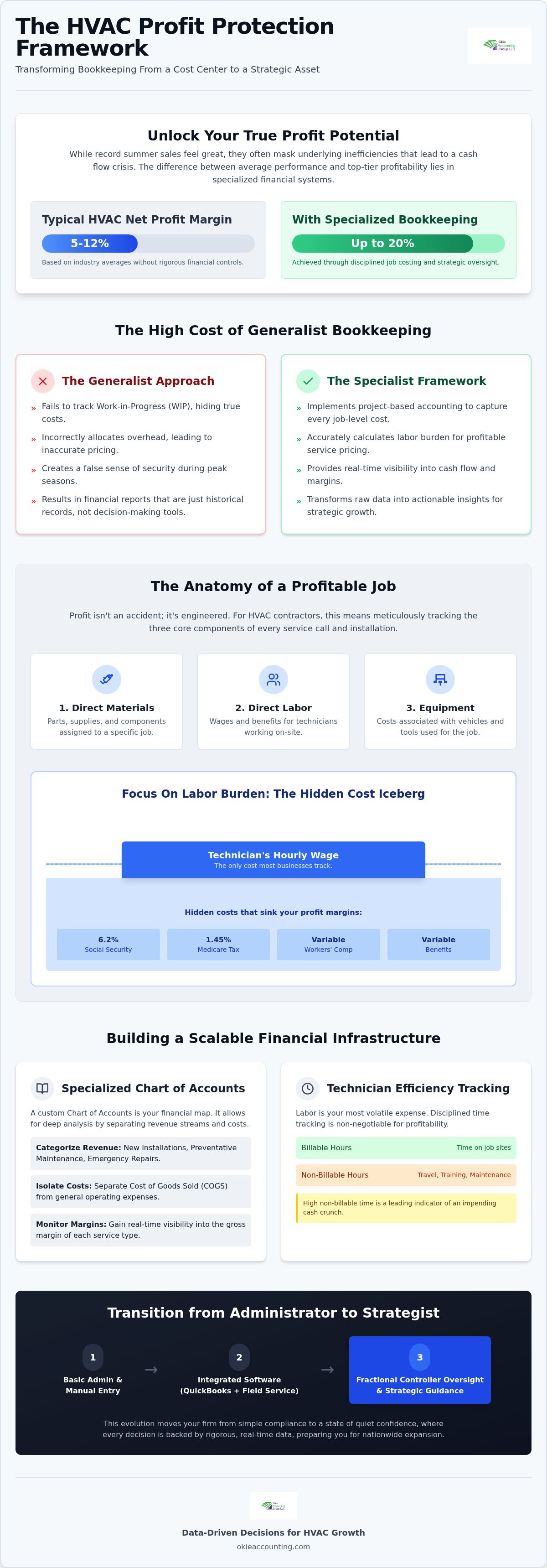
Why does a record-breaking summer of service calls so often lead to a silent cash flow crisis during the shoulder season? It's a frustrating reality for many, but the gap between high revenue and actual profit usually stems from a lack of structural oversight. Specialized bookkeeping for HVAC contractors is not just about recording history; it's about building a framework that protects your margins against every seasonal shift. While the average net profit margin for the industry often hovers between 5% and 12%, businesses with rigorous financial systems can reach benchmarks as high as 20%.
You likely already know that messy QuickBooks files and untracked job costs make it impossible to see which technicians are actually driving growth. This article provides a roadmap to transform that chaotic data into a disciplined financial system. You'll learn how to achieve real-time visibility into your expenses and move from simple administrative chores to a strategic partnership that scales. We'll walk through the 2026 Profit Protection Framework, focusing on automated job costing and the foundational systems required for long-term stability and nationwide expansion.
Beyond the Service Call: Why Specialized HVAC Bookkeeping is Non-Negotiable
HVAC bookkeeping is much more than a monthly tally of revenue and expenses. It's a specialized, project-based financial system designed to track the movement of parts, labor, and equipment across multiple job sites. Unlike retail or standard service industries, your business operates on thin margins and high seasonal variability. Effective bookkeeping for HVAC contractors requires a deep understanding of how to capture every dollar spent on a specific installation or service call. Without this granular focus, you're simply guessing at your profitability.
Generalist bookkeepers often treat every transaction as a simple line item. This approach fails to account for Work-in-Progress (WIP) or the complex nuances of job costing. When these details are overlooked, your financial reports might show a healthy bank balance while you're actually losing money on high-volume projects. At Okie Accounting, we believe in building a strategic foundation that prioritizes financial readiness. We don't just record history; we create a framework for your firm's future growth through disciplined data management.
The High Cost of Generalist Bookkeeping
A bookkeeper without industry expertise can inadvertently damage your bottom line. If they don't understand how to allocate overhead correctly, your pricing will likely be inaccurate. You might win every bid, but you won't clear enough profit to cover your fixed costs. During peak seasons, a failure to track unbilled revenue creates a false sense of security. You see a flurry of activity, but your books don't reflect the true cost of the labor and materials already deployed. This leaves you flying blind during the inevitable shoulder seasons when cash reserves become critical for survival.
Transitioning from Administrative Tasks to Structural Frameworks
Your books should function as a decision-making tool rather than just a compliance record for tax season. By applying management accounting principles, we turn raw data into actionable insights. This shift allows you to see exactly which technicians are most efficient and which service types offer the highest returns. As your firm scales, the need for high-level oversight grows. Integrating fractional controller services provides the strategic guidance you need to manage complex payroll and nationwide expansion without the overhead of a full-time executive. This transition establishes a sense of quiet confidence, ensuring your business decisions are always backed by rigorous data accuracy.
The Anatomy of Profit: Mastering HVAC Job Costing and Chart of Accounts
Profit in the HVAC industry isn't a vague end-of-year goal; it's a metric won or lost on every individual service call and installation. The job costing mechanism acts as the heartbeat of a truly profitable firm, allowing you to see exactly where your capital is deployed. For specialized bookkeeping for HVAC contractors, this means meticulously tracking three essential components: direct materials, direct labor, and equipment. When you fail to assign these costs to specific jobs, your financial reports become generic summaries that hide operational leaks.
One of the most frequent oversights in contractor accounting is the failure to calculate labor burden. A technician's cost to your firm isn't just their hourly wage. It includes the "hidden" expenses such as the employer's 6.2% Social Security contribution, the 1.45% Medicare tax, workers' compensation insurance, and any provided benefits. If you aren't factoring these into your job costing, you're likely underpricing your services. This granular level of detail is a core component of construction bookkeeping services, which prioritize building a scalable infrastructure over simple data entry.
Designing a Specialized HVAC Chart of Accounts
A Chart of Accounts is the structural map of your firm’s financial health. To gain real visibility, you must categorize revenue by service type, such as new installations, preventative maintenance, and emergency repairs. This allows you to distinguish between high-margin service work and high-volume installation projects. By separating Cost of Goods Sold (COGS) from general operating expenses, you can monitor your gross margin in real time. For guidance on standard accounting methods and expense classification, the IRS Tax Guide for Small Business provides the foundational regulatory framework required for compliant reporting.
Technician Efficiency and Labor Tracking
Labor is your most volatile expense, making daily time tracking a non-negotiable habit for your field staff. You need to distinguish between billable hours spent on a job site and non-billable time spent on travel, training, or vehicle maintenance. If a technician’s unbillable time exceeds industry benchmarks, it signals an efficiency problem that will eventually cause a cash crunch. Identifying a money-losing service call before it happens requires constant oversight of these labor ratios. This disciplined approach ensures that every hour logged contributes to the firm's overall stability. If you're ready to move beyond basic spreadsheets, you can schedule a discovery call to discuss building a more robust financial framework for your business.
Seasonal Resilience: Managing Cash Flow and Payroll Complexity in HVAC
A common objection among firm owners is the belief that they can't afford professional bookkeeping for HVAC contractors during the slow shoulder seasons. This reactive mindset often leads to a cycle of seasonal stress where the profits from a busy summer are consumed by poor oversight in the autumn. In reality, the quiet months are the most critical time for financial discipline. Implementing a robust framework for construction cash flow management ensures that your business remains liquid even when the service calls drop. True financial readiness isn't about surviving the peak; it's about engineering your firm to thrive during the valleys.
The transition from administrative bookkeeping to a strategic partnership allows you to anticipate these swings. Instead of wondering if you can meet your obligations in November, you'll have the data to prove your stability. This proactive stance alleviates the industry-specific stress that keeps many owners awake at night. By treating your financial data as a structural asset, you gain the clarity needed to make confident decisions about hiring, equipment purchases, and marketing spend throughout the entire year.
The Cash Flow Forecast: Your 2026 Survival Map
Bank balance accounting is a dangerous habit that hides the true health of your firm. Relying on what's currently in the bank doesn't account for upcoming equipment invoices or the payroll taxes due next month. Proactive forecasting allows you to set aside reserves during the high-demand summer and winter months. We use management accounting to identify hidden cash leaks, such as uncollected rebates or inefficient inventory stocking. This map provides a clear view of your financial runway, ensuring you never have to choose between making payroll and paying your suppliers.
Managing Payroll and Compliance for Field Teams
HVAC payroll is notoriously complex. Your technicians often earn a mix of hourly wages, overtime, spiffs for service agreements, and commissions on equipment sales. Tracking these variables manually is an invitation for errors and compliance risks. With federal rates such as the 6.2% Social Security tax on wages up to $184,500 and the 1.45% Medicare tax, the administrative burden is high. Utilizing specialized construction payroll services protects your firm from costly penalties. We ensure that every spiff and commission is tracked accurately, maintaining both employee trust and regulatory compliance as you scale your operations nationwide.
Building Your Tech Stack: QuickBooks Online and Field Service Integration
Modern bookkeeping for HVAC contractors relies on a seamless connection between the field and the back office. QuickBooks Online serves as the gold standard for this financial infrastructure because it provides the cloud-based accessibility required for nationwide operations. However, the software is only as effective as the data entering it. For many firms, the disconnect between a technician’s mobile app and the accounting ledger is where profit leaks begin. Establishing a disciplined tech stack ensures that every service call is captured, invoiced, and reconciled without manual intervention.
Integrating Field Service Management (FSM) platforms like ServiceTitan, Housecall Pro, or Jobber with your accounting software creates a single source of truth. This sync eliminates the need for double data entry, which is the primary source of accounting errors in the industry. To maintain this integrity, your team requires specialized QuickBooks setup and training. When your field staff understands how their inputs affect the firm’s financial health, they become active participants in protecting your margins.
Optimizing QuickBooks for HVAC Operations
A standard setup isn't enough to manage the complexities of a project-based business. We utilize Classes and Locations to track the performance of different service divisions, such as residential maintenance versus commercial installations. This allows you to identify which segments of your business are truly profitable and which are merely generating volume. Configuring your "Items" list correctly is equally vital for accurate material tracking. For a deep dive into these configurations, refer to our guide on Mastering QuickBooks for Contractors to ensure your foundation is secure.
Automation vs. Human Oversight
Technology should serve your strategy, not dictate it. Automation saves significant time by handling bank feeds and initial invoice processing, but it cannot replace professional discipline. Human oversight remains essential for complex tasks like job cost reconciliation and Work-in-Progress (WIP) adjustments. These adjustments ensure that your monthly financial statements reflect actual earned revenue rather than just cash flow. If your current system feels more like a burden than a tool, you should schedule a discovery call to discuss building a more automated, reliable financial framework.
From Admin to Strategy: Scaling Your HVAC Firm with Fractional Controller Oversight
Scaling an HVAC firm requires a fundamental shift in how you view your role as an owner. You've already established the foundational job costing and the integrated tech stack discussed in previous sections. Now, the challenge is moving from the daily grind of administrative tasks to high-level strategic leadership. Specialized bookkeeping for HVAC contractors provides the raw data, but it's the interpretation of that data that drives growth. This is the point where many firms plateau because they lack the structural oversight needed to manage increased complexity.
Transitioning to fractional controller services allows you to bridge this gap. You gain access to CFO-level insights and professional discipline without the overhead of a full-time executive salary. This partnership ensures that your financial reports aren't just records of the past, but maps for the future. Monthly financial reviews become your most valuable management tool, providing the quiet confidence that your firm is standing on a stable foundation as you prepare for nationwide expansion.
Interpreting the Data: KPIs That Matter
To lead effectively, you must focus on the metrics that actually impact your bottom line. Gross profit margin per job type is essential for identifying your "sweet spot," which is the specific service line that generates the highest return. You might find that residential retrofits provide a 50% margin while commercial maintenance only yields 30%. Without this clarity, you risk scaling your least profitable division. We also monitor your current ratio to ensure your firm has the immediate liquidity to handle operational spikes. KPIs are the vital signs of your business infrastructure.
The Roadmap to Nationwide Expansion
As you scale, the risk of internal error and fraud increases. Establishing rigorous internal controls is a non-negotiable step in protecting your growing assets. Meticulous oversight ensures that your financials are always lender-ready, which is critical when you need to secure capital for new fleets or facilities. Partnering with Sarah O'Quinn provides the disciplined, forward-thinking oversight required to navigate these complexities. Okie Accounting Group acts as your strategic partner, ensuring your financial health is managed with the same precision your technicians bring to the field. This disciplined approach transforms your books from a burden into your firm's greatest competitive advantage.
Securing Your Firm's Financial Future
Establishing a disciplined financial foundation is the primary difference between a firm that merely survives the off-season and one that scales with confidence. You've seen how specialized bookkeeping for HVAC contractors transforms chaotic data into a structural framework that protects your profit margins. By mastering job costing and integrating your field service software with QuickBooks Online, you gain the real-time visibility needed to manage your business with quiet confidence. Moving beyond basic administration to fractional controller oversight allows you to lead with data-driven clarity rather than seasonal guesswork.
Okie Accounting Group LLC is specialized in construction and HVAC operations, providing the fractional controller expertise and QuickBooks Online certified training required for nationwide growth. We understand the unique mechanics of your market and are dedicated to building the systems that ensure your long-term stability. Your financial data should be a tool for expansion, not a source of stress.
Ready to build a scalable financial infrastructure and reclaim control over your margins? Gain Financial Clarity with Okie Accounting’s Strategic Bookkeeping Services. Your path to operational clarity and seasonal resilience starts with a strategic partnership focused on your success.
Frequently Asked Questions
Why is job costing so important for HVAC contractors?
Job costing is the mechanism that reveals the true profitability of every service call and installation. It allows you to track direct materials, labor, and equipment against specific projects. Without this visibility, you can't identify which technicians are efficient or which service lines are underpriced. It prevents you from flying blind and ensures that high revenue actually translates into healthy net profit margins for the firm.
Can I use a general bookkeeper for my HVAC business?
While a generalist can record basic transactions, they often miss the industry-specific nuances required for specialized bookkeeping for HVAC contractors. HVAC firms require complex tracking of Work-in-Progress (WIP) and labor burden that generalists aren't trained to handle. A specialized partner builds a structural framework that protects your margins, whereas a generalist might only provide a historical record that lacks the strategic depth needed for scaling.
How does seasonality affect HVAC bookkeeping?
Seasonality creates significant revenue swings that can lead to cash flow crunches during shoulder seasons. Effective bookkeeping involves proactive forecasting to set aside reserves during peak summer and winter months. It ensures you have the liquidity to cover fixed costs and payroll when service demand drops. By maintaining a disciplined financial system year-round, you avoid the reactive stress that often plagues contractors during slower periods.
What is the best accounting software for HVAC contractors in 2026?
QuickBooks Online remains the gold standard for nationwide HVAC firms due to its cloud-based accessibility and robust integration capabilities. It syncs seamlessly with field service management software like ServiceTitan or Jobber, eliminating manual data entry errors. To maximize the platform's utility, specialized setup and training are required. This ensures your Chart of Accounts and item lists are configured to track the project-based data essential for your growth.
How do I track technician labor costs accurately?
Accurate labor tracking requires technicians to log billable and non-billable time daily through an integrated field service app. You must distinguish between time spent on a job site and hours dedicated to travel or training. This data should sync directly to your accounting software to calculate the true cost of every project. Consistent oversight of these labor ratios allows you to identify efficiency problems before they impact your firm's stability.
What is labor burden and why does it matter for HVAC profit?
Labor burden is the total cost of an employee beyond their gross hourly wage. It includes employer-paid taxes like Social Security and Medicare, workers' compensation insurance, and any provided benefits. If you don't factor these hidden expenses into your job costing, your pricing will be inaccurate. Understanding your true labor burden is essential for protecting your gross margins and ensuring every technician's work is actually profitable for the business.
How often should I review my financial statements?
You should conduct a comprehensive review of your financial statements at least once a month. This practice allows you to monitor key performance indicators like gross profit margin and your current ratio. Regular reviews provide the real-time visibility needed to make proactive business decisions rather than reactive ones. With fractional controller oversight, these meetings become strategic sessions that focus on long-term stability and preparing your firm for nationwide expansion.
Does Okie Accounting provide nationwide bookkeeping for contractors?
Yes, Okie Accounting Group LLC provides specialized bookkeeping and fractional controller services nationwide across the United States. Led by Sarah O'Quinn, our firm focuses on building scalable financial infrastructures for construction and specialty contractors. We deliver remote financial leadership and advisory support through cloud-based systems like QuickBooks Online. Our goal is to help you transition from basic administrative tasks to a strategic framework that supports your firm's long-term health.


Comments