
In-House vs. Outsourced Construction Accounting: The 2026 Strategic Guide
- Wendy Okie

- May 29
- 11 min read
What if the person sitting in your back office is actually the biggest bottleneck to your firm's growth? You've likely felt the sting of profit bleed from inaccurate job costing or the constant anxiety of keeping up with complex payroll regulations. It's frustrating to pay high overhead for administrative staff and still lack the real-time visibility needed to make fast, data-driven decisions on a job site. Choosing between in house vs outsourced construction accounting is a critical strategic pivot that determines whether your financial foundation is built on sand or solid rock.
We believe that clarity is the most valuable tool in your belt. This guide will help you discover the structural and financial differences between internal hires and specialized partnerships so you can build a scalable foundation for your firm. We'll explore the true costs of employment in 2026, the impact of restored 100% bonus depreciation under the One Big Beautiful Bill Act, and how moving toward specialized oversight replaces a single point of failure with a rigorous financial framework.
Key Takeaways
Implement project-centric accounting to capture the specific nuances of the construction lifecycle that traditional bookkeeping often misses.
Evaluate the structural costs of in house vs outsourced construction accounting by calculating the true expense of internal payroll taxes, benefits, and specialized training.
Strengthen your firm's financial readiness and bonding capacity through rigorous Work-in-Progress (WIP) reporting and Davis-Bacon Act compliance.
Utilize a two-step strategic framework to identify the specific revenue thresholds and visibility gaps that signal a need for a structural upgrade.
Transition from reactive administration to a strategic partnership that leverages real-time reporting to protect your project profit margins.
The Specialized Nature of Construction Financial Management
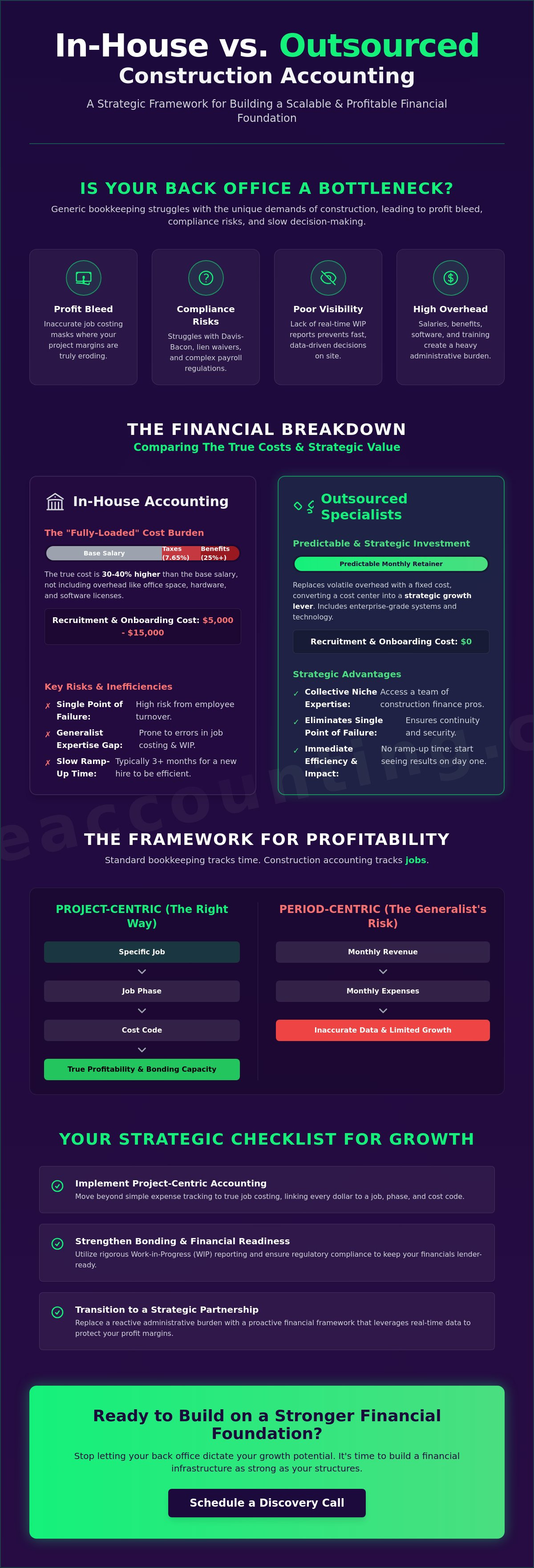
Construction accounting isn't just a variation of standard business bookkeeping; it's an entirely different discipline. While traditional businesses focus on period-centric reporting to track monthly revenue, construction firms must operate within a project-centric framework. This means every dollar spent or earned must be tied to a specific job, phase, and cost code. Without this granular level of detail, your financial statements are merely a collection of numbers rather than a roadmap for profitability.
Standard bookkeeping often fails to capture the intricate nuances of the construction lifecycle. From mobilization costs to retainage and lien waivers, the moving parts are too complex for a generalist to manage effectively. This is where the debate over in house vs outsourced construction accounting becomes critical. You need a system that ensures data integrity so your financials remain lender-ready and your bonding capacity stays protected. In 2026, treat your financial infrastructure as a growth lever rather than a back-office burden.
Project-Based vs. General Ledger Focus
The primary difference between a healthy firm and one that's struggling is the shift from simple expense tracking to true job costing. Simple tracking tells you how much you spent on lumber; job costing tells you how much that lumber cost relative to the specific project's estimate. This distinction is vital for accurate cash flow forecasting, especially for large-scale builds where capital is tied up for months. Utilizing specialized construction bookkeeping services provides the structural framework needed to link field operations directly to your financial reporting.
The Risk of the "Generalist" Bookkeeper
Hiring an in-house generalist who lacks niche-specific training is a significant risk. These individuals often struggle with complex revenue recognition methods like the Percentage of Completion. Errors in these areas lead to more than just messy books; they trigger tax liabilities and audit red flags. Specialized oversight is non-negotiable if you want to protect your profit margins. When comparing in house vs outsourced construction accounting, consider whether a single internal employee can match the collective expertise of a firm that lives and breathes Work-in-Progress (WIP) reporting every day.
The Financial Breakdown: In-House vs. Outsourced Costs
Understanding the financial implications of in house vs outsourced construction accounting requires looking far beyond a simple salary figure. While a base salary might seem manageable on paper, the "fully-loaded" cost of an internal employee often surprises firm owners. You aren't just paying for their time at a desk. You're funding a complex infrastructure of taxes, benefits, and operational overhead that can quietly erode your project margins if not carefully managed.
Transitioning to an outsourced model replaces these volatile, escalating expenses with a predictable monthly retainer. This shift allows you to move from a defensive posture of managing administrative burdens to a proactive stance focused on growth. By eliminating the "Single Point of Failure" risk associated with internal turnover, you ensure that your financial data remains secure and accessible, regardless of individual staff changes.
The Burdened Labor Calculation
Base salaries for accounting staff are only the starting point. When you factor in employer-paid payroll taxes (FICA) at 7.65% and employee benefits like health insurance and retirement plans, which typically add 25 to 30% to the base, the true cost of an internal hire climbs quickly. In the tight 2026 labor market, where the industry needs approximately 500,000 new workers to keep up with demand, the cost to recruit and onboard a new accounting employee is estimated to be between $5,000 and $15,000. An outsourced team provides a specialized financial framework that eliminates these expensive recruitment cycles and offers immediate efficiency without the typical three-month ramp-up time.
Technology and Systems Costs
To see how these structural changes can protect your specific project volume, you can schedule a discovery call to discuss a more efficient path for your firm's back office.
Expertise Gaps in Job Costing and Regulatory Compliance
The "Oversight Problem" is a common structural weakness in many growing firms. When you rely on a single internal employee, you're essentially asking them to audit their own work. Without a specialized controller to review the books, errors in job costing or tax nexus can go unnoticed for years. This lack of checks and balances is a primary driver in the in house vs outsourced construction accounting debate. Specialized firms provide a built-in layer of accountability and a structured remedy that an internal generalist simply cannot offer.
The WIP and Bonding Connection
Surety agents and lenders view Work-in-Progress (WIP) reports as the primary indicator of a firm's financial health. These reports are the "language" of bonding capacity; they reveal whether you're over-billed or under-billed on every active job. Outsourced specialists are uniquely equipped to produce these reports monthly with the precision required by financial institutions. Maintaining lender-ready financials at all times gives you a strategic advantage when bidding on larger projects. It ensures that your bonding capacity isn't throttled by administrative delays or inaccurate data entry.
Navigating Payroll and Tax Compliance
Regulatory compliance in 2026 is more complex than ever. The Davis-Bacon Act mandates prevailing wages for all federal construction contracts exceeding $2,000, requiring meticulous record-keeping and reporting. Managing the distinction between 1099 contractors and W2 employees is another area where mistakes lead to heavy penalties and profit bleed. Utilizing specialized construction payroll services ensures that you meet both state and federal requirements without the stress of manual tracking.
Specialized firms also handle the intricacies of multi-state payroll and local tax nexus, protecting you from unexpected liabilities. Relying on a construction bookkeeping checklist maintains audit-readiness across your entire organization. When you weigh in house vs outsourced construction accounting, consider the value of having a partner who understands the $32 million gross receipts threshold for small contractor exceptions. This level of expertise ensures your accounting methods align perfectly with your project complexity and business size.
A Strategic Decision Framework for 2026
Deciding between in house vs outsourced construction accounting isn't a one-time event; it's a strategic alignment that must evolve with your project volume. To determine the right path for your firm, you need a structured rubric that moves beyond simple cost comparisons. This framework helps you identify the specific triggers that signal a need for a structural upgrade in your financial back office.
Step 1: The Scaling Trigger. Evaluate your current revenue and project volume. If you're approaching the $32 million gross receipts threshold for the small contractor exception, your accounting complexity will shift significantly.
Step 2: The Clarity Test. Audit your existing financial visibility. If you can't access an accurate, project-level profit and loss statement within minutes, your current system is failing the test.
Step 3: Compliance Assessment. Review the complexity of your payroll. If you're managing multi-state projects or federal contracts subject to the Davis-Bacon Act, the risk of an internal error outweighs the cost of specialized oversight.
Step 4: The Opportunity Cost. Calculate the time management spends overseeing administrative staff. Every hour spent troubleshooting QuickBooks is an hour lost to bidding or project management.
By applying these steps, you can move from reactive bookkeeping to a proactive financial strategy. This disciplined approach ensures that your firm remains stable even as project demands intensify.
The Hybrid Model: The Best of Both Worlds?
For many mid-sized firms, the choice isn't binary. A hybrid model allows you to keep an office administrator for daily tasks like data entry and lien waivers while outsourcing high-level strategy to a Fractional Controller. This setup provides the rigorous oversight of an executive-level professional without the $150,000 plus salary and benefits package that a full-time hire requires. It bridges the gap between basic administrative tasks and a comprehensive structural framework, allowing your firm to scale without adding permanent overhead.
When to Make the Switch
The most common red flag indicating your in-house system is breaking is a consistent delay in month-end closings. If your financials are always thirty days behind, you're making decisions based on old data. Transitioning during a natural break between major project phases minimizes disruption. When you evaluate an in house vs outsourced construction accounting partner, verify their expertise in construction-specific GAAP and WIP reporting. If they don't speak the language of over-billings and under-billings, they aren't the right fit for your firm.
If you're ready to stop managing a back-office bottleneck and start leveraging a strategic financial framework, book a discovery call today to find the right structural fit for your firm.
Transforming Your Financial Infrastructure with Okie Accounting
At the intersection of in house vs outsourced construction accounting, the most successful firms are those that stop viewing the back office as a cost center and start treating it as a strategic asset. Choosing a specialized partner like Okie Accounting means you aren't just hiring a bookkeeper; you're installing a disciplined financial framework designed for the complexities of the 2026 market. We replace the reactive, "check-the-box" mentality of administrative staff with a proactive system focused on structural integrity and long-term health.
Our approach centers on providing real-time financial visibility that allows you to protect your margins before the project ends. By leveraging specialized management accounting, we move beyond simple data entry to provide project-level profit protection. This includes rigorous cash flow forecasting and project profitability analysis, ensuring you always know where your capital is tied up and where your next job's funding will come from. We believe that clarity is the best defense against the industry's inherent volatility.
The Okie Methodology: Clarity and Control
The transition from administrative chaos to methodical oversight begins with your tech stack. Many firms use QuickBooks Online as a basic ledger, but they fail to optimize it for construction-specific needs. We specialize in QuickBooks setup and optimization, turning a standard tool into a foundational engine for growth. This ensures that every transaction is mapped to a specific cost code, eliminating data silos and providing a single source of truth for your field and office teams. Our relationship with clients is built on a mentor-style partnership; we provide the high-level oversight of a fractional controller while empowering your team with the data they need to lead with confidence.
Ready for Structural Financial Integrity?
Moving your firm toward a specialized outsourced model is a commitment to stability. It replaces the "Single Point of Failure" risk of a lone internal accountant with a resilient team that understands the nuances of WIP reporting and prevailing wage compliance. The long-term ROI of this shift is found in reduced overhead, improved bonding capacity, and the peace of mind that comes from knowing your financials are lender-ready at all times. You don't have to manage your back office alone.
If you're ready to trade administrative stress for strategic financial leadership, we're here to help you build that foundation. Schedule a strategic consultation today to discover how a specialized partnership can transform your firm's financial future.
Build Your Firm on a Foundation of Financial Integrity
Navigating the volatile market of 2026 requires more than just basic administrative support. It demands a structural framework that protects every dollar of your project profit through rigorous oversight. We've explored how the strategic choice between in house vs outsourced construction accounting impacts your firm's ability to scale, maintain bonding capacity, and survive complex regulatory audits. By replacing the high overhead and narrow expertise of a generalist with a specialized team, you gain the real-time visibility needed to lead your business with quiet confidence.
Okie Accounting Group provides the specialized construction and real estate expertise your business deserves. Our fractional controller oversight and cloud-based real-time reporting systems are designed to turn your back office from a bottleneck into a powerful growth engine. We're as invested in your long-term health as you are. It's time to transition from simple record-keeping to a proactive partnership that secures your financial future.
Schedule Your Strategic Financial Consultation with Okie Accounting Group to begin building a more resilient organization today. Your firm is built to last; your financial systems should be too.
Frequently Asked Questions
Is outsourced accounting more expensive than hiring in-house?
Outsourcing is generally more cost-effective when you consider the fully-loaded expense of a full-time employee. While a salary might seem comparable to a monthly fee, an internal hire adds 25 to 30% in benefits, payroll taxes, and recruitment costs. When evaluating in house vs outsourced construction accounting, remember that a specialized firm eliminates the need for office space, hardware, and ongoing training expenses.
How does an outsourced firm handle my daily construction invoices and receipts?
We utilize integrated cloud-based systems to streamline your daily financial data. You can submit invoices and receipts digitally through mobile apps or dedicated portals, which are then categorized by our team into the appropriate cost codes. This automated workflow ensures that your job costing stays current without the need for manual data entry by your field staff.
Can an outsourced accountant help with my bonding and lending requirements?
Yes, we focus on providing the lender-ready financial reporting that surety agents and banks require. By producing accurate Work-in-Progress (WIP) schedules and project-centric balance sheets, we help you demonstrate the financial stability needed to increase your bonding capacity. This specialized oversight ensures your financials meet the rigorous standards of the construction industry.
What is a fractional controller and does my construction company need one?
A fractional controller is a high-level financial strategist who provides executive oversight on a part-time basis. If your firm is growing but isn't ready for a six-figure executive salary, a fractional controller offers the necessary structural framework for scalability. They focus on cash flow forecasting and internal controls to protect your profit margins during rapid expansion.
Will I lose control of my financial data if I outsource my bookkeeping?
You actually gain more control and transparency through a specialized partnership. We utilize QuickBooks Online to ensure you have 24/7 access to your financial data from any job site. Instead of relying on a single person's manual spreadsheets, you have a professional system that provides a single source of truth for your entire organization.
How does outsourcing help with Davis-Bacon and prevailing wage compliance?
We implement specialized payroll management systems designed to handle the complexities of federal and state labor laws. For contracts exceeding $2,000, we manage the meticulous record-keeping and reporting required by the Davis-Bacon Act. This proactive approach reduces the risk of costly penalties and ensures your firm remains in good standing for future government bids.
What software does Okie Accounting use for construction clients?
Our firm primarily utilizes and optimizes QuickBooks Online to manage construction workflows. We provide QuickBooks Setup and Training to ensure your software is configured for project-based tracking and job costing. This allows us to deliver real-time financial visibility while keeping your data secure in a cloud-based environment.
Can I keep my current office manager if I hire an outsourced accounting firm?
Yes, we frequently operate in a hybrid model where we support your existing administrative staff. Your office manager can continue to handle daily operational tasks like lien waivers and field coordination while we manage the specialized bookkeeping and controller functions. This partnership allows your team to focus on their strengths while we ensure your financial infrastructure remains solid.


Comments