_edited_edited.jpg)

Key Financial KPIs for Construction: A Strategic Guide to Profit Protection in 2026

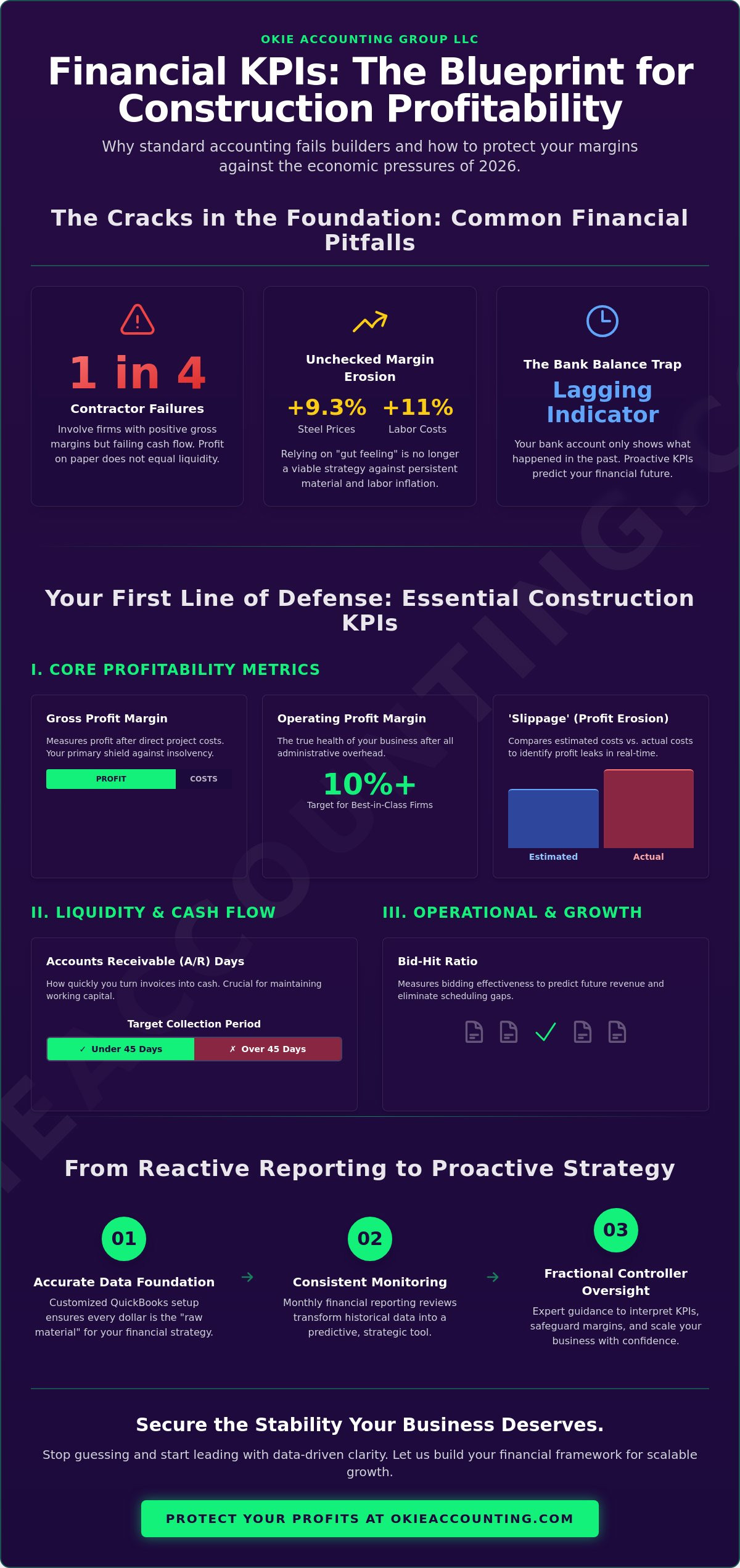
Did you know that one in four contractor failures involves a firm with positive gross margins but failing cash flow? It's a sobering reality that many builders face, especially when profit on paper doesn't translate to actual liquidity in the bank. You likely recognize the stress of managing shrinking margins while steel prices rise 9.3% and specialized labor costs climb by as much as 11%. Tracking the right financial KPIs for construction is no longer just a basic administrative task; it's the structural foundation of your firm's long-term survival.
We'll show you exactly how to implement a structured framework for financial oversight that safeguards your margins against the unique economic pressures of 2026. This guide provides the data-driven clarity you need to protect your bottom line and scale with confidence. We'll examine how to maintain accounts receivable under 45 days, leverage the permanent 100% bonus depreciation, and use historical data to ensure every bid you submit is grounded in reality rather than guesswork. By moving from reactive reporting to proactive strategy, you can secure the stability your business deserves.
Key Takeaways
Understand why general accounting metrics often fail builders and how project-specific tracking provides the data-driven clarity needed for scalable growth.
Identify the essential financial KPIs for construction that serve as your first line of defense against shrinking margins and rising material costs.
Master the liquidity metrics that ensure your firm maintains enough working capital to launch new projects without risking a cash flow crunch.
Evaluate your pipeline health by analyzing backlog volume and bid-hit ratios to predict future revenue and eliminate scheduling gaps.
Discover how a customized QuickBooks framework and fractional controller oversight transform basic administrative tasks into a strategic engine for profit protection.
Table of Contents
The Role of Financial KPIs in Construction Profit Protection
In the construction industry, profit is often an elusive target. You might see high revenue figures on your income statement while your bank account remains stubbornly low. This disconnect occurs because standard accounting often treats business as a series of time periods rather than a collection of distinct projects. To bridge this gap, successful firms rely on Key Performance Indicators (KPIs). These are quantifiable measurements that reflect the critical success factors of your firm. By tracking specific financial KPIs for construction, you gain a clear view of which projects are truly profitable and which are quietly eroding your margins.
Generalist KPIs often fail because they lack the granular detail required for project-based tracking. While a retail business might focus on inventory turnover, a construction firm must monitor labor productivity and material price variances. In May 2026, with material inflation at 5.3% and steel prices up 9.3% annually, relying on "gut feeling" is no longer a viable strategy. You need data-driven leadership to identify project slippage before it becomes a financial crisis. These metrics act as early warning systems, signaling when a job is veering off track long before the final invoice is sent.
Building a Foundation of Financial Readiness
Effective oversight begins with a shift in perspective. KPIs serve as the vital bridge between daily Monthly Bookkeeping and high-level Fractional Controller Services. Without accurate data entry, your metrics are essentially useless. We view clean data as the "raw material" for your financial strategy. This structural framework is essential for avoiding the "revenue trap." This is a common scenario where a firm takes on more work to cover rising overhead, only to find that rapid growth has led to insolvency because they didn't protect their margins at the project level. Accurate QuickBooks Setup & Training ensures that every dollar is categorized correctly from the start.
Moving Beyond Basic Administrative Tasks
The most dangerous mistake a growing contractor can make is relying solely on their bank balance to gauge business health. This is a lagging indicator; it only tells you what happened in the past. To protect your profit, you must focus on leading indicators that predict what will happen next. Establishing a steady rhythm of monthly Financial Reporting reviews allows you to interpret these numbers with precision. This proactive approach transforms your financial data from a historical record into a strategic tool. When you understand the difference between cash in the bank and actual earned profit, you can make commitments with confidence rather than anxiety. This transition from administrative task to strategic partnership is what defines a resilient construction firm in 2026.
Core Profitability Metrics: Beyond the Bottom Line
Revenue is often a vanity metric in the construction world. While a high top-line figure suggests growth, it can easily mask a failing business model if your margins are under siege. To protect your firm, you must look past the total contract value and analyze the specific ratios that define your operational efficiency. These financial KPIs for construction provide the structural visibility needed to distinguish between a busy company and a profitable one.
Gross Profit Margin acts as your primary shield, measuring what remains after direct project costs like labor and materials are settled. Best-in-class subcontractors should aim for a double-digit operating profit percentage of 10% or higher. If your gross margin is thin, your Net Profit Margin, the true health of the business after all administrative overhead, will inevitably suffer. We monitor these ratios with discipline to ensure that every project contributes to your long-term stability rather than just increasing your liabilities.
The 'Slippage' metric is a critical tool for identifying profit erosion in real-time. By comparing your estimated costs at the time of the bid against actual costs incurred during execution, you can pinpoint flaws in the estimating process or inefficiencies on the job site. This data-driven approach allows you to adjust course before a single project drains your annual reserves. This level of oversight transforms a reactive contractor into a strategic leader.
The WIP Factor: Accuracy in Project Reporting
Standard accounting often provides a distorted view of profitability because it ignores the timing differences between billing and production. Work-in-Progress (WIP) reporting is the only way to achieve true monthly clarity. Over-billings can make a project look more profitable than it is, while under-billings can hide earned revenue. Integrating WIP accounting for construction into your monthly close ensures that your financial statements reflect reality rather than just bank activity. This specialized reporting is a core component of our Fractional Controller Services, designed to give you total control over your project data.
Overhead Ratio and Fixed Cost Management
Your overhead ratio determines the "nut" your business must crack every month just to stay operational. This includes everything from office rent to the software used for Monthly Bookkeeping. If your project volume doesn't support your administrative structure, your net margin will evaporate. Identifying leaky expenses, such as underutilized equipment or excessive indirect labor, is critical for maintaining structural integrity. If you're unsure where your margins are going, our team at Okie Accounting Group LLC can help you build a more resilient financial framework.
Liquidity and Cash Flow: Ensuring Structural Integrity
Profit is a vital goal, but liquidity is an absolute requirement for survival. As we established when discussing margins, healthy project numbers can be deceptive if they aren't backed by accessible cash. Research from the Construction Financial Management Association (CFMA) highlights a critical vulnerability: one in four contractor failures involves a firm that remained profitable on paper while its cash flow collapsed. Monitoring liquidity through specialized financial KPIs for construction ensures your firm has the "oxygen" needed to fuel operations without relying on high-interest debt, which currently ranges from 6.5% to 9.5% for professional builders.
Working capital represents the baseline of your financial readiness. It's the capital available to fund daily operations, pay your crew through Payroll Management, and purchase materials before the first draw hits your account. When material costs for steel are rising at 9.3% annually, your working capital must be robust enough to absorb these fluctuations. We also track Days Sales Outstanding (DSO) to measure how quickly your invoices turn into cash. In the current market, keeping your accounts receivable (AR) under 45 days is the industry benchmark for maintaining a healthy operational cycle.
Managing the AR/AP Gap
Many contractors inadvertently act as a bank for their clients by financing project costs with their own cash. This "financing gap" occurs when you pay vendors and labor faster than you collect from owners. Improving your AR turnover requires disciplined Monthly Bookkeeping and clear communication with project stakeholders. We utilize construction cash flow forecasting to turn these KPIs into a strategic roadmap. This allows you to anticipate lean months and adjust your Accounts Payable (AP) turnover to preserve cash without damaging vital vendor relationships.
The Quick Ratio: Your Financial Safety Net
While the current ratio looks at all assets, the Quick Ratio provides a more conservative view of your stability. It excludes inventory and Work-in-Progress (WIP) that can't be immediately converted to cash, focusing instead on cash and high-quality receivables. The Quick Ratio serves as a measure of instant financial readiness by evaluating your ability to cover current liabilities using only your most liquid assets. Specialty contractors should generally aim for a higher ratio than general contractors to account for the risk of payment delays. Establishing this safety net is a core focus of our Fractional Controller Services, ensuring you're always prepared for the unexpected.
Operational and Growth KPIs: Monitoring Your Pipeline
Operational health is the engine that drives your profit protection strategy. While liquidity keeps the lights on, your pipeline metrics determine if that engine is running efficiently or burning out. In an environment where construction wages have increased by over 4% year-over-year, and up to 11% in high-demand markets, monitoring financial KPIs for construction related to labor and sales is non-negotiable. These numbers move beyond the balance sheet to provide a real-time view of your team's productivity and your firm's market position.
Revenue per Labor Hour is the ultimate metric for team productivity. To calculate this, you divide your total revenue by the total labor hours invested in a project. This number reveals the true value of your workforce and helps you identify if your job costing is accurate. Similarly, tracking equipment downtime and ROI is essential for heavy construction. Idle assets represent trapped capital that could be better utilized elsewhere. By measuring these operational metrics, you ensure that every resource is actively contributing to your bottom line.
Labor Efficiency and Job Costing
Finding hidden costs requires a granular approach to job costing. By tracking actual labor hours against your original estimate, you can pinpoint exactly where projects are losing money. This level of detail is only possible through specialized construction payroll services that integrate directly with your project data. When you identify your most and least profitable project types, you can stop chasing low-margin work and focus on the contracts that actually build wealth. This disciplined analysis prevents the "revenue trap" we discussed earlier, ensuring growth is always profitable.
Backlog Analysis and Future Readiness
Your backlog volume is a predictor of future stability. By calculating the "burn rate" of your current signed contracts, you can determine exactly when your team will need new work to avoid a schedule gap. A healthy backlog provides security, but rapid backlog growth often signals a need for Fractional Controller Services to manage the increased complexity. We also recommend using your bid-hit ratio to set "Go/No-Go" thresholds. If your hit ratio is too high, your prices may be too low; if it's too low, you're wasting estimating resources on the wrong leads. Balancing these financial KPIs for construction allows you to bid with precision and grow with intent.
If your current reporting doesn't give you clear visibility into your labor efficiency or backlog burn rate, it's time for a more structured approach. Our team can help you implement the systems needed for data-driven growth. Connect with Okie Accounting Group LLC today to build a more resilient pipeline.
Building a Scalable KPI Framework with Specialized Oversight
Implementing a list of metrics is only the first step toward profit protection. To truly safeguard your margins, you must move beyond viewing numbers in isolation and treat them as the load-bearing walls of your business structure. Without a foundational system to capture and categorize every dollar, your financial KPIs for construction will be built on shifting sand. Establishing this framework requires a shift from basic administrative record-keeping to a disciplined, system-driven approach that provides the structural integrity your firm deserves.
The transition starts with a monthly financial review to establish your baseline. This isn't just about looking at your bank balance; it's about evaluating your performance against the benchmarks we've discussed, such as the 10% operating profit goal or the 45-day AR window. By comparing your actual results to your strategic targets, you can identify precisely where your systems are succeeding and where they are failing. This regular rhythm of oversight ensures that small slippages don't evolve into catastrophic failures.
QuickBooks as Your Financial Command Center
A customized QuickBooks Online setup is the absolute prerequisite for clean, actionable data. Standard accounting templates often fail builders because they don't account for the complexities of project-based reporting. We focus on standardizing your Chart of Accounts so that every expense is mapped to a specific job or overhead category. By automating data feeds, we reduce the administrative burden on your team and eliminate the human error that often distorts your metrics. Our QuickBooks Setup & Training ensures that your staff understands how to feed the system the "raw material" it needs to produce accurate Financial Reporting.
Partnering for Strategic Financial Leadership
There's a significant difference between "keeping the books" and "managing the business." While Monthly Bookkeeping provides the data, our Fractional Controller Services provide the interpretation. An expert advisor helps you look past the spreadsheets to understand the strategic implications of your numbers. This might mean identifying that your bid-hit ratio is too high because you aren't accounting for the recent 10.2% surge in lumber costs, or realizing that your backlog burn rate is accelerating faster than your cash flow can support. This level of insight is what transforms you from a service provider into a strategic leader.
Consistent reporting requires the discipline of professional construction bookkeeping services. This partnership ensures that your financial readiness is never compromised by the daily chaos of the job site. At Okie Accounting Group LLC, we provide the specialized oversight needed to turn your financial data into a roadmap for scalable growth. You don't have to navigate these complexities alone. Schedule a consultation to build your profit protection framework and secure the long-term health of your construction firm.
Securing Your Firm’s Financial Future
Protecting your margins in 2026 requires more than just hard work in the field. It demands a shift from basic administrative record-keeping to a disciplined, data-driven strategy. By mastering project-based profitability metrics and maintaining strict oversight of your liquidity, you ensure that high revenue always leads to actual cash in the bank. Implementing the right financial KPIs for construction transforms your data from a historical record into a forward-looking strategy that anticipates market shifts before they impact your bottom line.
At Okie Accounting Group, we provide specialized expertise in the construction and real estate sectors to help you navigate these complexities. Our cloud-based systems offer national remote support, while our Fractional Controller Services deliver the strategic leadership your business deserves. We don't just organize your numbers; we build the structural frameworks that support your long-term health and stability. You've built your business with precision; let's ensure your financial foundation is just as strong.
Build Your Strategic Financial Framework with Okie Accounting Group and gain the clarity needed for scalable growth.
Frequently Asked Questions
What is the most important financial KPI for a small construction company?
Gross Profit Margin is the most critical metric because it serves as your primary defense against pricing errors and field inefficiencies. If your gross margin is weak, no amount of revenue will save the firm from eventual insolvency. It is essential to track this at the project level to ensure that direct costs for labor and materials don't consume your entire budget before the job is complete.
How often should I be reviewing my construction financial KPIs?
You should review your financial KPIs for construction at least once per month during a structured financial reporting session. This frequency allows you to identify project slippage early enough to make operational adjustments. Waiting until the end of a quarter or the conclusion of a project often means it's too late to recover lost margins or correct cash flow imbalances.
What is a good net profit margin for a construction business in 2026?
Best-in-class subcontractors should aim for a double-digit operating profit percentage of 10% or higher. While average margins in the industry often hover between 3% and 5%, achieving a higher percentage is the hallmark of a firm with rigorous cost controls and specialized oversight. Tracking financial KPIs for construction with this target in mind provides the necessary buffer for material price volatility and wage increases.
How do I track KPIs if my bookkeeping is currently behind?
You cannot track meaningful metrics until your foundational data is current and accurate. The first step is to perform catch-up bookkeeping to bring your records up to date and reconcile all project-related transactions. Once your data is clean, you can implement a structural framework that allows for real-time reporting and more accurate forecasting through our Monthly Bookkeeping services.
What is the difference between cash flow and profitability in construction?
Profitability measures the difference between your revenue and expenses on paper, while cash flow tracks the actual timing of money entering and leaving your bank account. In construction, you can be profitable yet fail because your cash is trapped in under-billings or slow-paying accounts receivable. This is why we prioritize Cash Flow Forecasting as a core component of our financial strategy.
Can QuickBooks Online track construction-specific KPIs like WIP?
QuickBooks Online can effectively track construction-specific metrics like Work-in-Progress (WIP) when it is configured with a specialized Chart of Accounts. Proper QuickBooks Setup & Training is required to ensure that over-billings and under-billings are correctly reflected on your balance sheet. Without this structural setup, your financial statements will likely distort your true profitability and lead to poor decision-making.
How does a fractional controller help with KPI management?
A fractional controller moves beyond basic data entry to provide high-level strategic interpretation of your financial data. They help you understand what the numbers mean for your long-term stability and guide choices like when to hire more crew or when to adjust your bidding strategy. This partnership through our Fractional Controller Services transforms your finance department from an administrative task into a strategic asset.
What is a healthy bid-hit ratio for general contractors?
A healthy bid-hit ratio for general contractors typically ranges between 1:4 and 1:6, though this varies depending on your specific market and sector. If your ratio is too high, you might be underpricing your work; if it's too low, you're likely wasting estimating resources on projects that aren't a good fit. Monitoring this KPI helps you refine your sales process and focus on high-probability, high-margin opportunities.



Comments