
Navigating Davis-Bacon Payroll Compliance: A Strategic Guide for Contractors
- Wendy Okie

- May 26
- 12 min read
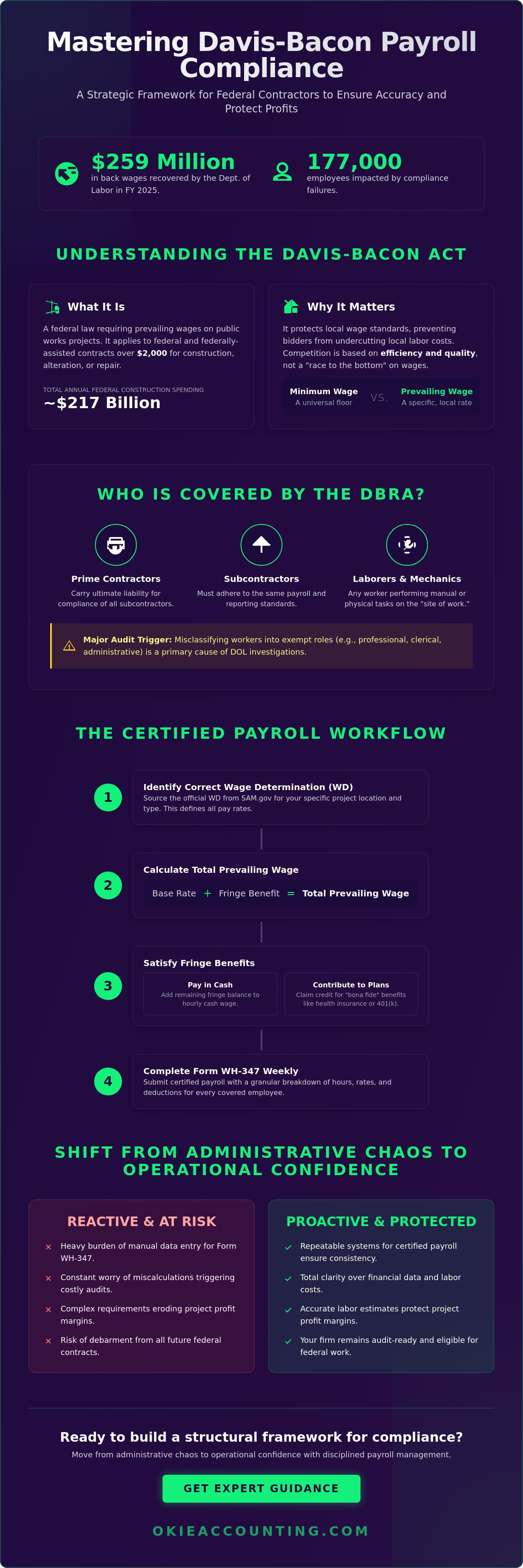
Did you know that in fiscal year 2025, the Department of Labor recovered $259 million in back wages for nearly 177,000 employees? For federal contractors, this figure serves as a stark reminder that Davis-Bacon payroll compliance is under more scrutiny now than it has been in decades. You likely feel the weight of manual data entry for Form WH-347 and the constant worry that a miscalculated fringe benefit could trigger a costly audit. It's a common concern that these complex requirements might erode your project profit margins or even lead to debarment from federal work.
We understand that you want more than just a way to survive an audit; you want a repeatable system that provides total clarity over your financial data. This guide will show you how to master the latest regulations, including the 2023 final rule changes and the return to the 30 percent rule methodology. By the end of this article, you'll have a strategic framework to protect your business's long-term health. We'll explore the critical steps to move from administrative chaos to operational confidence through disciplined payroll management and structural oversight.
Key Takeaways
Learn to identify correct Wage Determinations and calculate the full compensation package by accurately combining base rates with fringe benefits.
Identify common audit triggers like worker misclassification and overtime errors that can lead to significant back-wage penalties.
Discover how to build a structural framework for Davis-Bacon payroll compliance by integrating rigorous internal controls into your weekly reporting workflow.
Shift from reactive administrative tasks to proactive financial oversight by accurately estimating labor costs to protect your project profit margins.
Establish repeatable systems for certified payroll that ensure your firm remains audit-ready and maintains its eligibility for federal contracts.
What is Davis-Bacon Payroll Compliance?
The Davis-Bacon Act of 1931 established the foundation for federal labor standards on construction projects. It isn't just a legacy law; it's an active regulatory framework that applies to federal and federally assisted contracts exceeding $2,000. With federal construction spending reaching approximately $217 billion annually, Davis-Bacon payroll compliance has become a prerequisite for any firm looking to scale. This requirement covers the construction, alteration, or repair of public buildings and public works. Whether you're working on a traditional highway project or new infrastructure funded by recent federal initiatives, these rules dictate your financial reporting workflow.
Compliance isn't a mere administrative hurdle. It's a structural discipline that ensures your business remains eligible for lucrative government work. When you sign a federal contract, you're agreeing to a level of oversight that goes far beyond standard commercial projects. This oversight requires meticulous recordkeeping and a deep understanding of how local wage determinations impact your bottom line. Establishing a robust payroll management system early is the only way to avoid the pitfalls of manual data entry and classification errors.
The Core Purpose of Prevailing Wages
Prevailing wages serve a specific economic function by protecting local wage standards. Without these mandates, outside bidders could win contracts by importing low-cost labor from other regions, effectively undercutting local workers and businesses. This system ensures that competition is based on project quality, engineering skill, and operational efficiency rather than a "race to the bottom" on labor costs. Contractors must recognize that prevailing wages differ significantly from standard minimum wage laws. While a minimum wage provides a universal floor, a prevailing wage is a specific rate determined by the Department of Labor based on the local wages paid for similar work in that specific geographic area.
Who is Covered Under the DBRA?
The Davis-Bacon and Related Acts (DBRA) apply to both prime contractors and subcontractors. Under the law, prime contractors carry the ultimate liability for the compliance of every firm working under them. The scope of coverage includes all laborers and mechanics employed directly on the "site of work." This term generally refers to the physical location of the project or adjacent properties used specifically for the job. Covered roles include anyone performing manual or physical tasks, including apprentices and trainees. However, professional, clerical, and administrative staff are typically exempt. Misclassifying an employee into a non-covered role is one of the quickest ways to trigger a Department of Labor investigation, making accurate job tracking a vital component of your controller services and oversight strategy.
The Mechanics of Prevailing Wage and Certified Payroll
Mastering the technical side of Davis-Bacon payroll compliance requires a shift from general accounting to project-specific financial tracking. You can't rely on standard payroll defaults when federal funds are involved. Instead, you must align every hour worked with the specific Wage Determination (WD) assigned to your contract. This document, typically sourced from SAM.gov, acts as the definitive pay scale for your project. It lists the minimum hourly rates and fringe benefits for every job classification, from electricians to power equipment operators. Following the Department of Labor guidance ensures that you're using the correct schedule for your project's location and construction type.
The total prevailing wage is the sum of the basic hourly rate and the fringe benefit requirement. You have two ways to satisfy the fringe portion: pay it in cash directly to the employee or contribute to "bona fide" benefit plans. If you provide health insurance or 401(k) contributions, you can claim a credit against the required fringe rate. To calculate this credit accurately, divide the monthly premium or contribution by the employee's total hours worked in that month. Any remaining balance must be paid as a cash hourly equivalent to ensure the worker receives the full prevailing wage amount.
Decoding the Wage Determination
Reading a WD schedule requires precision. You must match workers to the exact classification that fits their actual duties on-site, not just their job title. The "Site of Work" rule is equally critical; it dictates that prevailing wages apply only to those physically working on the project location or specific adjacent sites. If your contract spans multiple years, you must stay vigilant. While many determinations remain fixed for the life of the contract, certain modifications or extensions may require you to adopt updated rates. Integrating these variables into your QuickBooks setup ensures that your systems reflect these specialized requirements from day one.
Completing Form WH-347 Correcty
Form WH-347 is the industry standard for weekly certified payroll reporting. It requires a granular breakdown of every employee's hours, including a distinction between Davis-Bacon project hours and work performed on other jobs. A common error is failing to reflect the actual hours worked versus the hours paid, which can trigger red flags during a DOL audit. The most vital part of the form is the Statement of Compliance. When you sign this document, you're legally certifying that the information is correct and that you've paid every worker the full prevailing wage. This signature carries significant liability, making it essential to have a rigorous internal review process. If the complexity of these weekly filings feels overwhelming, it might be time to schedule a discovery call to discuss a more structured approach to your payroll management.
Common Compliance Pitfalls and Audit Risks
The financial stakes of Davis-Bacon payroll compliance have never been higher. In fiscal year 2025, the Department of Labor recovered $259 million in back wages, a clear signal that enforcement is intensifying. For a mid-sized contractor, a single oversight can be devastating; one firm recently faced $180,000 in back wages and penalties for a single violation. These errors often stem from a lack of structural oversight rather than intentional fraud. Without a disciplined payroll management system, it's easy for granular details to slip through the cracks, leaving your business vulnerable to aggressive DOL scrutiny.
Misclassification remains the most frequent pitfall. Assigning a worker to a lower-paying labor category when they are performing skilled trade work, such as carpentry or electrical tasks, is a major audit trigger. Similarly, overtime calculations often trip up even experienced firms. You must remember that while fringe benefits are required for all hours worked, the overtime premium is calculated based on the basic hourly rate. Failure to pay the full prevailing wage for every hour beyond forty can lead to significant liquidated damages. Under the 2023 final rule changes, prime contractors now carry liability for their subcontractors' back wages regardless of intent, making rigorous oversight of the entire project chain essential.
Inadequate record-keeping is another area where contractors often stumble. You're required to maintain payroll and basic records for at least three years after the completion of all work on the prime contract. These records must be readily available for inspection and must include detailed information on worker classifications, hours worked, and benefit contributions. If your documentation is disorganized or incomplete, a DOL investigator may assume the worst, leading to expanded audits that threaten your project profit margins.
Red Flags That Trigger a DOL Investigation
Investigators often look for specific patterns before launching a full-scale audit. Inconsistencies between your weekly WH-347 reports and your general ledger payroll are immediate red flags. Additionally, the DOL monitors apprentice-to-journeyman ratios closely. If you're utilizing apprentices to reduce labor costs, they must be registered in a DOL-approved program, and you must adhere to the specific ratio allowed by the wage determination. Employee complaints regarding unpaid fringe benefits or late payments are also primary catalysts for investigations. Establishing strong controller services ensures these metrics are monitored internally before they become external liabilities.
The Consequences of Debarment
The most severe penalty for non-compliance is debarment. This sanction strips your firm of the right to bid on federal or federally assisted contracts for up to three years. Beyond the immediate loss of revenue, debarment causes lasting reputational damage with prime contractors and government agencies. It can also severely impact your bonding capacity and credit readiness, as lenders and sureties view debarment as a sign of fundamental management failure. Protecting your business from these outcomes requires a proactive transition from basic administration to a comprehensive compliance framework.
Building a Structural Framework for Compliance
Many contractors treat Davis-Bacon payroll compliance as a weekly fire drill. This reactive approach creates unnecessary stress and invites costly errors. Real control comes from building a structural framework that integrates these requirements directly into your daily operations. By configuring your bookkeeping system to handle the nuances of federal reporting, you transform a manual burden into a repeatable, data-driven process. Cloud-based accounting platforms offer the real-time visibility needed to monitor labor costs against wage determinations before the payroll cycle even closes. This proactive stance ensures that your financial data remains accurate, accessible, and audit-ready at all times.
Establishing internal controls isn't just about software; it's about the discipline of your workflow. You need a system where time-tracking, job costing, and payroll reporting speak the same language. When these elements are siloed, discrepancies are inevitable. A monthly financial review serves as a vital safety net, allowing you to catch misclassifications or fringe benefit errors before they become permanent records on a WH-347. This systematic approach mirrors the organized systems we build for our clients, providing a level of predictability that helps protect your project profit margins from unexpected back-wage claims.
Implementing Specialized Time-Tracking
Precision starts in the field. Relying on paper logs often leads to rounded hours or vague job descriptions that won't hold up during a Department of Labor investigation. Digital, GPS-verified timekeeping provides a verifiable audit trail that proves exactly where and when your team was working. These systems allow you to map job codes to specific Davis-Bacon classifications automatically. This automation ensures that a laborer isn't accidentally paid at a lower rate for performing skilled tasks. It's equally vital that field supervisors understand these classification rules. They are your first line of defense in ensuring data integrity at the source.
Strategic Oversight via Fractional Controller Services
While software provides the data, professional oversight provides the strategy. Our fractional controller services act as a high-level filter to catch compliance trends before they escalate into liabilities. This oversight involves linking your payroll data to WIP accounting for construction. When your labor costs are accurately tracked, when your job codes are correctly mapped, and when your oversight is consistently applied, you gain a clearer picture of your actual margins. This structured approach ensures your construction financial statements reflect the true cost of federal work. This level of granular reporting allows you to adjust bidding strategies for future government contracts with confidence. If you're ready to stop "firefighting" your weekly reports and start building a foundational system, schedule a discovery call today to see how we can help.
Why Professional Payroll Management is a Profit Protector
Professional payroll management acts as a shield for your bottom line. When Davis-Bacon payroll compliance is integrated into your high-level strategy, it ceases to be an obstacle and becomes a tool for profit protection. This oversight allows you to bid on federal contracts with the certainty that your labor costs are fully accounted for and your margins are secure. It's about moving from a state of constant administrative catch-up to a position of financial readiness. By prioritizing these systems, you ensure that every government project contributes to your firm's long-term health rather than draining its resources through unexpected penalties.
Confidence in your financial data allows you to focus on project execution and scaling your operations. When your records are audit-ready, the stress of federal oversight is replaced by the clarity of controlled data. This shift is essential for contractors who want to move beyond small-scale repairs and compete for major public works. Specialized management ensures that your business is not just surviving the complexities of federal work but is actively using them to build a
more disciplined and profitable organization.
The Role of Okie Accounting Group LLC as Your Strategic Partner
At Okie Accounting Group LLC, we serve as a strategic mentor to help you navigate these industry-specific complexities. Our methodology for construction payroll services moves beyond basic transactional tasks. We focus on constructing the comprehensive structural frameworks your business needs to thrive in the federal sector. Through customized QuickBooks training for contractors, we equip your team with the skills to manage specialized reporting internally. This partnership ensures that your financial data is not just accurate but also a strategic asset for future growth.
Next Steps for Federal Contractors
Readiness starts with a critical assessment of your current infrastructure. Before you commit to your next federal project, evaluate whether your systems can withstand the rigors of a Department of Labor audit. Engaging with a fractional controller from Okie Accounting Group LLC provides the disciplined oversight required to spot vulnerabilities early. We're dedicated to your success, offering the practical, data-driven choices that keep your business stable. Take the initiative to strengthen your financial reporting today to ensure your firm is prepared for the opportunities of tomorrow.
Secure Your Profit Margins with Structural Integrity
Transitioning from administrative chaos to operational clarity is a strategic choice that defines the future of your firm. By implementing digital time-tracking and integrating wage determinations directly into your bookkeeping workflow, you build a resilient foundation. Davis-Bacon payroll compliance then becomes a source of confidence rather than a point of stress. This structural discipline ensures your business remains audit-ready while protecting the project margins you've worked hard to earn. You've seen how misclassification and record-keeping gaps can threaten your bonding capacity; now is the time to replace those risks with rigorous systems.
Sarah O’Quinn founded Okie Accounting to provide contractors with the specialized construction accounting expertise they need to scale. We offer nationwide remote financial leadership focused on building robust frameworks that go beyond basic bookkeeping. Our fractional controller services provide the strategic oversight necessary to navigate complex federal requirements with precision. We're as invested in your long-term stability as you are. Ready to secure your federal contracts? Schedule a consultation for our fractional controller services today.
You don't have to navigate these complexities alone. We're here to be your strategic partner in achieving operational clarity and sustainable growth.
Frequently Asked Questions
What is the minimum contract amount for Davis-Bacon to apply?
The Davis-Bacon Act applies to federal and federally assisted construction, alteration, or repair contracts exceeding $2,000. This threshold covers all laborers and mechanics employed on the physical site of work. It's essential to review your contract documents early to confirm if these requirements apply, as even small-scale federal projects trigger these rigorous reporting mandates.
How often must certified payroll reports be submitted?
Certified payroll reports must be submitted on a weekly basis for every week in which work is performed on the project. These reports are typically due within seven days after the regular payment date of the payroll period. Maintaining this weekly rhythm is a non-negotiable requirement for Davis-Bacon payroll compliance and ensures your project remains in good standing with the contracting agency.
Can I pay fringe benefits in cash instead of into a benefit plan?
You can satisfy the fringe benefit requirement by paying the full amount in cash directly to the employee or by making contributions to a bona fide benefit plan. If you choose the cash option, the payment must be reflected as a separate hourly rate on the employee's pay stub. Many contractors use a combination of both methods to meet the total prevailing wage requirement for each classification.
What happens if I misclassify a worker on a Davis-Bacon project?
Misclassifying a worker can lead to significant financial penalties, including the payment of back wages and liquidated damages. In serious cases, the Department of Labor may pursue debarment, which prevents your firm from bidding on federal contracts for up to three years. Establishing a rigorous internal review process helps catch these classification errors before they become significant legal or financial liabilities.
Do Davis-Bacon requirements apply to private projects with federal grants?
Yes, Davis-Bacon requirements often apply to private projects that receive federal assistance through grants, loans, or loan guarantees. These are known as Related Acts and cover a wide range of infrastructure and housing developments. You should always verify the funding source of a project to determine if prevailing wage mandates are triggered by federal involvement in a private development.
How do I find the correct prevailing wage for a specific job site?
You can find the correct prevailing wage determinations on the System for Award Management website at SAM.gov. These determinations are organized by state, county, and construction type, such as building, residential, or highway. It's critical to use the specific wage determination identified in your contract, as rates are specific to the geographic area where the work is performed.
Is certified payroll the same thing as a standard payroll register?
A standard payroll register is an internal document used for general bookkeeping, while a certified payroll report is a legally binding document submitted to a government agency. Certified reports include specific job classifications and a signed Statement of Compliance, which verifies the accuracy of the data. This distinction is a core part of maintaining structural integrity in your project-based financial reporting.
Can I use QuickBooks Online to generate Form WH-347?
QuickBooks Online does not natively generate Form WH-347, but it can be configured to track the necessary data with a specialized setup. Most contractors use third-party applications or integrated tools that pull data from their QuickBooks records to complete the weekly filing. We offer QuickBooks setup and training to help you establish a workflow that makes this process repeatable and accurate for every project.


Comments