
QuickBooks for Real Estate Investors: Building a Scalable Financial Infrastructure in 2026
- Wendy Okie

- May 22
- 12 min read
Your real estate portfolio is only as strong as the financial framework supporting it; without proper architecture, growth is simply a fast track to operational chaos. With $875 billion in commercial and multifamily loans maturing in 2026, the ability to present clean, lender-ready financials is no longer a luxury. It's a survival requirement. If you're still struggling with co-mingled funds or the inability to see a clear profit and loss statement for each individual property, you aren't just disorganized. You're losing the data needed to scale. Mastering QuickBooks for real estate investors requires moving beyond basic administrative tasks to build a disciplined system that protects your profits and your peace of mind.
You likely started with a simple spreadsheet, but as your holdings grow, that lack of structure creates a ceiling on your potential. We understand the stress of managing a shifting environment where QuickBooks Online plans have seen 15% to 25% price increases and legacy desktop support is ending. This article will teach you how to transform QuickBooks into a strategic asset that fuels your portfolio expansion. We'll explore how to leverage permanent 100% bonus depreciation and the exact methodology for architecting a scalable financial infrastructure that provides the clarity you need to move forward with confidence.
Key Takeaways
Learn how to architect a Chart of Accounts that mirrors IRS Schedule E to ensure structural integrity and simplify annual tax preparation.
Discover why a specialized setup of QuickBooks for real estate investors is the only way to move beyond "shoebox" accounting and achieve multi-dimensional property tracking.
Identify the critical operational thresholds for migrating to QuickBooks Online Advanced to manage complex portfolios with ten or more entities effectively.
Establish a disciplined monthly close process that ensures 100% data integrity through the rigorous reconciliation of bank accounts and mortgage statements.
Understand how transitioning from administrative bookkeeping to fractional controller services provides the strategic oversight needed to protect profit margins.
Why Generic QuickBooks Setups Fail Real Estate Investors
Many investors treat QuickBooks like a digital ledger, but a specialized setup for QuickBooks for real estate investors is actually a multi-dimensional tracking system. It must account for individual properties, specific units, and capital expenditures simultaneously. Without this structural integrity, your data becomes a "black hole" where profit margins disappear and tax season becomes a crisis of disorganized receipts. Generic setups fail because they treat every dollar the same, ignoring the nuanced requirements of asset management.
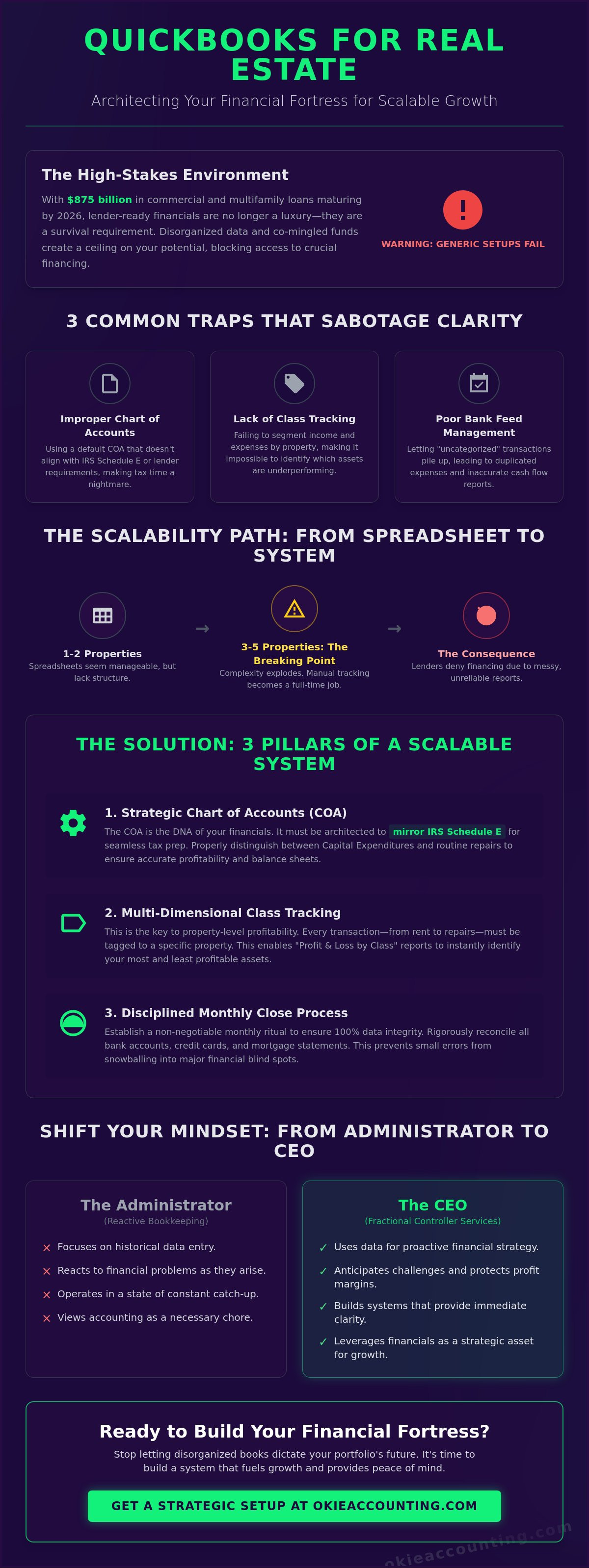
The danger of the "Shoebox Method" persists even in a digital environment. This occurs when you upload receipts or sync bank feeds without mapping them to a specific asset or liability. You might have the data, but you don't have the insight. This reactive approach creates a divide between administrative data entry and the construction of a structural financial framework. To scale, you must move beyond simply recording what happened and start building a system that predicts what is possible. Most investors fall into three common setup traps that sabotage their clarity:
Improper Chart of Accounts: Using a default COA that doesn't align with real estate tax categories or lender requirements.
Lack of Class Tracking: Failing to segment income and expenses by property, making it impossible to identify which assets are underperforming.
Poor Bank Feed Management: Allowing "uncategorized" transactions to pile up, which leads to duplicated expenses and inaccurate cash flow reports.
The Scalability Trap: Why Spreadsheets Stop Working
Manual tracking usually hits a breaking point once you reach 3 to 5 properties. At this stage, the complexity of understanding real estate investing as a business rather than a hobby becomes clear. Disorganized data does more than cause stress; it prevents you from securing new debt. Lenders require sophisticated, transparent reporting to approve financing in a high-interest environment. If you can't produce a clean Balance Sheet or a trailing twelve-month report instantly, you lose your competitive edge. Financial readiness is the bridge between owning a few rentals and building a legacy portfolio.
Software vs. System: The Okie Accounting Group LLC Perspective
It's vital to recognize that QuickBooks is merely the engine of your financial vehicle; the accounting system you build around it is the driver. Software alone cannot provide the strategic oversight required to navigate market volatility. This is where management accounting becomes essential. It shifts your focus from reactive bookkeeping to proactive financial strategy. We focus on building a framework that protects your cash flow and ensures every dollar is working toward your long-term stability. The goal is a system that provides immediate clarity and data-driven choices, allowing you to act as a disciplined CEO rather than a frantic administrator.
Architecting Your Real Estate Chart of Accounts for Scalability
The Chart of Accounts (COA) functions as the DNA of your financial reporting structure. When architecting QuickBooks for real estate investors, the COA must be designed to provide granular detail without becoming an unmanageable list of accounts. A common failure point for many investors is using a generic, service-based COA that lacks the nuance required for asset management. Instead, your accounts should be structured to mirror IRS guidelines on rental income and expenses. This alignment ensures that your monthly data entry flows seamlessly into your annual tax preparation, specifically simplifying the completion of Schedule E.
One of the most critical distinctions in your COA is the separation of Capital Expenditures (CapEx) from Repairs and Maintenance. Repairs are expenses that keep a property in its current operating condition, while CapEx includes improvements that add value or extend the life of the asset. Misclassifying these can distort your perceived profitability and lead to significant errors on your balance sheet. Additionally, you must handle Escrow and Security Deposits with precision. These funds should be recorded as liabilities rather than income to avoid artificial balance sheet inflation. If your current setup feels disorganized, our QuickBooks Setup & Training can help you establish a disciplined framework from the start.
Class Tracking: The Key to Property-Level Profitability
The "Class" function in QuickBooks is the primary tool for achieving multi-dimensional tracking across a growing portfolio. Every single transaction, from a minor plumbing repair to a monthly rent payment, must be tagged to a specific property class. This discipline allows you to generate a "Profit and Loss by Class" report, which is essential for identifying which assets are performing and which are draining your cash reserves. While some users confuse "Classes" with "Locations," classes offer the specific flexibility needed for project-based tracking. This level of detail is what transforms your bookkeeping from a basic administrative task into a strategic asset.
Organizing the Balance Sheet for Lenders
A lender-ready balance sheet requires more than just a list of bank balances. You must properly record property acquisitions by separating land value from building value and capturing all capitalized closing costs. Mortgage liabilities should reflect the principal balance accurately, which requires a monthly habit of reconciling interest and principal splits. For those managing multi-partner or LLC structures, tracking equity correctly is vital for maintaining legal and financial boundaries. Establishing this structural framework for growth ensures that when a new opportunity arises, you are financially ready to strike without delay.
Choosing the Right QuickBooks Version and Essential Integrations
Selecting the right version of QuickBooks for real estate investors is a foundational decision that dictates your ability to scale. While legacy debates on forums often favor desktop versions for job costing, the modern investor requires the agility and accessibility of the cloud. QuickBooks Online (QBO) has evolved to handle the complexities of property management, provided you choose the tier that matches your portfolio's structural needs. For most investors starting out, QBO Plus offers the necessary class tracking features, but QBO Advanced becomes non-negotiable once you manage ten or more entities. This is due to the robust custom fields and enhanced reporting capabilities that allow for deeper analysis across a complex organizational structure.
A common mistake is trying to force QuickBooks to perform tasks it wasn't designed for, such as tenant screening or maintenance ticketing. Specialized property management software like Buildium or AppFolio should handle these operational tasks. However, these tools don't replace your general ledger. The goal is to establish a "Single Source of Truth" by syncing your property management data with QBO. This ensures that your financial reporting remains the definitive record of your business's health, allowing you to present a unified and accurate picture to lenders and partners.
Why Cloud-Based Accounting is Essential for National Investors
Cloud-based accounting is a requirement for investors who operate across state lines. It allows for real-time data access, which is vital when working with remote teams or fractional controllers. Unlike local desktop files that are prone to corruption or loss, QBO provides automatic backups and enterprise-level security. This transition to the cloud ensures that your financial data is always protected and available for strategic decision-making. For investors who want to master the QBO interface and maximize its potential, our software training provides the technical proficiency needed to maintain a disciplined system.
The Tech Stack: Automating Data Flow
Your tech stack should focus on automating data flow to reduce manual entry errors. Tools like Hubdoc or Dext are excellent for automated receipt capture; they allow you to instantly tag documents to specific properties and push them into QuickBooks. Implementing bank feed rules further streamlines the process by automatically categorizing recurring expenses. You must be careful, however, to ensure these integrations don't create "data clutter" in your general ledger. A clean ledger is the only way to maintain the structural integrity required for long-term stability. By automating the granular details, you free up time to focus on the broader implications of your financial health.
The Investor’s Monthly Workflow: From Rent to Lender-Ready Reports
A disciplined monthly close is the non-negotiable habit that separates professional operators from casual landlords. For those utilizing QuickBooks for real estate investors, this process ensures that your financial data reflects the true state of your portfolio. It's not enough to simply sync bank feeds and hope for the best. You must perform a rigorous reconciliation of all bank accounts and mortgage statements to ensure 100% data integrity. This involves verifying that every interest payment and principal reduction is accurately recorded; mortgage lenders will scrutinize these figures during your next financing round.
Beyond basic reconciliation, you must audit "Other Assets" and "Other Liabilities" to prevent balance sheet drift. This includes tracking security deposits held in escrow and ensuring that prepaid insurance or property taxes are amortized correctly. Establishing a scalable system for how to track expenses for rental properties is the first step toward this level of precision. When your daily inputs are clean, your monthly outputs become a strategic tool rather than a source of stress.
Generating High-Impact Financial Statements
The ultimate goal of your monthly workflow is the production of the "Big Three" reports. These provide the clarity needed for high-level decision making:
P&L by Property: Identifies which assets are driving yield and which are underperforming.
Balance Sheet by Entity: Provides a clear view of equity and debt across your entire organizational structure.
Statement of Cash Flows: Tracks the actual movement of cash, which is vital for maintaining liquidity.
These reports allow you to identify "Cash Drag," where underperforming assets or excessive idle cash are diluting your overall returns. A lender-ready packet isn't just a pile of documents; it's a structured narrative of your portfolio's stability. By providing these statements in a professional format, you signal to banks that you are a low-risk, high-discipline borrower.
Managing Cash Flow and Reserves
Effective cash management requires a clear distinction between "Maintenance Reserves" and "Operating Cash." You can use QuickBooks to track these funds separately, ensuring that a sudden roof repair doesn't compromise your ability to meet debt service obligations. This foresight allows you to forecast upcoming tax liabilities or large CapEx projects months in advance. If you find this level of oversight overwhelming, exploring real estate investor bookkeeping services can provide the professional support needed to maintain this workflow. To see how we can transform your financial reporting into a strategic asset, schedule a discovery call today.
Beyond Bookkeeping: Strategic Financial Oversight with Okie Accounting Group LLC
Scaling a real estate portfolio requires a fundamental shift in perspective. You must move away from viewing financial management as a series of administrative tasks and start seeing it as the construction of a comprehensive structural framework. While mastering QuickBooks for real estate investors is a critical first step, the true value lies in how you interpret the resulting data. Strategic oversight ensures that your financial infrastructure isn't just a record of the past, but a roadmap for future growth. In an environment where loan maturities are increasing, having a partner who understands lender requirements is a vital safeguard for your assets.
Specialized oversight protects your profit margins during periods of market volatility. A generalist provider might record a transaction accurately, but they often lack the niche expertise to identify "Cash Drag" or to ensure your data aligns with evolving tax rules. We act as a strategic mentor, helping you navigate the complexities of project-based financial tracking. This proactive stance alleviates industry-specific stresses by providing immediate clarity and control over your data. By establishing rigorous internal controls and methodical reporting, we transform your books into a powerful tool for portfolio expansion.
What a Fractional Controller Does for Your Portfolio
Transitioning to fractional controller services provides the high-level strategy that basic bookkeeping lacks. A controller doesn't just reconcile accounts; they implement internal controls to protect your equity and create sophisticated budgets to manage cash flow. This level of oversight is essential for driving better acquisition and disposition decisions. By interpreting your financial statements through a strategic lens, a controller helps you understand the broader implications of your debt-to-equity ratios and operating expenses. This ensures that every move you make is backed by data-driven confidence rather than abstract theory.
The Okie Accounting Group LLC Difference: Niche Expertise
Okie Accounting Group LLC distinguishes itself through a disciplined focus on the construction and real estate sectors. We understand that your business requires more than a "once-a-year" check-in with a tax preparer. Instead, we offer a proactive partnership that prioritizes your financial readiness and long-term stability. Our approach is grounded and practical, focusing on the unique mechanics of the real estate market. Okie Accounting Group LLC serves as a nationwide strategic partner for service-based entrepreneurs who require rigorous management and long-term financial stability. To begin building a financial infrastructure that supports your vision for 2026 and beyond, schedule a Discovery Call to build your scalable financial infrastructure today.
Securing Your Financial Future in a Shifting Market
Navigating the complexities of a growing portfolio requires more than basic software. It demands a disciplined system that provides immediate clarity and data-driven choices. By implementing the workflows and structural frameworks discussed, you move beyond disorganized data toward operational control. Mastering QuickBooks for real estate investors is the foundation of this transformation, allowing you to present lender-ready financials at a moment's notice and act with confidence.
Since 2020, Okie Accounting Group LLC has specialized in the real estate and construction sectors, providing the expert QuickBooks setup and training necessary for long-term health. Our fractional controller services offer the strategic oversight required to protect your profit margins and drive intelligent acquisition decisions. We aren't just service providers; we're strategic partners dedicated to your business's structural integrity. Ready to scale your portfolio with professional financial oversight? Book a Discovery Call with Okie Accounting Group LLC today.
Your path to financial readiness and portfolio expansion is clear. It's time to build a foundation that supports your vision for 2026 and beyond. Let's ensure your business is as stable as the assets you acquire.
Frequently Asked Questions
Is QuickBooks Online good for real estate investors?
QuickBooks Online is an excellent tool for real estate investors because it provides a scalable, cloud-based framework for multi-dimensional financial tracking. It allows you to move beyond basic administrative tasks and establish a single source of truth for your portfolio. This accessibility is vital for collaborating with fractional controllers and ensuring your data is ready for lenders at any moment. It's the industry standard for professional asset management.
How do I track multiple rental properties in QuickBooks?
You track multiple rental properties by utilizing the "Class" feature to tag every transaction to a specific asset. This discipline allows you to generate a Profit and Loss report by class, which reveals the individual performance of each property in your portfolio. Without this structural separation, your financial data becomes a disorganized "black hole" that obscures which properties are actually driving your yield and cash flow.
Which version of QuickBooks is best for real estate investors?
QuickBooks Online Plus is the minimum requirement for most investors because it includes the essential class tracking features. However, QuickBooks Online Advanced is the superior choice for portfolios with ten or more entities due to its enhanced custom fields and robust reporting capabilities. Choosing the right version of QuickBooks for real estate investors ensures your financial infrastructure can handle the complexities of a growing business.
Can QuickBooks track security deposits and escrow accounts?
QuickBooks effectively tracks security deposits and escrow accounts when they are architected as "Other Current Liabilities" on your balance sheet. It's critical to record these funds as liabilities rather than income to avoid artificial balance sheet inflation. By maintaining separate accounts for these funds, you ensure that your financial reporting remains accurate and that you are always prepared for tenant move-outs or required tax payments.
Should I use Classes or Locations for my properties in QuickBooks?
You should primarily use "Classes" for individual properties because they offer greater flexibility for project-based financial tracking and reporting. While "Locations" can be used for separate business entities or physical offices, classes allow you to segment income and expenses at a more granular level. This distinction is vital for investors who need to see a detailed profit and loss statement for every individual asset they own.
How do I handle property management fees in QuickBooks?
Property management fees should be recorded as a dedicated expense account within your Chart of Accounts, mapped specifically to the property receiving the service. If your property manager collects rent and deducts their fee before sending you the balance, you must record the full gross rent as income and the fee as an expense. This ensures your financial statements accurately reflect your total revenue and true operating costs.
How often should a real estate investor reconcile their QuickBooks accounts?
You must reconcile your accounts at least once a month to maintain 100% data integrity and catch errors early. This non-negotiable habit involves matching your bank statements and mortgage balances against your QuickBooks records to verify every transaction. Regular reconciliation is the foundation of financial readiness, ensuring that your reports are always lender-ready when new acquisition or disposition opportunities arise in the market.
What is the best way to track rehab costs vs. repairs in QuickBooks?
The most effective way to track these is by distinguishing between Capital Expenditures (CapEx) and Repairs and Maintenance in your Chart of Accounts. Rehab costs that add value or extend the asset's life should be recorded as assets on the balance sheet, while routine repairs are recorded as expenses. Utilizing QuickBooks for real estate investors with this level of precision protects your profit margins and simplifies annual reporting.


Comments