
Roofing Company Bookkeeper Costs: 2026 Pricing Guide

What if the "affordable" bookkeeper you hired is actually the most expensive line item on your profit and loss statement? It's a common realization for roofing owners who see high-revenue months but can't find the cash for the next big material order. You're likely asking how much does a bookkeeper cost for a roofing company in Los Angeles because you need a predictable fee that fits your budget. However, a generalist who doesn't understand the nuances of progress payments or subcontractor management can leave your business vulnerable to hidden losses on every project.
We understand that you're looking for more than just a data entry clerk; you need a strategic partner who keeps you audit-ready and protects your margins. In this 2026 pricing guide, you'll discover the specific cost drivers for roofing bookkeeping and how to choose a service that provides real-time visibility into your cash flow. We'll examine the shift from hourly rates to flat monthly fees and explain how specialized systems ensure you understand your exact profit per roof. By the end of this article, you'll have a clear roadmap for building a financial foundation that supports long-term stability and growth.
Understanding the Financial Infrastructure of a Profitable Roofing Firm
Roofing isn't a retail business where you simply sell a product and move on. It's a complex, project-based endeavor that requires a robust financial infrastructure to survive. For a roofing firm to remain profitable, bookkeeping must be viewed as a structural framework for growth rather than a simple administrative burden. Many owners start by asking how much does a bookkeeper cost for a roofing company in Los Angeles, but the true cost of a generalist often lies in what they fail to track. A specialized approach shifts your focus from a checkbook mentality to a management accounting mindset. This transition allows you to move beyond recording history and start protecting your profit margins through data-driven choices.
Roofing companies face unique financial pressures that general service businesses don't encounter. These include:
High-velocity material purchases that require real-time cash flow visibility.
Complex subcontractor tracking and 1099 compliance.
Variable labor costs and specialized workers' compensation reporting.
Seasonal revenue fluctuations that demand proactive forecasting.
The Role of Specialized Construction Bookkeeping
Generalist providers often struggle with the unique lifecycles of roofing projects. They may miss the nuances of subcontractor retainage or the specific way material deposits affect your cash flow. By understanding bookkeeping as a specialized construction tool, you ensure that every job is costed accurately. This precision is vital when you seek bonding or lending to take on larger commercial contracts. A management accounting foundation ensures that your financial statements are always ready for high-level scrutiny. It establishes a culture of accuracy that protects your business from the "hidden" losses that occur when job costs aren't tracked at a granular level.
Cloud-Based Systems as the Modern Standard
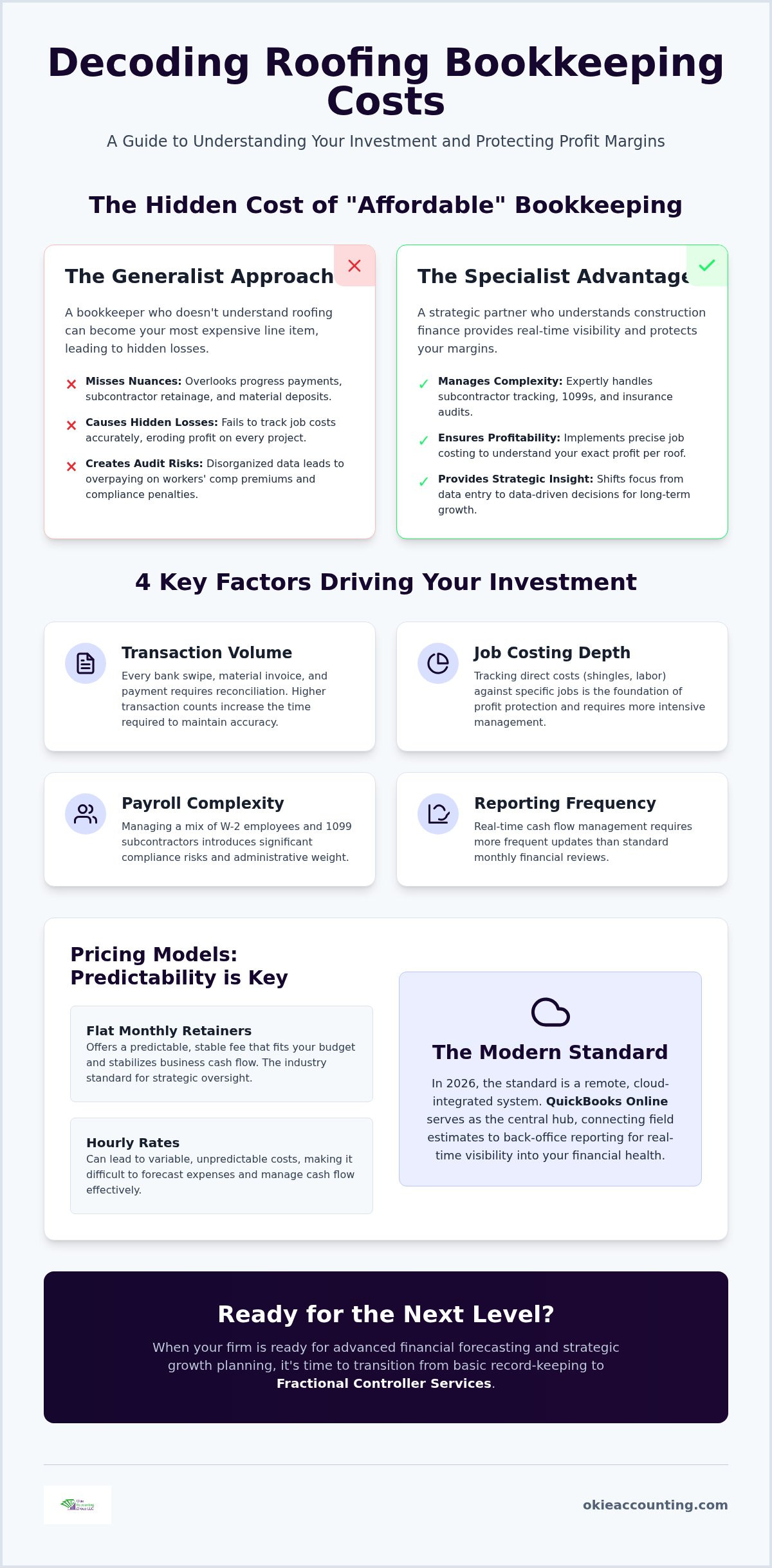
In 2026, the industry standard has moved decisively toward remote, cloud-integrated oversight. QuickBooks Online serves as the central hub for modern roofing operations; it connects your field estimates directly to your back-office reporting. Achieving this level of synchronization requires professional QuickBooks setup and training. Without a correctly configured system, your data remains fragmented and unreliable. A cloud-based approach provides real-time visibility into your financial health. When you evaluate how much does a bookkeeper cost for a roofing company in Los Angeles, you're actually looking for a strategic partner who provides a clear, digital roadmap to profitability and long-term stability.
4 Key Factors That Determine Your Monthly Bookkeeping Investment
Calculating the investment for professional oversight requires looking beyond a simple monthly fee. While owners frequently search for how much does a bookkeeper cost for a roofing company in Los Angeles, the actual price is dictated by the operational complexity of your specific business. A firm running multiple crews with high material turnover requires more rigorous management than a solo operator. Four primary drivers determine the scope of work and the resulting fee structure.
Transaction Volume: Every bank swipe, credit card purchase, and material invoice requires reconciliation. Higher volume increases the time required to maintain accuracy.
Job Costing Depth: Tracking direct costs like shingles and labor against specific addresses is more intensive than general expense categorization.
Payroll Complexity: Managing a mix of W-2 employees and 1099 subcontractors introduces significant administrative weight and compliance risks.
Reporting Frequency: Real-time cash flow management often requires weekly updates, whereas smaller firms might only need monthly financial reviews.
The Impact of Job Costing on Price
Job costing is the process of tracking costs against revenue for every individual project to ensure sustainable profitability. This isn't just an "extra" service; it is the foundation of profit protection. When every dollar of labor, materials, and overhead is allocated to a specific roof, you can identify which types of jobs are actually driving your growth. While this depth of tracking increases the service fee, it prevents the hidden losses that occur when overhead swallows your margins. By shifting to this model, you gain the clarity needed to bid more effectively on future projects and ensure every contract contributes to your bottom line.
Payroll and Subcontractor Management
The roofing trade is uniquely burdened by payroll compliance and the administrative weight of field crews. Professional bookkeeping fees often account for the heavy lifting involved in tracking 1099 certificates of insurance and managing W-2 wages. This oversight is essential for workers' compensation audit preparation. If your data is disorganized, you risk overpaying on premiums or facing steep penalties during an audit. According to data on median bookkeeper pay, the cost of a full-time in-house employee often exceeds the investment in a specialized outsourced partner who already understands these nuances.
For a deeper look at compliance, you can explore our guide on construction payroll services to see how strategic frameworks protect your business. If you're ready to see how these factors apply to your specific volume, you can schedule a discovery call to discuss a tailored plan for your firm.
Flat Monthly Retainers vs. Hourly Rates: Which Model Fits Your Roofing Business?
Choosing between an hourly rate and a flat monthly retainer is one of the most critical decisions you'll make for your back office. While many contractors start their search by asking how much does a bookkeeper cost for a roofing company in Los Angeles, the billing structure often impacts your long-term profitability more than the initial price tag. Hourly billing might seem transparent, but it frequently creates a misalignment between your goals and your bookkeeper's incentives. A flat fee, by contrast, focuses on the delivery of an organized financial system rather than the time it takes to enter data.
Why Hourly Billing Can Be a Trap for Contractors
The most significant risk of hourly billing is the "efficiency penalty." In this model, you pay more for a bookkeeper who is slower or less experienced with construction-specific software. It's a structure that rewards inefficiency rather than results. Additionally, roofing is a seasonal business. Budgeting for accounting costs becomes a headache when your fees spike during peak summer months just because your transaction volume increased. This uncertainty often discourages proactive communication. You might hesitate to call your bookkeeper with a strategic question if you know every minute is being clocked and billed, which ultimately leaves you without the guidance you need during your busiest seasons.
The Predictability of Monthly Retainers
A flat monthly retainer offers the structural integrity that a growing firm needs. It allows you to align your accounting costs with your fixed overhead projections, making your cash flow more predictable. This model is essential for effectively managing your business finances because it shifts the focus from time spent to value delivered. At Okie Accounting, we favor this model because it fosters a strategic partnership. Your retainer ensures your books are always "audit-ready" and includes essential services like reconciliations, job costing, and comprehensive financial reporting. You aren't just paying for data entry; you're investing in a system that protects your profit margins.
Value-based pricing justifies a stable investment because it includes the specialized expertise of a partner invested in your success. Instead of worrying about a ticking clock, you gain access to a disciplined mentor who focuses on profit protection. This approach ensures that your financial records aren't just a list of past transactions, but a reliable foundation for future scaling. By choosing a predictable retainer, you eliminate the stress of variable billing and gain the clarity needed to understand your true profit per roof. This level of oversight is what transforms a standard service provider into a strategic business partner.
Beyond the Price Tag: Why Generalist Bookkeeping Costs You More in the Long Run
When roofing owners evaluate how much does a bookkeeper cost for a roofing company in Los Angeles, they often focus solely on the monthly fee. This narrow view ignores the "cleanup cost" that inevitably follows generalist work. A general bookkeeper might handle basic data entry, but they lack the technical language of project-based financial tracking. If your material costs are creeping up by 3% across multiple jobs, a generalist won't notice the trend. A strategic partner identifies these profit leaks before they erode your annual stability. Poorly categorized books lead to massive catch-up fees when a specialist eventually has to reconstruct your records for tax season or a loan application.
Having "lender-ready" financials is a prerequisite for growth in 2026. If you want to apply for equipment financing or a new line of credit for a large commercial project, the bank requires more than a simple profit and loss statement. They need to see structural integrity in your data. A specialized provider ensures your financial statements reflect the true health of your business, making you a much more attractive candidate for competitive interest rates and higher credit limits.
The Hidden Cost of Failed Insurance Audits
Roofing is one of the most heavily scrutinized industries during annual workers' compensation reviews. If your bookkeeper places a ground-level employee and a high-slope installer into the same general labor category, you'll likely pay the highest possible premium for both. A specialized bookkeeper can save a roofing firm thousands by ensuring labor is categorized correctly before an audit begins. This proactive oversight prevents the stressful "audit bill" that arrives when an insurance carrier discovers your records don't match the actual risk levels of your crew.
Protecting Your Margins with WIP Accounting
Work-in-Progress (WIP) reporting is a foundational system that most generalist providers simply don't offer. WIP reports allow you to see exactly where you stand on long-term projects by comparing actual costs to your initial estimates. This prevents the common trap of over-billing or under-billing, which can create a false sense of security regarding your cash on hand. By mastering construction cash flow management, you ensure that the money in your bank account is actually yours to keep rather than being owed to future material suppliers.
If you're tired of "hidden" losses and want a partner who understands the mechanics of your market, we're here to help. You can request a discovery call to see how our specialized systems can protect your profit margins and build a foundation for scale.
Scaling Your Roofing Firm with Strategic Financial Oversight
Scaling a roofing business requires a transition from reactive management to proactive strategy. While many owners start their journey by asking how much does a bookkeeper cost for a roofing company in Los Angeles, those who successfully reach the seven-figure mark understand that basic record-keeping is only the first step. Bookkeeping records history; strategic oversight forecasts the future. To move from survival to scale, you need financial data that drives better bidding on large-scale commercial projects and informs hiring decisions for new crews. Choosing a nationwide specialized firm offers a higher ROI than a local generalist because you gain access to industry-specific benchmarks that a neighborhood provider simply doesn't have.
The Fractional Controller Advantage
For firms reaching the $1M to $5M revenue milestone, the complexity of operations often outpaces basic bookkeeping. This is where Fractional Controller services become essential. A controller doesn't just categorize expenses; they build internal controls to prevent fraud and develop cash flow forecasting models that prepare you for major material purchases. By implementing high-level budgeting and job-costing analysis, you ensure that your growth is profitable rather than just busy. You can explore our Fractional Controller guide for specific implementation steps to protect your margins during rapid expansion.
Partnering with Okie Accounting Group
Okie Accounting Group, led by Sarah O’Quinn, focuses on building the structural integrity your firm needs to scale with confidence. We don't just provide a service; we act as a strategic partner invested in your long-term health. Our approach moves beyond administrative tasks to create a comprehensive financial framework that supports your specific goals. When you look at how much does a bookkeeper cost for a roofing company in Los Angeles, consider the value of a partner who understands the unique mechanics of your market and provides the clarity needed for data-driven choices.
The transition from a service provider to a disciplined mentor is what distinguishes our work. We focus on immediate clarity and long-term stability, ensuring your financial statements are always ready for the next level of growth. If you're ready to move beyond basic data entry and build a scalable back office, the next step is simple. We invite you to request a consultation for a customized financial framework that protects your profit and fuels your ambition.
Building Your Foundation for Profitable Growth
Investing in your back office is a strategic choice that determines the structural integrity of your roofing firm. While you likely began this search by asking how much does a bookkeeper cost for a roofing company in Los Angeles, you now understand that the true value lies in specialized job costing and audit-ready financials. A flat monthly retainer provides the predictability your cash flow requires. By contrast, a generalist's hourly rate often hides the high cost of data errors and missed profit leaks.
As QuickBooks Certified ProAdvisors with nationwide construction expertise, we focus on the strategic financial oversight that allows you to scale with confidence. We don't just record your past; we build the systems that protect your future margins. Transitioning from a simple service provider to a dedicated strategic partner ensures that your data is a tool for growth rather than a source of stress. You deserve a financial framework that works as hard as your crews do on the roof.
Ready to gain total clarity over your profit per project? Request Your Specialized Roofing Financial Review today. We look forward to helping you build a more stable and profitable business.
Frequently Asked Questions
How much should a roofing company spend on bookkeeping monthly?
A roofing company's monthly investment depends on project volume and the depth of job costing required. While you might wonder how much does a bookkeeper cost for a roofing company in Los Angeles, the national standard for specialized construction bookkeeping often ranges from $500 to $2,000 per month. This fee covers complex tasks like subcontractor tracking and progress billing. Investing in a flat monthly retainer ensures your financial data remains accurate without the unpredictable spikes of hourly billing.
Do I need a local bookkeeper for my roofing business in 2026?
You don't need a local provider to maintain accurate books in 2026. Cloud-based systems allow specialized firms to offer national expertise that often surpasses local generalists. By partnering with a remote specialist, you gain access to construction-specific insights and rigorous management practices regardless of your physical location. This approach ensures that your financial infrastructure is built on industry best practices rather than regional administrative habits.
What is the difference between a bookkeeper and a construction controller?
A bookkeeper focuses on recording historical transactions and performing monthly bank reconciliations. In contrast, a fractional construction controller provides high-level financial strategy and strategic oversight. Controllers focus on budgeting, internal controls, and interpreting data to drive business decisions. While a bookkeeper ensures your data is clean, a controller uses that data to forecast your future cash flow and protect your long-term profit margins.
Can a generalist bookkeeper handle roofing job costing?
Generalist bookkeepers often struggle with the complexities of roofing job costing because they lack experience with project-based allocations. Roofing requires every dollar of labor and materials to be assigned to a specific project to ensure sustainable profitability. A generalist might categorize expenses broadly, which hides profit leaks and makes it difficult to see your true margin per roof. Specialized oversight is necessary to maintain the granular data required for accurate bidding.
How does professional bookkeeping help with workers comp audits?
Professional bookkeeping provides the structural integrity needed to survive annual insurance reviews. By categorizing labor correctly before an audit begins, a specialist ensures you aren't paying the highest possible premium for ground-level employees. Accurate records separate subcontractors with their own insurance from your W-2 crew. This level of precision protects your business from the unexpected audit bills that often result from poorly organized or miscategorized financial data.
Is QuickBooks Online the best software for roofing companies?
QuickBooks Online is the modern standard for roofing companies due to its robust integration capabilities. It serves as a central hub that connects your field estimation tools with your back-office financial reporting. When properly configured through professional setup and training, it provides real-time visibility into your cash flow and job costs. This cloud-based approach allows for seamless remote collaboration and ensures your financial statements are always audit-ready.
What information should be included in a roofing company financial report?
A comprehensive roofing financial report should go beyond a basic profit and loss statement. Essential documents include a Profit and Loss by Job report to track individual project margins and a Work-in-Progress (WIP) report to manage over-billing and under-billing. Additionally, your report should feature cash flow forecasting and accounts receivable aging. These metrics provide the immediate clarity needed to understand your firm's financial health and make informed hiring or equipment purchasing decisions.


Comments