
Understanding Construction Financial Statements: A Strategic Guide for Contractors
- Wendy Okie

- May 25
- 13 min read
Why does your bank balance often tell a completely different story than your Profit and Loss statement at the end of a major project? It's a common frustration for contractors to see healthy margins on paper while struggling with cash flow in reality. You know that managing a construction firm requires more than just basic math. It requires a specialized lens to see where your money is actually tied up. Mastering the art of understanding construction financial statements is the difference between simply surviving the next job and building a truly scalable enterprise.
We understand that revenue recognition and profit fade aren't just accounting terms. They are the daily obstacles standing between you and the growth you've worked for. This guide will show you how to transform your reporting into a strategic blueprint that protects your margins and satisfies even the most skeptical lenders. We'll break down the complexities of ASC 606 and the latest OBBBA tax updates, such as the reinstated 100% bonus depreciation, so you can move from reactive bookkeeping to proactive financial leadership. You'll gain the clarity needed to ensure your reports are always lender-ready and your cash flow remains predictable.
Key Takeaways
Learn why general accounting methods fall short in the field and how a specialized framework provides the structural integrity your business needs.
Master the mechanics of understanding construction financial statements to identify profit fade before it impacts your bottom line.
Discover how the Work-in-Progress (WIP) report acts as a critical bridge between project management and your ledger to ensure accurate revenue recognition.
Identify the specific KPIs, like Working Capital and Days in AR, that signal long-term stability and make your firm lender-ready.
Understand the transition from administrative bookkeeping to strategic fractional controller oversight to build a predictable, scalable financial foundation.
Beyond the Basics: Why Construction Financial Statements Require a Specialized Framework
Standard accounting methods often treat a construction firm like a retail store, but selling a service over eighteen months is fundamentally different from selling a product over a counter. General business accounting fails because it doesn't account for the unique risks of long-term contracts, retainage, and fluctuating material costs. Truly understanding construction financial statements requires a shift from viewing your books as a historical record to seeing them as a strategic blueprint. This transition from administrative recording to strategic financial oversight is what separates stable firms from those that collapse during a growth spurt.
By adopting project-based financial tracking, you gain a granular view of your firm’s health. This specialized framework isn't just for your internal peace of mind; it's a requirement for external growth. Lenders and bonding companies look for "financial readiness." They want to see that you understand your margins at every stage of a build. Utilizing Construction accounting principles ensures that your reports reflect the reality of your obligations, rather than just a list of checks written. It establishes a level of professional discipline that builds trust with your strategic partners.
The Conflict Between Cash Flow and Accrual Accounting
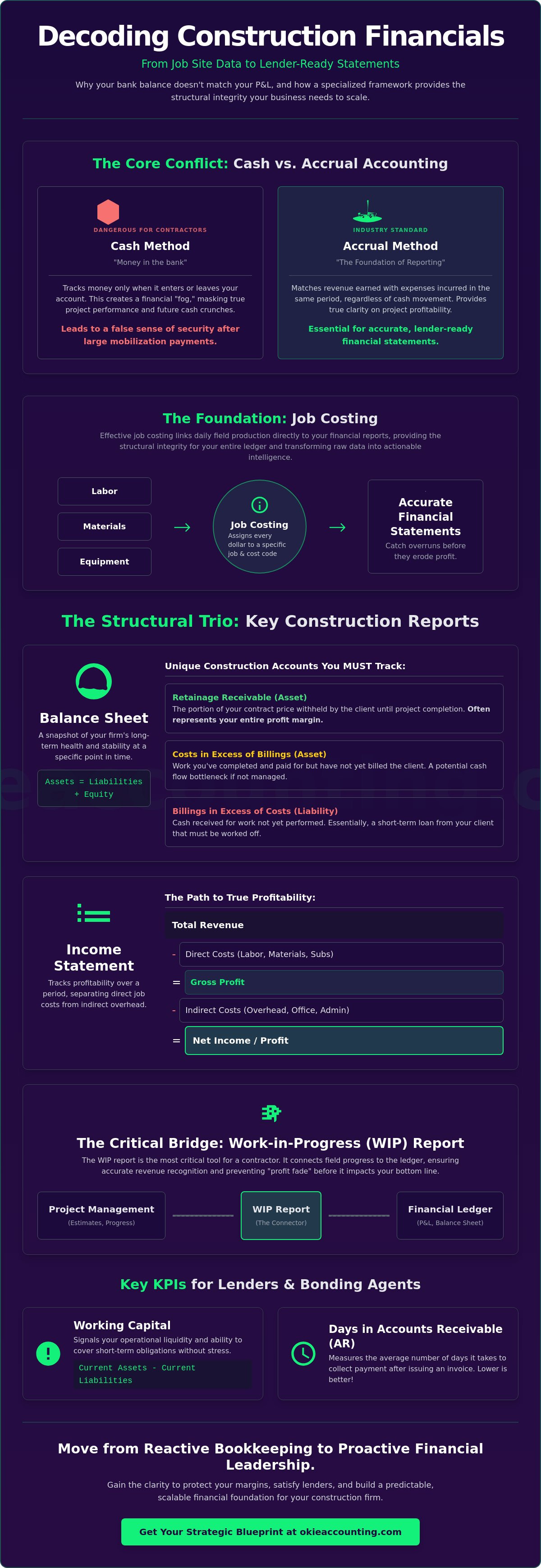
Relying on "money in the bank" as a primary metric is one of the most dangerous habits a contractor can develop. You might see a high balance after a large mobilization payment, but that capital is often already spoken for by subcontractors and material suppliers. This creates a financial "fog" where you feel profitable while actually drifting toward a cash crunch. The accrual method serves as the foundation for modern construction reporting. It matches revenue earned with the expenses incurred to earn it, regardless of when the cash actually moves. This clarity allows you to see through the timing differences in billing and costs that often mask project performance.
Job Costing: The Foundation of Every Statement
Every line item on your balance sheet starts in the field. Job costing is the process of assigning every dollar of labor, material, and equipment to a specific project and cost code. Without this granular data, your financial statements are just guesses. Effective job costing links daily field production directly to your final reports, allowing you to catch overruns before they erode your profit. Job costing provides the structural integrity of a contractor’s ledger. It transforms raw data into actionable intelligence, ensuring that your financial reporting reflects the true cost of doing business and the actual health of your firm.
The Structural Trio: Balance Sheets, Income Statements, and Cash Flow in Construction
Think of your three primary financial reports as the structural support of your firm. While the job costing we discussed previously provides the raw data, these statements organize that data into a narrative that lenders and partners can trust. Mastery of understanding construction financial statements ensures you aren't just looking at numbers, but at the actual viability and scalability of your company. When these documents are accurate, they move beyond simple compliance and become "lender-ready" blueprints for growth.
The Construction Balance Sheet: Assets, Liabilities, and Retainage
The Balance Sheet acts as a snapshot of your firm’s long-term health and stability at a specific point in time. Unlike a general business balance sheet, a contractor's statement features unique accounts like "Retainage Receivable." This represents the portion of your contract price that a customer withholds until the project is complete. It’s a critical asset to track because it often represents your entire profit margin for a job. If you lose track of retainage, you’re essentially losing track of your profit.
Another key metric is "Costs in Excess of Billings." This occurs when you've spent money on a project but haven't yet billed the client. While it's listed as an asset because it represents work performed, it can also signal a cash flow bottleneck if you aren't billing fast enough. Conversely, "Billings in Excess of Costs" is a liability that represents cash you've received for work not yet done. Equity reflects the cumulative success of your completed contracts and your firm's overall net worth, showing how much of the business you truly own after all obligations are met.
The Income Statement: Tracking Profitability by Project
The Income Statement, or P&L, must be viewed through a project-centric lens to be useful. It's not just about total revenue; it's about understanding the construction income statement in a way that separates direct job costs from indirect overhead. Direct costs include labor, materials, and subcontractors specific to a site. Indirect costs cover things like office rent, administrative salaries, and insurance.
In this high-risk industry, the gap between Gross Profit Margin and Net Profit Margin is telling. A healthy gross margin means your projects are estimated correctly and managed well in the field. However, a thin net margin suggests your overhead is eating your gains. High-quality construction bookkeeping services are essential here to ensure every expense is coded accurately to the correct project. If you need help refining your reporting structure to see these margins clearly, you can schedule a discovery call to discuss building a more robust financial framework.
Finally, the Cash Flow Statement serves as the pulse of your operation. Because construction is capital-intensive, you can be profitable on your P&L while being broke in your bank account. This report tracks the actual movement of cash, helping you anticipate lean months before they happen. When these three reports work in harmony, you gain the clarity needed to protect your margins and secure the financing required for larger projects.
Revenue Recognition and WIP: The Core Mechanics of Project Reporting
Revenue recognition in construction is rarely as simple as looking at your latest invoice. Because projects span months or even years, the industry relies on the Percentage of Completion method as the gold standard for accuracy. This method ensures that your income statement reflects the work you've actually performed, rather than just the cash you've requested. Mastering the mechanics of understanding construction financial statements means moving beyond the "Structural Trio" discussed earlier and diving into the Work-in-Progress (WIP) report.
The WIP report serves as the vital bridge between the daily activity on the job site and the formal ledger in your office. Without a functioning WIP, your financial data remains disconnected from reality. This report is your primary defense against "profit fade," a common industry ailment where margins slowly erode as a project nears completion. By comparing estimated costs to actual progress, you can spot budget overruns early enough to take corrective action. It provides the disciplined oversight required to keep your firm’s structural integrity intact.
How to Read a WIP Report in 5 Steps
Interpreting a WIP report shouldn't be a mystery. Follow these five steps to gain immediate clarity on your project health:
Step 1: Compare total contract price to estimated costs. This establishes your projected gross profit from the start.
Step 2: Track actual costs incurred to date. This includes all labor, materials, and equipment currently committed to the project.
Step 3: Calculate the percentage of completion. Divide your actual costs by your total estimated costs to see how far along you truly are.
Step 4: Identify over-billings vs. under-billings. Compare your earned revenue (based on progress) to the amount you've actually invoiced.
Step 5: Adjust the P&L. Ensure your income statement reflects earned revenue, not just billed revenue, to show your true profitability for the period.
The Strategic Importance of Under/Over Billings
Under-billing is often a source of significant emotional and financial stress for contractors. When you are under-billed, you've performed more work than you've invoiced, which means you are essentially providing an interest-free loan to your client. This drains your working capital and forces you to fund the project out of your own pocket. It's a dangerous position that can stall your firm's growth if left unaddressed.
Over-billing, while better for cash flow, presents its own risks. It can easily mask deeper cash flow problems in other areas of your business, giving you a false sense of security. If you aren't careful, you might spend that "excess" cash before the project costs are actually due. For a deeper look at implementing these systems, explore our guide on WIP accounting for construction. Balancing these billings is a hallmark of a mature, stable operation that prioritizes long-term health over short-term bank balances.
Interpreting the Data: Key KPIs for Profit Protection and Scalability
Once you have established a reliable WIP report and a project-centric income statement, the next step is translating those numbers into actionable strategy. Raw data alone won't grow your firm; you need to identify the specific metrics that signal health or highlight hidden risks. Mastery of understanding construction financial statements involves looking beyond the bottom line to the Key Performance Indicators (KPIs) that drive long-term stability. These metrics act as your firm's early warning system, allowing you to adjust your course before a minor budget leak becomes a structural failure.
Working Capital is perhaps the most vital metric for any contractor looking to scale. Calculated as your current assets minus current liabilities, it represents the fuel available to fund new projects. Lenders and bonding agents prioritize this figure because it dictates your capacity to take on larger, more complex contracts. Similarly, tracking "Months in Backlog" provides a clear view of your future revenue stability. If your backlog is shrinking while your overhead remains static, it’s a signal to ramp up your business development efforts or trim excess costs. To ensure your business isn't becoming top-heavy, you must also monitor your Overhead Ratio, which compares your administrative expenses to your total revenue. A lean, efficient office ensures that more of your hard-earned project profit stays in the business.
Liquidity and Leverage: What Bondsmen Look For
Surety agents and lenders evaluate your firm through the lens of risk management. They focus heavily on the Debt-to-Equity ratio to determine how much of your operation is funded by creditors versus your own investment. A high ratio suggests you are over-leveraged, which can make securing new bonds difficult. They also look closely at the Current Ratio, where a target of 1.5 or higher is generally the industry goal for demonstrating stability. This ratio proves you have $1.50 in liquid assets for every $1.00 of immediate debt. Maintaining these specific targets signals a level of "financial readiness" that gives partners the confidence to back your firm's growth.
Using QuickBooks to Automate KPI Tracking
Manually calculating these metrics is time-consuming and prone to human error. Leveraging QuickBooks for contractors allows you to automate the generation of these KPIs, providing real-time oversight of your firm’s performance. However, automation only works if the underlying data is accurate. Professional software training is essential to ensure your team is coding expenses and billings correctly from the start. With clean data and custom dashboards, you can move from reactive management to proactive leadership. If you are ready to stop guessing and start leading with data-driven confidence, book a discovery call today to discuss how strategic financial oversight can protect your margins.
Building Financial Clarity: Moving from Bookkeeping to Strategic Controller Oversight
Many contractors reach a point where basic administrative bookkeeping is no longer enough to support their growth. While recording transactions is necessary, it doesn't provide the high-level insight required to manage multiple complex projects simultaneously. Building true financial clarity requires a shift toward strategic oversight. This transition is essential for understanding construction financial statements as tools for future expansion rather than just historical logs of past spending. By moving from a "looking back" mentality to one of "forecasting forward," you protect your profit margins during rapid scaling and ensure your firm remains resilient.
Bookkeeping tells you where your money went, but strategic oversight tells you where your business is going. This distinction is vital for contractors who find that their current systems are buckling under the weight of new, larger contracts. At Okie Accounting Group LLC, we bridge this gap by transforming administrative tasks into comprehensive structural frameworks. We don't just provide a service; we act as a disciplined mentor for firms ready to move beyond the basics and establish a scalable financial foundation. Our team understands the unique mechanics of national construction firms, providing the professional discipline needed to manage complex, multi-state operations.
The Role of a Fractional Controller in Financial Reporting
A fractional controller does more than just prepare reports; they interpret the data to guide critical business decisions. Instead of just seeing a total on a page, you'll understand why a specific project is underperforming and how to reallocate resources to fix it. Monthly financial reviews serve as a proactive defense, identifying project risks like over-billing or profit fade before they jeopardize your cash flow. These experts also implement rigorous internal controls. These systems are the structural framework that prevents fraud and reporting errors, ensuring that the information you provide to lenders is always beyond reproach. This level of oversight ensures that understanding construction financial statements becomes a core competency of your leadership team.
Next Steps for Your Construction Firm
If your current reports feel disorganized, start with a clean-up of your Chart of Accounts. This foundational step ensures that every dollar is categorized correctly, providing the granular data needed for accurate job costing. Next, consider a professional audit of your WIP process to identify any disconnects between the job site and the ledger. Finally, we invite you to gain a new level of clarity through management accounting. These steps move you away from the stress of financial uncertainty and toward a state of operational confidence. By building these systems today, you ensure your firm is ready for the opportunities of tomorrow.
Establish the Structural Integrity of Your Financial Future
Mastering the art of understanding construction financial statements is a shift from recording history to designing your firm's future. By implementing precise revenue recognition through WIP reporting and monitoring the KPIs that lenders prioritize, you move from reactive management to proactive leadership. You have already mastered the complexities of the job site; now it's time to bring that same level of discipline to your ledger. These systems don't just track costs; they protect the profit you've worked so hard to earn.
At Okie Accounting Group LLC, we specialize in the unique financial mechanics of the construction and real estate sectors. Led by Sarah O’Quinn, an expert mentor for contractors, our team provides nationwide fractional controller services that transform your data into a strategic blueprint. We help you move beyond basic administrative tasks to build a comprehensive framework for growth. If you are ready to secure your firm’s stability and scale with confidence, Gain Financial Clarity with Okie Accounting Group LLC by scheduling your discovery call today. You've built the projects; let's build the foundation to sustain them.
Frequently Asked Questions
What is the most important financial statement for a construction company?
The Work-in-Progress (WIP) report is arguably the most critical document for a contractor’s daily operations. While the Balance Sheet tracks long-term stability, the WIP report provides the real-time data needed to manage project-level profitability. It acts as the primary tool for identifying profit fade and ensures that your income statement reflects actual earned revenue rather than just billing milestones.
How does revenue recognition work for long-term construction contracts?
Revenue recognition for long-term contracts relies on the Percentage of Completion method as the industry gold standard. This method matches revenue to the actual progress made on a project by comparing costs incurred to the total estimated costs. It provides a more accurate picture of financial health than simply recording revenue when an invoice is sent or when cash is received.
Why does my P&L show a profit when I have no cash in the bank?
Your P&L shows profit because it records revenue as it's earned, not when cash arrives in your account. You may have high accounts receivable or significant funds tied up in retainage that haven't been collected yet. This timing gap is why understanding construction financial statements through the lens of cash flow forecasting is essential for maintaining your firm's liquidity.
What is a WIP report, and why do I need one?
A WIP report is a project management tool that tracks the financial status of every active job. You need one to bridge the gap between your field operations and your accounting ledger. It allows you to identify over-billings and under-billings, ensuring your financial reporting is accurate for lenders and that you aren't unknowingly funding a client's project with your own capital.
How often should a contractor review their financial statements?
Contractors should review their WIP reports weekly and their full financial statements at least once a month. Weekly reviews allow you to catch labor overruns or material price spikes before they erode your margins. Monthly reviews with a fractional controller provide the strategic oversight needed to analyze overhead ratios and ensure your firm is meeting its long-term growth targets.
What are over-billings and under-billings on a balance sheet?
Over-billings represent cash received for work not yet completed, appearing as a liability, while under-billings represent work performed but not yet invoiced, appearing as an asset. Balancing these figures is a core part of understanding construction financial statements. If under-billings are too high, your cash flow will suffer; if over-billings are too high, you may be using future project funds to cover current expenses.
Can I use standard QuickBooks for construction financial statements?
You can use standard QuickBooks, but it requires a specialized setup to handle project-based job costing and WIP reporting effectively. Without professional configuration and software training, the data often becomes disorganized and fails to provide the granular insights contractors need. Many firms pair QuickBooks with specialized apps to automate their reporting and ensure their data is always lender-ready.
What financial ratios do bonding companies look for?
Bonding companies primarily focus on your Current Ratio and your Debt-to-Equity ratio to assess risk. They typically look for a Current Ratio of 1.5 or higher, proving you have $1.50 in liquid assets for every $1.00 in debt. Maintaining these specific ratios demonstrates the financial readiness required to secure larger contracts and shows that your firm has the structural integrity to handle increased project volume.


Comments