
What Successful Roofing Contractors Do: Mastering Construction Accounting for Scalable Growth
- Wendy Okie

- May 18
- 12 min read
The difference between a roofing company that survives and one that scales isn't found on the job site; it's found in the structural integrity of the general ledger. It's frustrating to watch hard-earned profits disappear into overhead or to manage the constant stress of cash flow gaps between material purchases and insurance payouts. Most owners recognize that inaccurate job estimates are the silent killers of growth. Understanding what successful roofing contractors do (in relation to accounting and bookkeeping) involves moving beyond simple data entry to build a comprehensive framework for profit protection and long-term stability.
This article reveals the advanced financial strategies and meticulous bookkeeping habits that separate high-growth roofing firms from those struggling to stay afloat. You'll discover how to secure real-time visibility into your project profitability and maintain lender-ready financials for future equipment financing. We'll explore the specific systems required for predictable cash flow and examine how staying ahead of regulatory shifts, such as the 2026 Cost Accounting Standards threshold increases to $35 million, can provide a strategic edge in the marketplace. By the end, you'll have a roadmap to transition from basic administrative oversight to a sophisticated model of financial health.
Key Takeaways
Implement project-level job costing to ensure every installation delivers a predictable margin instead of just covering basic overhead.
Eliminate the "Cash Basis" trap with Work in Progress (WIP) accounting to maintain a realistic view of profitability during long-term projects.
Determine your exact labor burden to account for the full cost of installers, ensuring your bids remain competitive and profitable.
Discover what successful roofing contractors do (in relation to accounting and bookkeeping) to shift from reactive tracking to proactive 13-week cash flow forecasting.
Build a scalable financial infrastructure that provides lender-ready reporting and the clarity needed to transition from a service provider to a strategic leader.
Table of Contents
Mastering Job Costing: The Foundation of Every Profitable Roofing Project
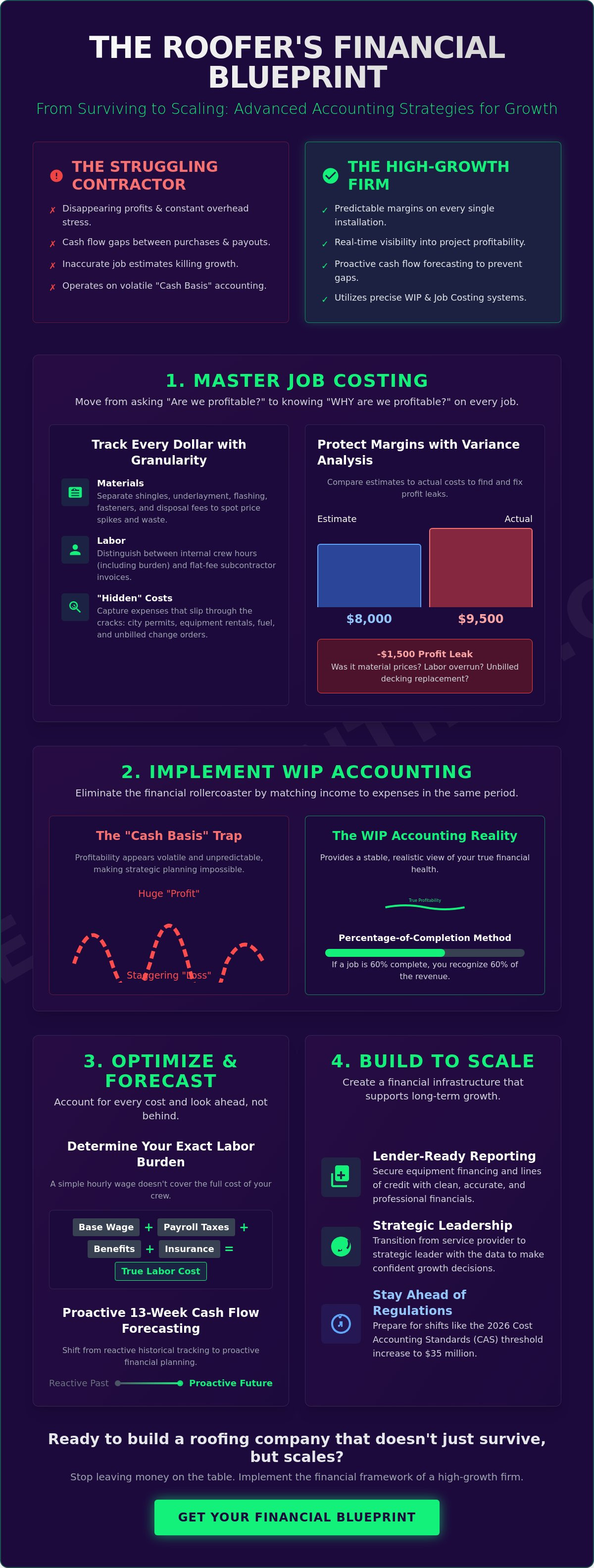
Scaling a roofing business requires a shift from viewing your bank balance to analyzing individual project performance. At its core, job costing is the systematic process of tracking every dollar spent on a specific contract. While general accounting tells you if the company is profitable, job costing tells you why. What successful roofing contractors do (in relation to accounting and bookkeeping) is move beyond company-wide averages to scrutinize the financial health of every roof they touch. This precision allows owners to identify which types of jobs, like steep-slope residential or flat-roof commercial, are actually driving growth.
Establishing this framework often starts with professional construction bookkeeping services. These specialized systems automate the flow of data from field reports and supplier invoices directly into your financial software. Instead of manually sorting through a stack of crumpled receipts at the end of the month, you gain a real-time pulse on your spending. This structural clarity is what separates a stable firm from one that is constantly surprised by empty accounts despite a full schedule.
The Granular Breakdown: Materials, Labor, and Subs
Precision begins with how you categorize your data. Successful firms don't just have a "materials" line item. They separate asphalt shingles, underlayment, and flashing from disposal fees and fasteners. This level of detail makes it easier to spot price spikes from suppliers or waste on the job site. Tracking labor requires similar discipline. You must distinguish between internal crew hours, which include payroll taxes and benefits, and flat-fee invoices from subcontractors. It is vital to capture "hidden" costs that often slip through the cracks, such as city permit fees, specialized equipment rentals like boom lifts, or the fuel used to transport materials to a remote site.
Analyzing Variance to Protect Your Margins
The most powerful tool in a roofer's arsenal is variance analysis, which is the comparison of your original estimate against the actual costs incurred. If your estimate for a residential tear-off was $8,000 but the actual cost hit $9,500, you need to know exactly where that $1,500 went. Was it a material price increase, or did the crew take two days longer than planned? What successful roofing contractors do (in relation to accounting and bookkeeping) is use this data to refine their future bidding strategies, ensuring that yesterday's mistakes don't become tomorrow's standard practice. Margin erosion occurs when unforeseen site conditions lead to unbilled change orders, such as discovering rotted decking that requires additional materials and labor not captured in the original estimate. By documenting these variances, you can implement stricter change-order policies that protect your bottom line.
Implementing WIP Accounting and Accurate Revenue Recognition
Operating a roofing company on a cash basis often leads to a financial rollercoaster. You might see a massive profit in May after collecting deposits for several large storm restoration projects, only to face a staggering loss in June when the material bills and labor costs arrive. This volatility makes it nearly impossible to judge your true performance. What successful roofing contractors do (in relation to accounting and bookkeeping) is move away from simple cash tracking and implement Work in Progress (WIP) accounting. This method ensures that your income and expenses are matched in the same period, providing a stabilized view of your actual earnings.
Revenue recognition should be based on the percentage-of-completion method. If a commercial roof is 60% complete based on the costs incurred to date, you should recognize 60% of the total contract value as earned revenue. This approach follows the standard principles of Construction Accounting and Financial Management, allowing you to see past the cash in your bank account to understand your actual profit position. It prevents the dangerous assumption that a high bank balance always equals high profit.
The Mechanics of the WIP Report
A functional WIP report acts as the heartbeat of your financial operations. It calculates whether you are overbilled or underbilled on every active project. Overbilling occurs when you've collected more cash than the work you've performed, which creates a liability because you still owe that labor and material to the client. Conversely, underbilling is an asset; it represents work completed but not yet invoiced. Lenders and bonding companies prioritize these reports because they demonstrate that a contractor has a firm grip on their obligations. Without this visibility, you risk spending "float" money that belongs to future project costs. Maintaining these records accurately often requires specialized Financial Reporting that generalist bookkeepers might overlook.
Aligning Revenue with Project Milestones
For roofing firms, insurance supplements can easily distort financial clarity if not handled correctly. What successful roofing contractors do (in relation to accounting and bookkeeping) is standardize how these supplements are recognized as the scope of work evolves. Your profit and loss statement must reflect the actual progress of the crew on the roof, not just the timing of insurance check arrivals. By aligning revenue recognition with production milestones, you ensure that your sales and production teams are working from the same set of facts. This alignment protects your margins and ensures that your internal data remains a reliable tool for making strategic growth decisions.
Optimizing Labor Burden and Payroll Compliance
Many contractors focus solely on the hourly rate they pay their crew, but this narrow view often leads to financial instability. What successful roofing contractors do (in relation to accounting and bookkeeping) is calculate the "fully burdened" cost of labor for every project. If you pay an installer $25 per hour, the actual cost to your business often reaches $40 per hour once you account for the layers of hidden expenses. Failing to recognize this gap is a primary reason why roofing firms see their expected 40% gross margins erode into a meager 20% by the time the job is finalized.
Accurate labor allocation requires a disciplined approach to data entry and reporting. When labor costs are miscalculated, your job costing data becomes unreliable, leading to underpriced bids and a lack of cash for growth. Utilizing specialized construction payroll services allows you to automate the tracking of these variables, ensuring that your financial statements reflect the true cost of production. This structural clarity is essential for passing workers' comp audits and maintaining a healthy bottom line.
Calculating Your True Labor Burden
To understand your real costs, you must look beyond gross wages. A comprehensive labor burden calculation includes several critical components that must be tracked at the project level:
Payroll Taxes: Employer-paid portions of FUTA, SUTA, and Social Security.
Workers' Comp Insurance: Premiums that vary based on the specific risk of roofing work.
Employee Benefits: Health insurance, retirement contributions, and paid time off.
Non-Billable Time: Paid hours spent on safety meetings, travel, and warehouse maintenance.
To calculate the full cost of a project, you must apply a predetermined burden percentage to every hour of direct labor entered into your job costing software. This data allows you to set more competitive and profitable hourly rates, ensuring your estimates are grounded in financial reality rather than guesswork.
Navigating Subcontractor Compliance
Managing a mix of internal crews and subcontractors adds another layer of risk to your financial framework. Successful roofers never allow a subcontractor to step onto a site without first collecting a W-9 and a valid Certificate of Insurance (COI). This proactive stance protects you from being hit with unexpected premiums during your own insurance audits. You must also remain vigilant about the "employee vs. contractor" classification trap. The IRS looks closely at how much control you exercise over your subs; misclassification can lead to significant back taxes and penalties. Systematizing the collection of lien waivers for every payment made to a subcontractor is equally vital. This practice protects your business and the homeowner from legal disputes, reinforcing your reputation as a disciplined and reliable strategic partner.
Transitioning from Historical Tracking to Proactive Cash Flow Forecasting
Most business owners treat their bookkeeping as a post-mortem analysis of what went wrong last month. What successful roofing contractors do (in relation to accounting and bookkeeping) is prioritize forward-looking visibility over rear-view mirror record-keeping. By transitioning from historical tracking to proactive forecasting, you gain the ability to predict cash crunches before they disrupt your operations. This shift in perspective is the hallmark of a scaling firm, allowing you to move from survival mode to strategic growth. What successful roofing contractors do (in relation to accounting and bookkeeping) is treat their financial data as a GPS for the future rather than a diary of the past.
A robust financial framework provides the clarity needed to make major capital decisions with confidence. You shouldn't have to guess if you can afford a new boom truck or if it's the right time to onboard a fourth installation crew. By leveraging Fractional Controller Services, you can transform raw data into a roadmap for expansion. This high-level oversight ensures that every decision is backed by a clear understanding of your current liquidity and future obligations. It moves the conversation from "what happened?" to "what's next?"
The 13-Week Cash Flow Forecast
A 13-week forecast is the primary tool for managing the unique rhythms of the roofing industry. You must map out expected inflows from open invoices while specifically accounting for the common lag times associated with insurance supplements. This forecast integrates your fixed overhead with variable project costs to reveal your weekly cash position. It is particularly vital for identifying your "burn rate" during off-seasons or extended rainy periods. Knowing exactly how many weeks of runway you have allows you to adjust spending or pivot your sales strategy before a shortfall occurs.
KPIs That Drive Roofing Growth
Measuring the right metrics is essential for maintaining structural integrity as you scale. Beyond the standard profit and loss statement, you should monitor specific Key Performance Indicators (KPIs) tailored to the construction sector:
Days Sales Outstanding (DSO): Track this specifically for insurance-backed jobs to identify bottlenecks in your collection process.
Sales-to-Production Ratio: Monitor this to ensure your production team can keep pace with your sales pipeline without sacrificing quality or safety.
Quick Ratio: Use this to measure your immediate financial liquidity by comparing your most liquid assets against your current liabilities.
By focusing on these metrics, you ensure your business remains agile and prepared for the next opportunity. If you are ready to gain this level of control over your numbers, our Cash Flow Forecasting services provide the structural framework your business needs to thrive.
Building a Scalable Financial Infrastructure with Professional Oversight
The transition from a small local crew to a regional powerhouse requires a fundamental shift in how you manage your back office. Many owners begin with a "DIY" approach to their finances, but this often leads to a fragmented system that cannot support rapid growth. What successful roofing contractors do (in relation to accounting and bookkeeping) is invest in a professional, cloud-based infrastructure that provides a single source of truth for every project. Moving beyond simple data entry allows you to build a lender-ready business that is prepared for equipment financing, bonding increases, or even a future sale. This structural maturity is what distinguishes a strategic leader from a service provider who is simply treading water.
A sophisticated financial framework requires more than just generalist knowledge. Just as specialized accounting for real estate investors focuses on the unique mechanics of property portfolios, construction accounting requires an expert understanding of project-based profitability. By partnering with a firm like Okie Accounting Group LLC that understands these niche complexities, you ensure your business is built on a foundation of accuracy and long-term stability. This proactive oversight protects your profits and provides the clarity needed to scale without the constant fear of hidden financial leaks.
QuickBooks Online: The Industry Standard
Successful roofing firms utilize QuickBooks Online (QBO) as the hub of their financial operations, integrating it seamlessly with field management software like Roofr or JobNimbus. This integration ensures that data flows automatically from the initial estimate to the final invoice, reducing manual errors and saving time. A clean Chart of Accounts, specifically tailored for the construction industry, is essential for tracking the granular details of job costing and labor burden discussed in previous sections. Investing in professional QuickBooks Setup & Training for your internal team ensures that every transaction is categorized correctly from the start, maintaining the integrity of your data.
The Fractional Controller Advantage
There is a significant difference between a tax preparer who looks at your numbers once a year and a strategic partner who provides ongoing leadership. Our Fractional Controller Services at Okie Accounting Group LLC bridge the gap between basic bookkeeping and high-level financial strategy. We implement rigorous internal controls to prevent fraud and ensure that your Financial Reporting is always accurate and timely. This level of oversight provides the "financial readiness" required for rigorous audits or complex bonding requirements. Ultimately, professional financial leadership grants you the freedom to focus on your vision for the company, knowing that your profit protection and cash flow are being managed with disciplined precision.
Establishing Structural Integrity for Future Growth
Scaling a roofing company requires more than just high-quality craftsmanship; it demands a rigorous financial framework. By integrating project-level job costing, WIP reporting, and accurate labor burden calculations, you move from operational complexity to strategic clarity. What successful roofing contractors do (in relation to accounting and bookkeeping) is treat their financial data as a tool for proactive decision-making rather than a historical record. This transition to 13-week forecasting ensures your firm is always lender-ready and prepared for the next growth opportunity. It allows you to focus on leading your team while your systems protect your hard-earned margins.
Okie Accounting Group LLC specializes in construction and real estate accounting, offering fractional controller expertise and cloud-based systems for nationwide accessibility. We help you build the foundational systems required for long-term stability and owner freedom. Ready to gain financial clarity? Schedule a consultation with Okie Accounting Group LLC today. You have the vision to lead your company to the next level. We provide the organized, methodical partnership to ensure your financial data supports every step of that journey.
Frequently Asked Questions
How is roofing bookkeeping different from general small business accounting?
Roofing bookkeeping requires project-centric oversight rather than just tracking monthly expenses. Unlike general retail, what successful roofing contractors do (in relation to accounting and bookkeeping) is tie every material purchase and labor hour to a specific job address. This specialized approach allows for accurate revenue recognition and ensures that complex insurance claim timelines don't distort your overall financial health.
What is job costing, and why is it essential for roofing contractors?
Job costing is the practice of assigning all direct costs, including shingles, flashing, and disposal fees, to a specific project. It's essential because it reveals which roof types and crews are actually driving your margins. By comparing estimated costs to actual spending, you can identify hidden leaks and adjust your bidding strategy to protect your bottom line on future contracts.
Why does my roofing company have cash in the bank but no profit on the P&L?
This discrepancy often occurs because of customer deposits and overbillings. You may have cash from a project that hasn't started yet, which is a liability rather than earned profit. Without WIP accounting, your bank balance reflects "float" money that is already committed to future material bills and labor costs, creating a false sense of financial security.
Can I use QuickBooks Online for my roofing business?
QuickBooks Online is the industry standard when it's properly configured for the construction sector. It integrates with field management tools like JobNimbus or Roofr to automate the flow of data from the site to the office. Success depends on a clean Chart of Accounts and professional QuickBooks Setup & Training to ensure your job costing and payroll remain accurate as you scale.
How often should I review my financial statements as a roofing contractor?
You should review your cash flow and production reports weekly to maintain immediate operational control. Full financial statements, including your WIP report and profit and loss statement, should be analyzed monthly with your strategic partner. This regular cadence allows you to spot negative trends and make data-driven adjustments before small issues become structural problems.
What is a labor burden, and how do I calculate it for my crews?
Labor burden is the total cost of an employee beyond their gross wages, including payroll taxes, workers' comp premiums, and benefits. To calculate it, add these annual overhead costs and divide by the total billable hours worked by the crew. This produces a burden multiplier that you must apply to your job costing entries to ensure your bids cover the true cost of labor.
Do I need a full-time CFO, or is a fractional controller enough?
Most scaling roofing firms don't need the heavy overhead of a full-time CFO. What successful roofing contractors do (in relation to accounting and bookkeeping) is utilize a fractional controller to provide high-level strategic oversight and internal controls. This partnership offers the financial leadership required for bonding and audits without the commitment of a six-figure executive salary.
How do I handle insurance supplements in my bookkeeping?
Insurance supplements should be treated as contract modifications that increase your total project value. You must update your revenue recognition milestones and WIP reports to reflect these changes as they are approved. Proper tracking ensures that your financial reporting remains accurate even when the final insurance payout differs significantly from the original adjuster's estimate.


Comments